
Utah Potash Mining Phenomenon: Blue Candy-Coloured Ponds Resembling Space Imagery
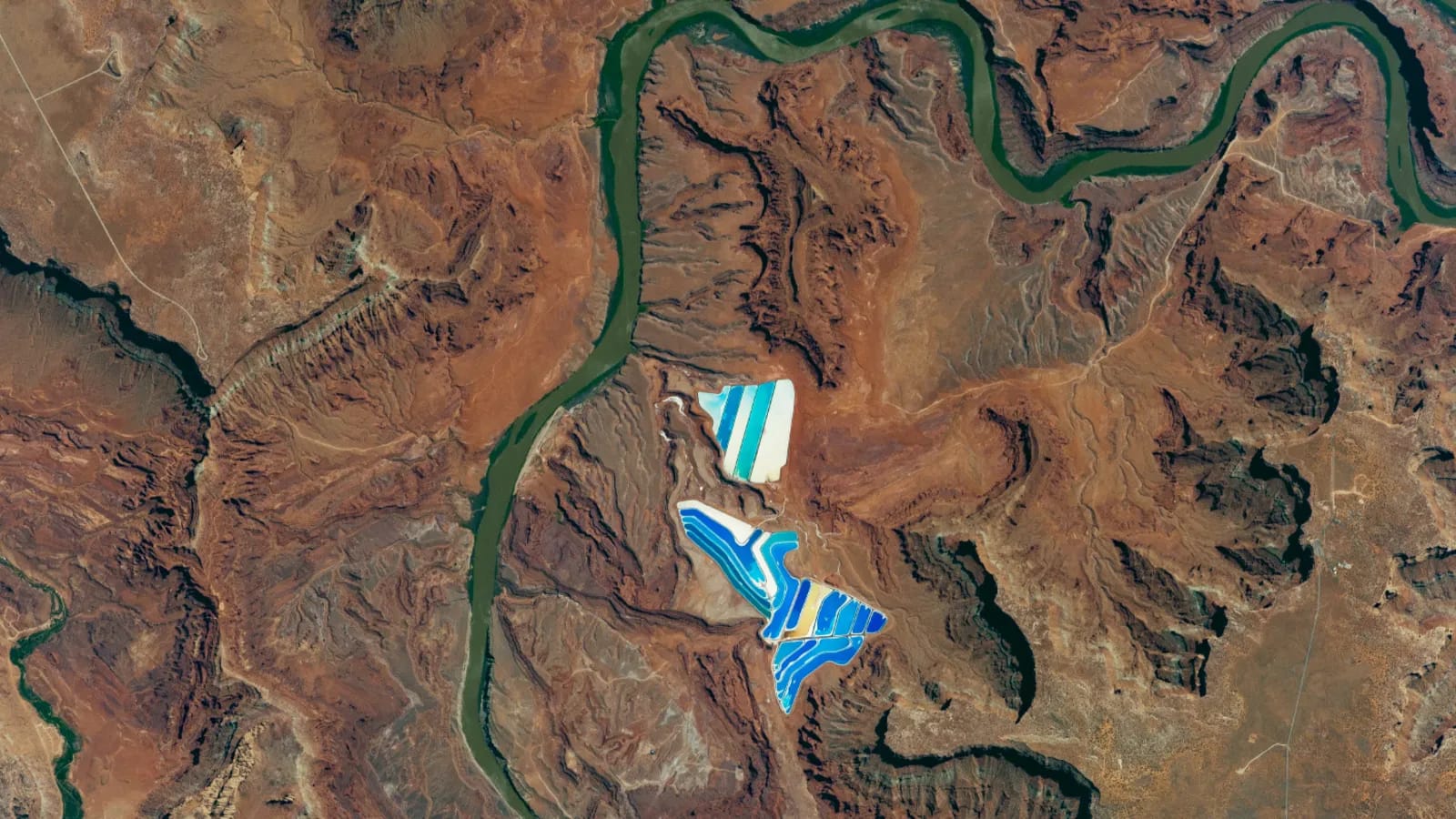
Have you ever imagined gazing at vast expanses of electric-blue ‘giant candies’ from space? This mesmerising visual phenomenon was captured by an astronaut’s camera, showing a stark contrast between the bright ponds and the dark green flow of the Colorado River in Utah, United States. Yet behind its beauty lies a complex interplay of industrial technology and mineral extraction.
The article examines how solar-evaporation technology creates this surreal landscape, the vital uses of potash for civilisation, and the environmental impacts that accompany it.
The ponds, located about 13 kilometres southwest of Moab, are not a natural phenomenon. They are a potash (potassium chloride) mining facility that uses the broad Colorado Plateau. There are around 23 evaporation ponds spanning an area of 160 hectares.
The vivid blue colour results from human intervention. Workers add dark blue dye to the brine solution. The aim is highly technical: the darker colour helps absorb more sunlight and heat, accelerating evaporation and leaving behind the mineral crystals required.
The term ‘potash’ has a unique etymology, derived from the phrase ‘pot ash’. In pre-industrial times, fertilisers were made by soaking wood ash in water, then heating it in a pot. Chemically, the main element found is potassium, which was internationally named potassium.
Today, potash is a vital commodity with a range of uses:
Nevertheless, the extraction activity is not without environmental challenges. The process of pumping hot water into the ground to dissolve the minerals can cause noise pollution and damage to local habitats.
On the other hand, the Colorado River, seen dark green in the photograph, reveals its natural character, rich in suspended sediment. As the sixth-longest river in the US, the Colorado plays a crucial role in North American ecosystems, including the formation of the iconic Grand Canyon.
The ‘giant candy’ sight in Utah is a visual reminder of how human technology reshapes the Earth’s landscape to meet global resource needs. While visually stunning from orbit, the balance between mineral production efficiency and the preservation of the Colorado River ecosystem remains a critical issue that must continue to be addressed by environmental scientists.