
USU Professor Endorses Smallholder Palm Oil Corporation Model Amid Land Fragmentation
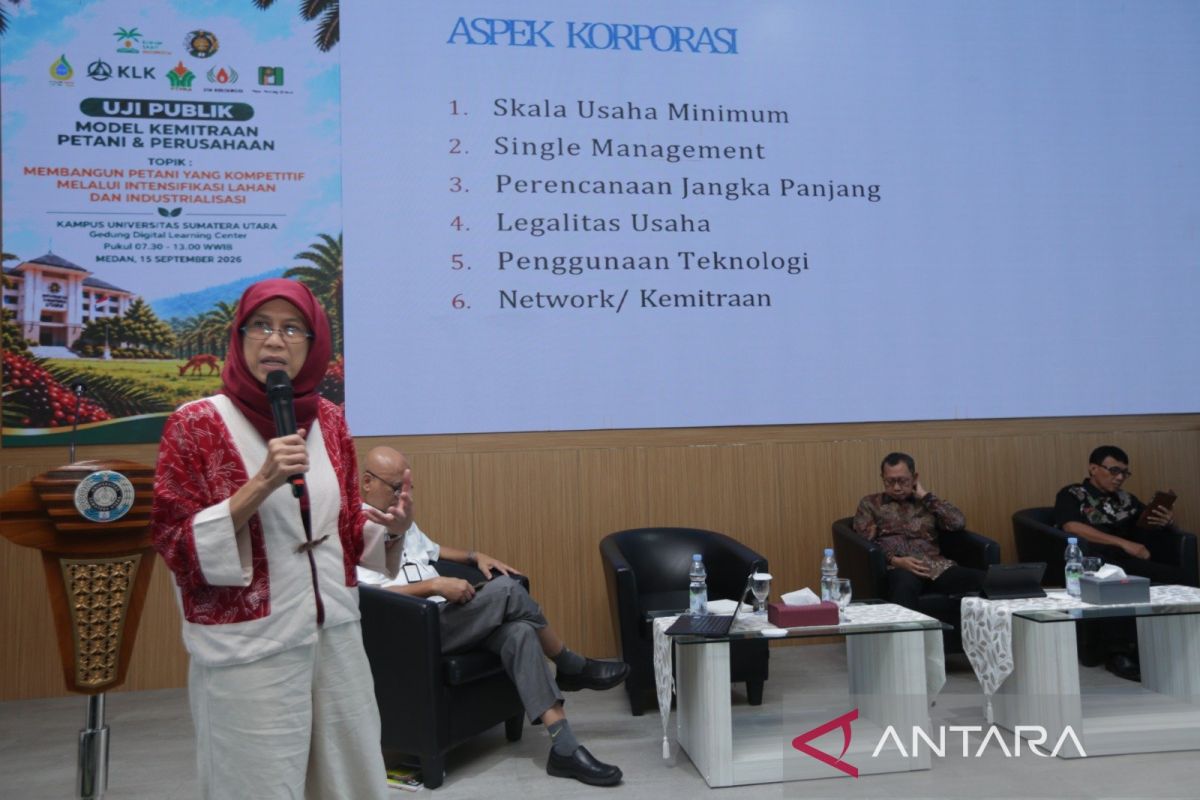
Medan (ANTARA) - Professor Dr Ir Diana Chalil, MSi, PhD, of the Faculty of Agriculture at Universitas Sumatera Utara (USU), has expressed support for a corporation model for oil palm farmers amid increasingly fragmented land.
According to her, the corporatisation of smallholder plantations is a crucial step in strengthening the bargaining position of independent oil palm farmers as the scale of national land ownership continues to shrink.
“Through integrated institutional governance, independent farmers have a great opportunity to increase productivity while expanding access to global export markets,” said Professor Diana during a public consultation discussion titled “Farmer-Company Partnerships in Building Resilient and Competitive Farmers Through Land Intensification and Industrialisation”, organised by Rumah Sawit Indonesia in collaboration with Universitas Sumatera Utara in Medan on Tuesday.
In her presentation, titled “Corporatisation and Partnerships as an Alternative for Improving the Position of Smallholder Plantations in the Supply Chain”, Professor Diana highlighted the challenges of land ownership structures in Indonesia.
Based on national data, some 17.25 million agricultural households, or 61.3 percent, managed land of less than 0.5 hectares in 2023, a jump of around 21.03 percent compared with 2013.
The situation is increasingly alarming because the number of very small-scale farmers holding less than 0.1 hectares surged by up to 70 percent, reaching 7.39 million people.
“This high level of land fragmentation limits operational efficiency and weakens farmers’ bargaining position when dealing with the industrial supply chain,” said Professor Diana.
To address the problem of efficiency caused by minimal land ownership, she offered a concept of farmer corporatisation built on six main pillars.
These six pillars comprise meeting the minimum business scale, implementing single management, long-term planning, legal certainty of the business, adoption of modern technology, and the strengthening of networks or strategic partnerships.
According to Professor Diana, in practice, the nucleus-plasma partnership model has great potential to become the foundation of modern farmer corporatisation, with adjustments to the initial aspects of land ownership.
“This model allows independent farmers to consolidate the management of their plantations without losing rights over their individual land,” she said.
According to her, the development of farmer corporations can begin using a top-down approach, particularly for beginner groups, in order to build an initial managerial foundation.
However, the ultimate goal is to transform the institution into a bottom-up approach so that business units are formed that are independent, highly competitive, and sustainable in the long term.
Professor Diana added that this bottom-up approach requires more mature basic institutional capacity compared with conventional farmer groups.
Therefore, planned and consistent capacity-building programmes for the management and members of farmer groups are key to a smooth transition.
She also emphasised the importance of strategic partnerships with plantation companies as an accelerator for capacity improvement.
“Partnerships cover not only technical and managerial assistance, but also facilitate institutional education and open up fairer financial and market access for smallholder farmers,” said Professor Diana.
Source: jawawa.id (https://jawawa.id/newsitem/usu-professor-endorses-smallholder-palm-oil-corporation-model-amid-land-fragmentation-1789491264)
Originally published by Antara (Indonesian) (https://www.antaranews.com/berita/5742891/guru-besar-usu-model-korporasi-petani-sawit-di-lahan-terfragmentasi), translated from Indonesian