
US’s New Military Geography Signals More Than a Name Change
US’s New Military Geography Signals More Than a Name Change
Washington drops “Indo” from Indo-Pacific Command
By: Salman Rafi Sheikh
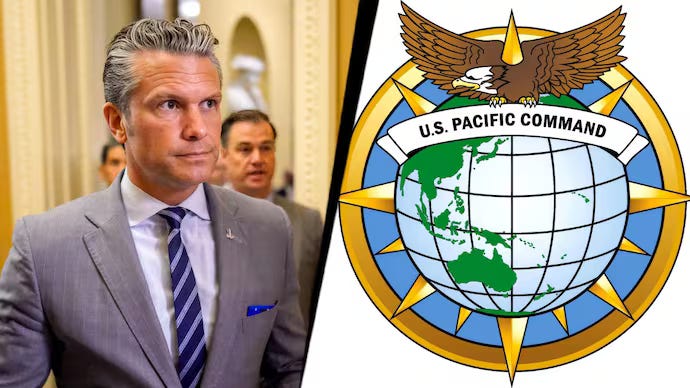
The Pentagon’s mid-June decision to restore “US Pacific Command,” reversing a 2018 decision to rename the command as the Indo-Pacific Command, is not merely a bureaucratic rebranding. It is the clearest institutional signal yet that Washington is narrowing its strategic horizon.
The 2018 choice was deliberately political, reflecting an emerging strategic consensus that the Indian and Pacific Oceans constituted a single geopolitical theatre and that India would become indispensable to maintaining a favorable balance of power against China. Then-Secretary of Defense James Mattis described the decision as recognizing the “increasing connectivity between the Indian and Pacific Oceans,” while the Trump administration’s subsequent Indo-Pacific Strategy Report placed India at the center of its vision for a “free and open Indo-Pacific.” The command’s new name institutionalized this strategic imagination within the US military itself.
That institutional commitment now appears to be receding. In June, the Department of War, restored the command’s historical designation while explicitly retaining its existing area of responsibility. Officially, the change is presented as a return to tradition rather than a change in mission. Yet strategic institutions rarely rename themselves without purpose. Military commands embody particular conceptions of geography, priorities, and threats. While operational responsibilities remain unchanged, the vocabulary through which Washington defines its principal theatre of competition has unmistakably changed. The question, therefore, is not whether the command’s map has changed, but whether America’s strategic imagination has. The answer increasingly appears to be yes.
The Indo-Pacific concept emerged at a moment when Washington believed that balancing China required integrating the entire maritime space stretching from the eastern coast of Africa to the western shores of the Americas. India occupied a central place in this vision. It was expected to serve as the western anchor of an emerging coalition alongside Japan, Australia and the United States. The Quadrilateral Security Dialogue (Quad), revived in 2017, complemented this broader strategic architecture by projecting the image of four major democracies collectively shaping regional order. Eight years later, many of the assumptions underpinning that vision have weakened.
Most importantly, the military challenge posed by China has become significantly more immediate. Taiwan has shifted from being one contingency among many to becoming the organizing principle of US defense planning in Asia. The Pentagon’s force posture, alliance coordination and operational concepts increasingly revolve around deterring a Chinese attempt to alter the status quo in the Taiwan Strait. This has inevitably concentrated American attention on the first and second island chains, particularly Japan, the Philippines and Guam, where military assets can directly influence a potential conflict. As strategic urgency has narrowed geographically, so too has Washington’s conception of which partners matter most.
Why India No Longer Occupies the Center
The restoration of the Pacific Command designation doesn’t suggest that India has become strategically irrelevant. It remains indispensable to American efforts in technology cooperation, supply-chain resilience, intelligence sharing and long-term balancing against China. However, strategic importance and operational centrality are not the same. Washington’s earlier Indo-Pacific strategy assumed that India would gradually emerge as an increasingly integrated security partner capable of anchoring the Indian Ocean component of regional deterrence. That expectation has encountered important structural limits.
India has consistently preserved its doctrine of strategic autonomy. It has refused formal military alliances, maintained longstanding defense relations with Russia despite Western pressure, and repeatedly demonstrated that it will align with Washington only where its own national interests converge. None of these policies are surprising; they simply reflect India’s longstanding foreign policy tradition.
From the perspective of US military planners, however, these realities carry important implications. In the event of a Taiwan contingency, treaty allies such as Japan and Australia provide legally institutionalized commitments, established command structures and integrated military planning. The Philippines has similarly assumed renewed strategic significance by expanding American access to military facilities under the Enhanced Defense Cooperation Agreement. These partnerships translate directly into operational planning.
India occupies a different category. Its value lies less in participating in immediate military contingencies than in shaping China’s long-term strategic environment. That distinction matters because Washington increasingly appears to be prioritizing the former over the latter.
The restoration of the original name, therefore, reflects more than nostalgia. It suggests that American strategy is moving from an expansive geopolitical vision toward a more concentrated military geography. The decisive theatre is no longer conceived primarily as the vast Indo-Pacific; it is increasingly the Western Pacific.
New Alliance System
If the restoration reflects a narrowing of America’s strategic geography, it also points towards an evolving hierarchy of alliances. The beneficiaries of this shift are unlikely to be new partners, but existing treaty allies situated closest to the prospective theatre of conflict.
Japan has embarked upon its most ambitious military modernization since WWII, significantly increasing defense spending and adopting a new National Security Strategy that explicitly identifies China as the greatest strategic challenge. Australia has become c