
USK Students Implement Solar Panel Innovation for Pidie Jaya Community
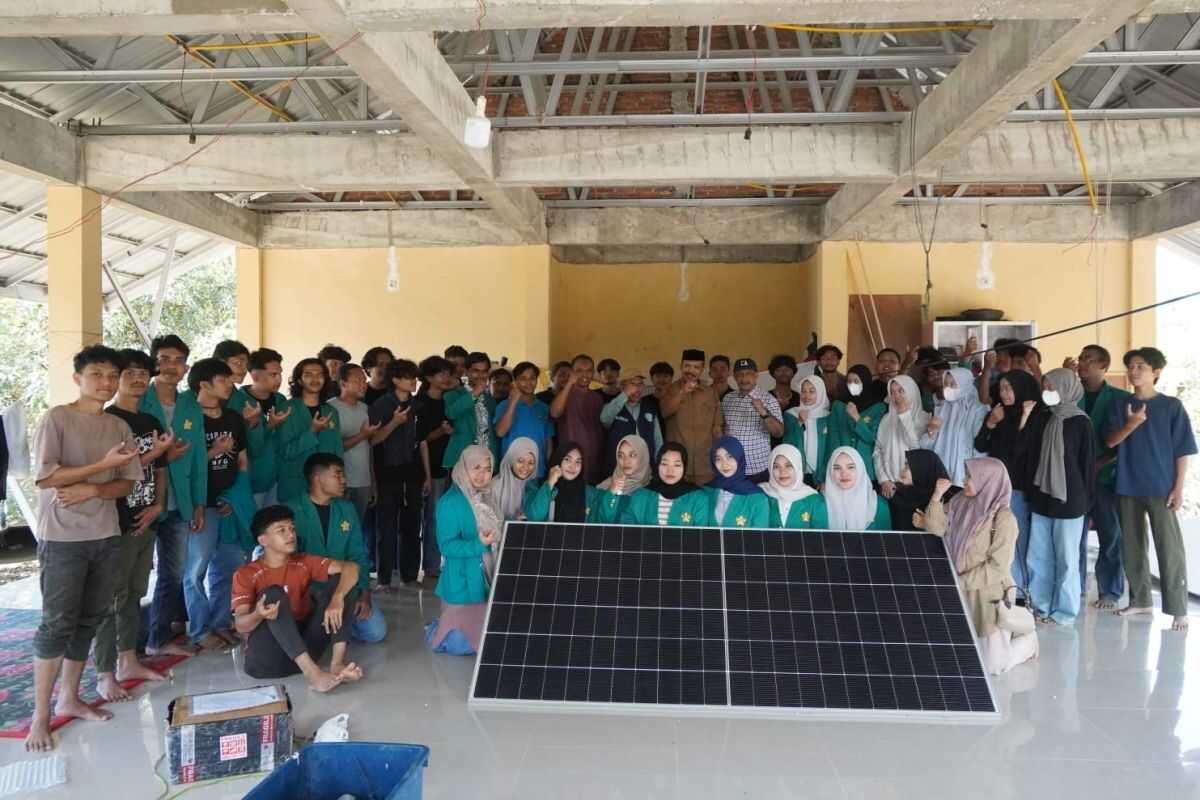
Banda Aceh — A team of students from Universitas Syiah Kuala (USK) in Banda Aceh has collaborated with the Pidie Jaya Regency Government to introduce a solar panel innovation as a step to restore conditions after a disaster in Mesjid Tuha Village, Pidie Jaya, Aceh.
‘This innovation is to answer the challenges of the green energy transition and infrastructure resilience in disaster-prone areas,’ said Yuraddin, head of the USK Impact Students Team, in Pidie Jaya on Thursday.
The project is conducted under the ‘Impact Students Programme’. The team is implementing an initiative titled Basis Alternatif Nir-emisi Guna Ketahanan Infrastruktur Terbarukan (Bangkit) to transform Mesjid Tuha Village, Meureudu District, into a model village that is smart, energy-independent.
In its implementation, the project rests on four main pillars: autonomous IoT-based clean water supply, and a solar-powered reverse osmosis (RO) filtration system.
‘The system is equipped with IoT sensors integrated with the village website, so residents, particularly local youths, can monitor water reserves in real time,’ Yuraddin said.
Then, he added, electrical hazard mitigation, i.e., education and safety inspections of electrical installations in residents’ homes to prevent the risk of further short circuits.
The third pillar, digital transformation of village MSMEs, involves digital marketing training (upskilling) for PKK women’s groups involved in MSMEs to boost online economic independence.
Finally, housing rehabilitation, with communal efforts to restore residential areas so the environment is safe and habitable again.
Yuraddin explained the innovation is designed so the village will not be paralysed during crises. They want to prove that innovations such as solar panels and IoT can be implemented directly to safeguard vital village facilities.
‘This is a small step from Aceh for sustainable infrastructure resilience,’ he said.
Meanwhile, Dedy Kuesnedy, the Kepala Desa of Mesjid Tuha, appreciated and welcomed the USK students’ initiative, which the local community feels the benefits of directly.
‘In the aftermath of the disaster, we really need synergies in the form of ideas, energy, and minds. The presence of the programme in Mesjid Tuha helps restore conditions and re-energise our people to rise again,’ said Dedy.
On this occasion, Saifuddin, head of the Pidie Jaya Department of Information and Communications, emphasised the regional government’s commitment to supporting sustainable innovation.
The Pidie Jaya government appreciated this breakthrough by USK students, with the collaboration on renewable energy and digitalisation aligned with the vision to build smart and disaster-resilient villages.