
Using DTSEN, Religious Affairs Ministry Strengthens Baznas’ Data-Driven Ecosystem to Tackle Poverty
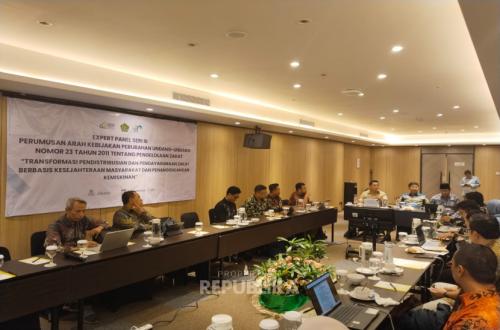
JAKARTA — The Religious Affairs Ministry (Kemenag) is encouraging stronger data-based zakat management, using the National Unified Social and Economic Data (DTSEN) as one reference for identifying and prioritising beneficiaries, known as mustahik.
The initiative aims to improve the accuracy of zakat distribution, strengthen community empowerment and support the government’s efforts to tackle poverty.
The policy was discussed at an event organised by the ministry’s Subdirectorate for Zakat Management and Supervision at the Grand Orchardz Hotel in Kemayoran, Jakarta, on Thursday (5 November 2026).
One focus was the development of a data-driven zakat management ecosystem at the National Zakat Agency (Baznas).
This approach uses data as the basis for planning, targeting, programme delivery and evaluating the impact of zakat distribution and use.
Integrating DTSEN with the mustahik data held by zakat management institutions is expected to make beneficiary identification more systematic, taking account of people’s socio-economic circumstances, welfare levels and needs.
The use of this data is also expected to improve coordination between the government, Baznas and zakat collection agencies, preventing overlapping assistance and ensuring it reaches those most in need.
The ministry’s Director General of Islamic Community Guidance, Professor H. Abu Rokhmad, stressed that zakat management must remain guided by Islamic law, particularly the provision that zakat may be given to eight asnaf, or eligible categories of recipients.
He said zakat had significant potential to improve human resources and strengthen communities’ economic independence. One way to do so is through educational scholarships that give beneficiaries the opportunity to develop their capabilities.
“Zakat can be provided in the form of educational scholarships. The hope is that scholarship recipients will improve their capabilities and, once successful and established in their work, benefit those around them,” Abu Rokhmad said.
Zakat can also be used to provide business capital, supporting enterprise growth and improving household incomes.
“Similarly, capital assistance is expected to generate a multiplier effect for the community’s economic improvement. This reflects the attention of the government and Baznas to people in need, while also encouraging independence and the welfare of the Muslim community,” he said.
He added that, in a data-driven Baznas ecosystem, data would not only identify who was entitled to receive zakat but also serve as a tool for measuring the effectiveness of empowerment programmes.
Evaluations could examine changes in beneficiaries’ incomes, the growth of productive businesses, improved access to education and shifts in mustahik’s socio-economic circumstances after receiving assistance.
Accordingly, the success of zakat management should be measured not only by the amount raised and distributed, but also by the extent to which it improves beneficiaries’ lives.
The ministry’s Director of Zakat and Waqf Empowerment, Professor Waryono, stressed that zakat distribution was not solely an expression of social concern but also involved the state’s responsibility for public welfare.
“At its core, zakat distribution is not just about social sensitivity; the state or government has a role towards its people,” Waryono said.
His statement underscored the importance of cooperation between the government and zakat management institutions in building a community empowerment system integrated with social protection policies.
The event was also attended by Baznas Deputy II for Distribution, Utilisation and Empowerment, Dr Imdadun Rahmat, and Professor Muhammad Maksum of UIN Syarif Hidayatullah Jakarta.
The involvement of stakeholders formed part of efforts to strengthen coordination and build a zakat management ecosystem centred on integrated data, transparency, accountability and impact measurement.
Through the use of DTSEN and a strengthened data-driven Baznas ecosystem, Kemenag is seeking to make zakat management more accurately targeted, measurable and sustainable.
The aim is for zakat to serve not only as a social assistance instrument but also as a strategic means of improving human resources, developing productive economic activity, strengthening public welfare and accelerating poverty reduction.
Source: jawawa.id (https://jawawa.id/newsitem/using-dtsen-religious-affairs-ministry-strengthens-baznas-data-driven-ecosystem-to-tackle-poverty-1793893877)
Originally published by Republika (https://news.republika.co.id/berita/to182e291/mengacu-dtsen-kemenag-perkuat-ekosistem-datadriven-baznas-untuk-tanggulangi-kemiskinan), translated from Indonesian