
Use of Deciles to Restrict Pertalite Deemed Problematic
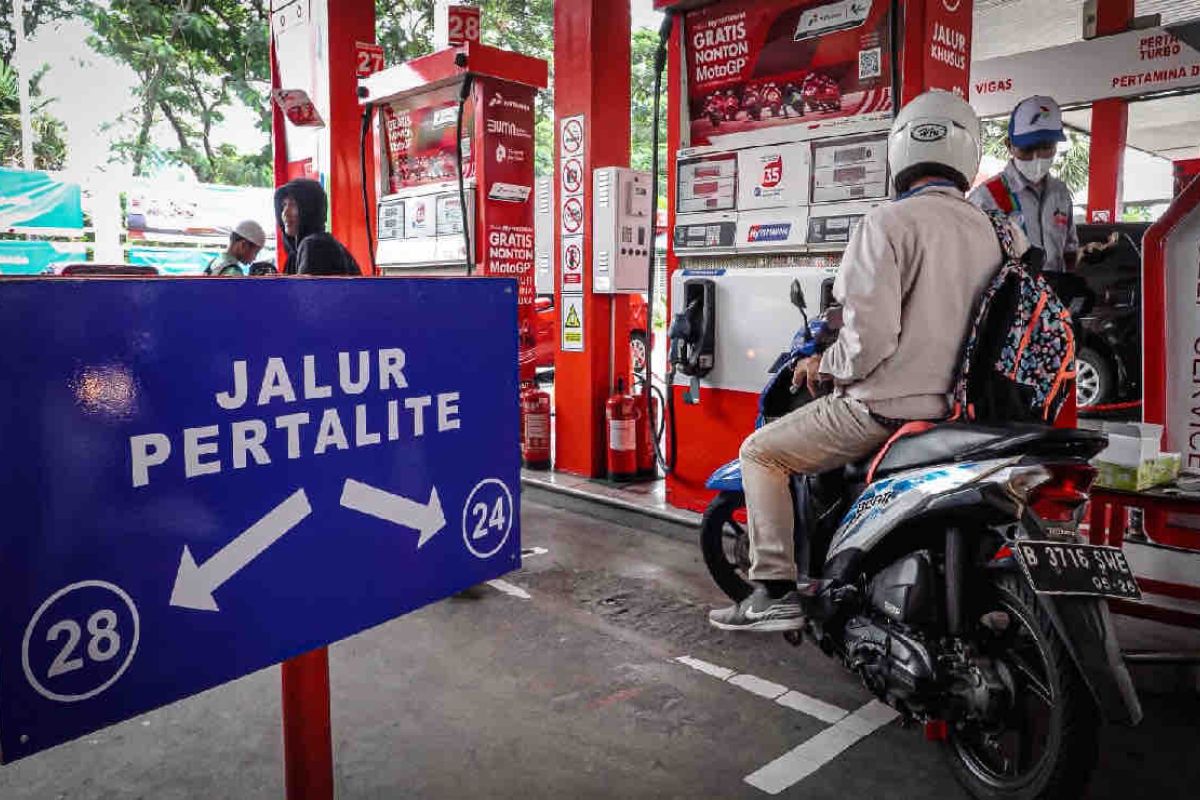
The use of deciles as a dividing line to determine the planned restriction on subsidised fuel purchases has been deemed problematic. Economist Yusuf Rendy Manilet of the Center of Reform on Economics (CORE) said that proxy means testing (PMT) is indeed useful for estimating welfare levels, but its accuracy is not uniform across the entire distribution.
Around the boundary of deciles 8 and 9, he said, the difference in economic conditions between households can be very slight. A small error in estimation can cause someone to shift groups. Moreover, the expenditure model only explains part of the variation in economic conditions, while the remainder is a residual not captured by the model.
“Another more fundamental problem is that variables such as assets, housing conditions, electricity, and education mostly describe the stock of past welfare. Yet a person’s ability to cope with rising fuel costs is determined by today’s cash flow,” Yusuf said when contacted on Tuesday (18/8).
He gave the example of someone who owns a decent house through inheritance but does not necessarily have sufficient income. Likewise, an online motorcycle taxi driver who appears relatively well-off in terms of assets but is highly sensitive to daily operational costs.
“A model like this could fail to capture economic shocks that are precisely the most relevant to fuel policy,” he said.
“The risk is even greater because one classification is used for many programmes, from social assistance to education and health services, and now fuel. If a classification error occurs, the impact no longer stands alone,” he added.
The same error could affect several entitlements at once. Therefore, according to Yusuf, the National Socio-Economic Data (DTSEN) should be treated as an initial screening stage, not as a final decision. Households near the boundary line need additional verification and a clear appeals mechanism.
On the other hand, methodological transparency is also important. The government, Yusuf said, does not have to open the entire formula to the point where it can be easily manipulated, but at least needs to explain the variables used, the ranking method, and the validation results.
“Error statistics, including inclusion error and exclusion error rates, are actually more important for the public to know. Researchers should also be able to test the model through controlled data access,” he explained.
If the government wants to use vehicle characteristics as one indicator, Yusuf sees advantages. Vehicles are easier to observe and verify than economic status determined entirely by a model.
“The aim is not to replace DTSEN with another single indicator, but to build a stronger verification system,” he said.
“So, I do not question the goal of making subsidies better targeted. What needs to be ensured is that the tool for determining who loses access must be sufficiently accurate. If the data design is not ready, the relatively limited fiscal savings could be paid for with significant mistargeting and a decline in the quality of the database we need to protect vulnerable groups,” he concluded.