
USABC Issues Eight Recommendations to Support Indonesia’s 8% Economic Growth Target
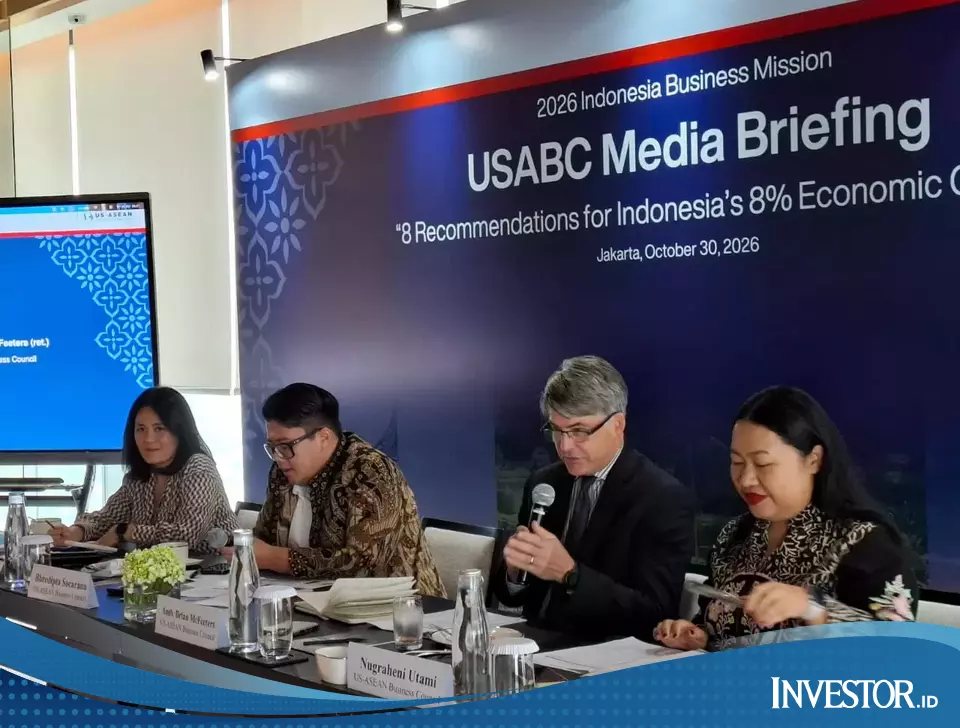
Indonesia could achieve its target of 8% economic growth by 2029 through consistent and sustained efforts. The target is ambitious, but the country recorded growth of 9.9% in 1980 and averaged 6.8% between 1986 and 1996.
The 1980 performance was supported by an oil boom, while growth from 1986 to 1996 was driven by investment and export performance. An average growth rate of 8% requires a long-term commitment. The US-ASEAN Business Council (USABC) says its experience in ASEAN countries such as Vietnam shows that sustained growth targets are backed by top-level leadership, translated into policy and adopted as a shared reference point by ministries and provincial governments.
Against this backdrop, the USABC has published a white paper containing eight recommendations to support Indonesia’s growth target. The recommendations are based on the experience of member companies, the council’s dialogue with the government throughout the year and discussions at the Indonesia Business Mission (IDBM) on 27–28 October 2026.
The eight recommendations are:
Modernise import processes by simplifying requirements, setting realistic deadlines and establishing clear monitoring and escalation mechanisms.
Strengthen confidence in standards and certification through transparent criteria, recognition of assessments by credible foreign bodies and expanded accredited testing capacity.
Improve the government’s technical certainty in the digital sector by conducting trials before broad implementation and making productive and secure use of artificial intelligence, cloud computing and cybersecurity.
Increase regulatory certainty through meaningful consultation, clear implementation guidance, adequate transition periods and coordination between central and regional governments.
Position the government as a long-term investment partner through the Investment Coordinating Board (BKPM), while strengthening mechanisms for resolving problems and escalating issues.
Expand knowledge transfer and build local capacity through commercial partnerships and alignment of domestic content requirements (TKDN) with the capabilities of local industry.
Balance foreign-exchange reserve stability with reinvestment flexibility by reviewing the policy on export proceeds from natural resources, with input from the government, industry and banks.
Deliver on trade commitments through an implementation roadmap, engagement with affected industries and measurement of relevant outcomes.
USABC President and CEO Ambassador Brian McFeeters said US companies had long contributed to Indonesia’s economic development. “Policy certainty and consistency are important factors that enable companies to maintain investment, expand operations and build stronger partnerships with local businesses,” he said at a USABC press conference on the eight recommendations for Indonesia’s 8% economic growth target in Jakarta on Friday, 30 October 2026.
The recommendations are aligned with the development priorities set out in the 2025–2029 National Medium-Term Development Plan (RPJMN) and Asta Cita, including downstream processing, industrialisation, bureaucratic reform and investment mobilisation.
Brian said the USABC and its member companies hoped to continue working with the Indonesian government through the white paper’s recommendations to strengthen the investment climate, promote sustainable business expansion and extend the benefits of economic growth to communities, workers, local suppliers and Indonesian businesses.
Bhredipta Socarana, the USABC’s Indonesia country representative, said investment had the greatest potential to drive growth. Foreign investors already operating in Indonesia, he said, were the most reliable source of investment for three reasons: they pay taxes and non-tax state revenue; provide goods and services that support the government’s agenda; and strengthen the ecosystem as customers of local suppliers, employers, trainers and sources of innovation.
“When companies can operate in a business ecosystem that provides legal and policy certainty, they can increase their investment and business activity. Many business associations and the OECD say regulatory certainty and consistent implementation are key to attracting and retaining investment,” he said.
Bhredipta identified three conditions that shape companies’ reinvestment decisions. The first is clarity and consistency: companies can comply when requirements, authorities and deadlines are clear and consistently applied. USABC members associate unclear procedures, overlapping obligations and uncertain transition periods with delayed decisions.
The second is capability and proportionality. Regulation is most effective when it addresses identified risks and is suited to the available human resources, systems and domestic capacity. “Our members say that rules introduced without readiness in testing, human resources or systems delay products reaching the market, and some investors postpone launches,” he said.
The third condition is partnership. Licensing, he explained, is only the beginning of the investment cycle. Investors need government counterparts who can resolve cross-agency problems and hear concerns early. “Members say investors often find it difficult to identify the right partner,” he said.