
US Weapons Called 'Death Throes', Trump and Pentagon Dig In
White House and Pentagon officials have firmly denied a series of reports indicating that the United States’ supply of offensive and defensive weapons has fallen to a critically dangerous level. The drastic decline in military munitions stocks was reported after five months of warfare with Iran.
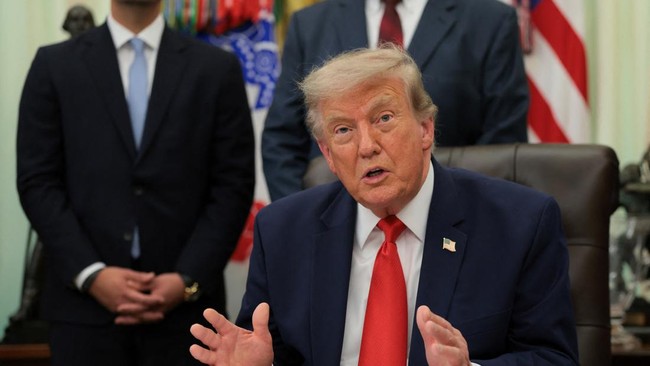
US President Donald Trump rejected claims that his country faces a weapons shortage in a statement on Tuesday. He instead blamed former President Joe Biden, whom he accused of giving Patriot interceptor munitions to Ukraine and Europe for free. “We have far more munitions than anyone in the world, and far more than we need, despite the fact that unprecedented amounts were given away by Corrupt Joe Biden and the Biden Administration to Ukraine and Europe at no cost, in one of their many very stupid acts,” Trump said. “And as we build them, we will begin issuing more to our allies in Europe and elsewhere,” he stressed.
Pentagon spokesman Sean Parnell also denied that the US military is in a dire ammunition shortage situation. He asserted that the American military is the most powerful in the world and has everything it needs to execute at the time and place of the President’s choosing. “We have carried out various successful operations across combatant commands while ensuring the US military has deep capability arsenals to protect our people and interests,” he said.
Several reports on Monday, however, suggested that the US weapons crisis may be far more real than officials publicly acknowledge. CNN reported that the US military has expended 80 per cent of its THAAD interceptors and about half of its Patriot interceptors, leaving stockpiles at very low levels. US Defence Secretary Pete Hegseth quickly contested the 80 per cent figure and the threat characterisation, responding to the report by writing “not true” and “shameful” on platform X on Monday.
An analysis from the Center for Strategic and International Studies (CSIS) on 27 July also calculated that the US military has just over a third of its Patriot missiles and about half of its THAADs remaining. CSIS projected it would take at least three years to restore stocks to pre-war levels despite new funding injections. Reuters and CBS News separately reported that the US military has also expended most of its highly accurate long-range offensive ATACMS and PrSM missiles. Two sources revealed that nearly all of these missiles have been used, with each missile costing around US$1 million.
The Trump administration has so far not publicly acknowledged the threat posed by this crisis. Nonetheless, the government has requested a defence budget of US$95 billion for Fiscal Year 2027 and an additional funding request of US$21 billion to replenish its warehouses. Chairman of the Joint Chiefs of Staff, Dan Caine, has reportedly repeatedly voiced concerns about the crisis behind closed doors. The New York Times mentioned that these weapons supply concerns were one of the factors behind Trump’s pullback from a larger escalation in late July. The decision to step back came after a memorandum of understanding between Washington and Tehran to halt hostilities in June failed, triggering reciprocal attacks from both sides for nearly two full weeks.
Retired US Marine Corps colonel and CSIS senior adviser Mark Cancian assessed that the shortage of ATACMS and PrSM weapons will reduce the army’s ability to launch long-range strikes. He said US forces would have to use alternative mechanisms such as JASSM or Tomahawk missiles and conduct close-range attacks that are more dangerous for troops. “For ATACMS and PrSM, if you are nearly out or out, then you have to use some other mechanism, and that could be delivered by air or sea, so you might be talking about Joint Air-to-Surface Standoff Missiles or Tomahawks to strike deep targets, or have aircraft fly over enemy territory,” he said. “That is more dangerous, and you really have to defeat any air defence systems.”
Cancian also stressed that the air defence interceptor crisis is far more serious because there is no comparable replacement weapon. These concerns proved real during the 17 July attack on Muwaffaq Salti airbase in Jordan, which killed three US soldiers after an Iranian missile penetrated US and Jordanian military defence systems. He assessed that Iran is unlikely to be able to completely exhaust the remaining US interceptors in the short term. However, every US missile used reduces the availability of weapons to deter China, a point at which the joint staff are now extremely nervous. “Every missile used is one less available to deter China, and we are now at a point where the joint staff are really, really nervous about that,” Cancian explained.