
US Threatens Sanctions on Banks Involved in China's 'Teapot' Refineries
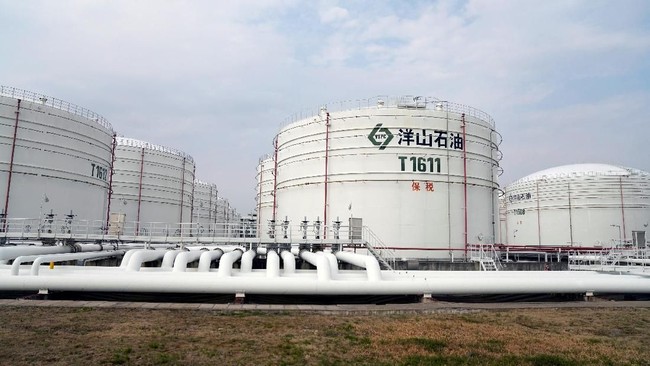
Jakarta - The United States has warned global financial institutions not to engage in transactions with China’s independent oil refineries known as ‘teapot’ refineries. This step is taken because such involvement risks triggering sanctions related to Iranian oil trade.
The US Department of the Treasury, in its statement, emphasised that banks and financial institutions must avoid facilitating transactions with these refineries, particularly those importing crude oil from Iran.
“This revenue ultimately benefits the Iranian regime, its weapons programme, and its military. Some Chinese ‘teapot’ refineries have used the US financial system to conduct transactions in US dollars and purchase US goods,” the Department of the Treasury wrote, as quoted by CNBC International on Wednesday (29/4/2026).
The US noted that China absorbs around 90% of Iran’s oil exports, with the largest portion processed by these independent refineries. Therefore, Washington urges financial institutions to conduct stricter due diligence, especially on transactions involving refineries in Shandong Province and entities in Asia and the Middle East that are part of Iran’s oil supply chain.
US Treasury Secretary Scott Bessent affirmed that the government will continue to increase pressure on parties assisting the flow of Iranian oil to global markets.
“We will continue to apply maximum pressure. Any individual, vessel, or entity facilitating the illegal flow to Tehran risks facing US sanctions,” Bessent stated.
He also revealed that Iran’s main export terminal on Kharg Island is approaching storage capacity. This situation could force Iran to cut production and lose around US$170 million per day, equivalent to Rp2.89 trillion.
‘Malaysian Blend’ Modus Operandi
This US action is part of the ‘maximum pressure’ policy against Iran, which has been intensified again since February, ahead of escalating conflicts in the region.
Last week, Washington imposed sanctions on one of China’s large refineries, Hengli Petrochemical (Dalian), which is said to be a major customer of Iranian oil. In addition, four other small refineries were also added to the sanctions list.
Surveillance has also been expanded to port terminal operators in Shandong and logistics service providers involved in the distribution of Iranian oil.
The Department of the Treasury revealed that Iranian oil is generally shipped using a ‘shadow fleet’ of tankers that attempt to avoid tracking by manipulating location data. Shipments often involve ship-to-ship transfers at sea, including in the Persian Gulf and the Malacca Strait.
In several cases, the oil is mixed with supplies from other countries or relabelled using fake documents. This practice is widely known as the ‘Malaysian blend’ to disguise the oil’s origin.
This warning comes ahead of the planned visit by US President Donald Trump to Beijing, where trade and investment issues are expected to be the main agenda.
On the other hand, China continues to reject unilateral sanctions. In a meeting with Iranian Foreign Minister Abbas Araqchi, Chinese Foreign Minister Wang Yi emphasised that Beijing opposes “the abuse of power and illegal unilateral sanctions.”
Currently, the US and Iran are still in an indefinite ceasefire situation, although tensions have not subsided. Iran has not reopened the Strait of Hormuz, while the US continues to maintain a blockade on Iranian ports.