
US Spending Rp4.3 Trillion Per Day in Iran War: Where is the Money Going?
Since the United States began its military operations against Iran on 28 February 2026, war costs have continued to swell. Over a five-month period, the Pentagon is estimated to have spent US$38.1 billion, or approximately Rp670.56 trillion.
On average, these estimated war costs amount to US$246 million, or roughly Rp4.33 trillion, every single day. These costs are expected to rise as the fighting has not yet concluded.
These figures were revealed in a recent report by the Congressional Budget Office (CBO) released on Tuesday (15/9/2026). The CBO is a non-partisan agency that provides budget and economic analysis to the US Congress.
The CBO’s calculations include additional costs incurred by the Pentagon up to 1 August 2026. The tally began when the US launched air strikes and cruise missile attacks on Iran under the operation known as Operation Epic Fury.
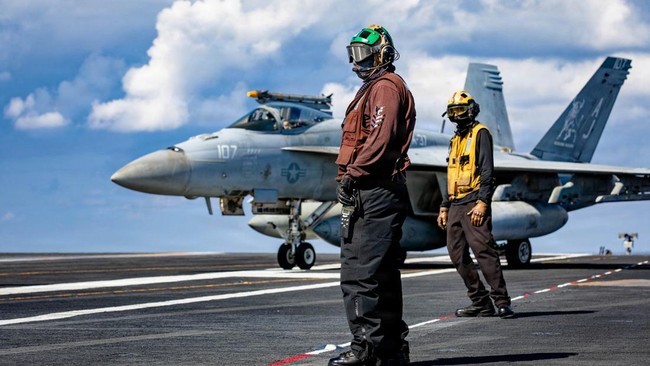
At the onset of the war, the US deployed fighter jets, bombers, warships, and air defence systems to the Middle East. While fighting briefly subsided following a ceasefire agreement between the US and Iran on 8 April, tensions escalated again after US President Donald Trump declared the ceasefire ended on 10 July, following a series of Iranian attacks on tankers in the Strait of Hormuz.
Since then, combat intensity has increased, driving up war expenditures. A significant portion of the Pentagon’s funds has been used to replenish missiles and ammunition that have been expended. Other costs stem from increased aircraft flight hours, rising fuel prices, and various military equipment that has been lost or destroyed.
The CBO compiled these calculations using government databases and publicly available reports, as the Pentagon did not provide the specific information requested by the CBO. While data limitations introduce some uncertainty, it is certain that war costs are still rising. If combat continues at the rates seen in May and June, the Pentagon is expected to spend an additional US$2 billion, or Rp35.2 trillion, per month.
Conditions are currently intensifying. As of Wednesday (16/9/2026), the escalation in fighting means the costs borne by the US could be significantly higher. The CBO estimates monthly costs could rise to US$3 billion, or Rp5lar52.8 trillion, if combat returns to the levels seen in July. This figure could climb even higher if the war expands.
More Than Half of War Costs Spent on Ammunition
Missiles represent the most expensive component of this war. Every missile launched must be replaced to ensure US weapon stockpiles do not deplete further. Of the US$38.1 billion spent by the Pentagon, approximately 57% was used to replace ammunition, amounting to US$21.7 billion, or about Rp381.92 trillion.
A large portion of this cost comes from air defence interceptor missiles. The Pentagon is estimated to need US$13.1 billion to replace the interceptors used to counter Iranian ballistic missiles and drones targeting US bases in the Middle East, Israel, Gulf nations, and Jordan.
To intercept these attacks, the US utilised its most advanced air defence systems, including Patriot, Terminal High Altitude Area Defense (THAAD), Standard Missile-3 (SM-3), and Standard Missile-6 (SM-6). These weapons are extremely expensive; a single Patriot or SM-6 missile is estimated to cost US$4 million, or roughly Rp70.4 billion. A THAAD missile can cost up to US$12 million (Rp211.2 billion), while the highly advanced SM-3 can reach US$28 million (Rp492.8 billion) per unit. A single SM-3 shot can cost nearly half a trillion rupiah, and the use of dozens of interceptors in a single wave causes costs to skyrocket.
The US has also spent US$7.3 billion to replace cruise missiles used to attack Iran, primarily consisting of Tomahawk and Joint Air-to-Surface Standoff Missiles (JASSM). The scale of missile usage was evident in a single attack in June, where US forces reportedly fired approximately 50 Tomahawk missiles.
Loss of Aircraft, Drones, and THAAD Radar in Combat
It is not only missile supplies that have been depleted. The war has also resulted in the destruction or damage of various US aircraft, helicopters, drones, and air defence equipment. The CBO list shows losses across various fleets, including not only frontline fighter jets but also support aircraft essential for maintaining operations.
Four F-15E fighter jets were recorded lost during the war, alongside one F-35A, one A-10, and one E-3 surveillance aircraft. The US logistics fleet was also impacted, with two KC-135 and two MC-130J aircraft lost during combat. Several military helicopters, including the AH-64, HH-60W, and MH-6, were also included in the loss list.
However, the highest number of losses involved unmanned aerial vehicles. A total of 24 MQ-9 drones were lost during the war, with replacement costs estimated at US$720 million, or approximately Rp12.67 trillion. An MQ-4C reconnaissance drone, valued at US$150 million, was also recorded as lost. This drone is typically used for long-range maritime surveillance.
Another significant loss occurred within air defence systems, as Iran destroyed one AN/TPY-2 radar, a critical component of the THAAD system. The radar, valued at US$500 million (Rp8.8 trillion), is used to detect and track ballistic missiles. Without this radar, a THAAD battery faces difficulty detecting incoming threats. This loss is particularly significant because each THAAD battery relies on a single AN/TPY-2 radar, and the Pentagon possesses only eight THAAD batteries to be deployed across various regions.