
US Senator’s Farewell Speech: People Are Tired of Political Theatre as Development Is Hindered
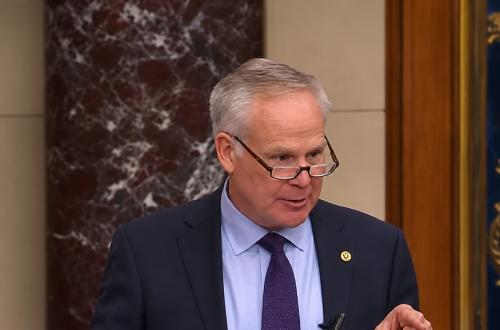
JAKARTA — Republican US Senator Alan Armstrong has sharply criticised what he sees as Washington’s focus on partisan interests, short-term popularity and electoral calculations, saying it is holding back the country’s progress.
In his farewell speech to the US Senate on Friday (20 November 2026), Armstrong warned that Americans were tired of watching political theatre among the elite while fundamental issues affecting the nation’s future remained unresolved.
“Please, do not let partisan political manoeuvring paralyse our nation’s progress. The American people are tired of political theatre. They are tired of the outbursts of anger. They expect us to solve the difficult problems facing this nation,” Armstrong said.
The former chief executive of energy company Williams Companies delivered his criticism after serving 250 days in the Senate. He said the period held particular significance because it coincided with the 250th anniversary of American independence.
The Washington Post reported on Saturday (28 November 2026) that Armstrong was due to leave office on 30 November, after helping to pursue reforms to the infrastructure permitting system, which had long been caught in political deadlock.
Armstrong’s farewell address came a day after the Senate approved the Bipartisan American Affordability and Jobs Act (BAAJA), a legislative package aimed at speeding up permits for infrastructure, energy and industrial projects in the United States.
The Senate’s approval of the bill gave Armstrong an opportunity to remind Washington politicians of the nature of power, their responsibility to future generations and the importance of putting national interests ahead of short-term political considerations.
Government makes development too difficult
Armstrong said one of the major problems facing the United States stemmed from the government and regulatory system the country had built for itself.
During nearly four decades in the private sector, he had seen increasingly complex bureaucracy obstruct infrastructure development, delay investment and eliminate job opportunities.
“I came to Washington believing that our country had made it too difficult to build the things we need,” Armstrong said.
Working alongside engineers, construction workers, environmental experts and business owners had given Armstrong first-hand insight into the economic consequences of regulatory uncertainty.
The United States, he said, had the natural resources, capital, technology and workforce needed to build strategic infrastructure. But that capacity was often held back by a permitting system that was complicated and difficult to predict.
“Projects that should take a year instead take as long as a decade. Investments that could create jobs and strengthen the economy are delayed or abandoned. American families and businesses are the ones who ultimately bear the consequences,” Armstrong said.
The issue, he argued, was not simply a matter of concern to large companies. Delays to energy and industrial infrastructure projects affected the cost of living, employment opportunities and the competitiveness of the national economy.
Armstrong said permitting procedures could be simplified without sacrificing environmental protections or increasing federal spending programmes.
“If there is one contribution I can leave behind from my short time in the Senate, I want it to be helping America regain its ability to build,” he said.
From engineer and energy CEO to US senator
Armstrong’s path to the Senate differed from that of most American politicians, who build their careers through political parties, government posts or elections.
The Associated Press reported in March 2026 that Oklahoma Governor Kevin Stitt had appointed Armstrong to fill the Senate seat vacated by Markwayne Mullin after the Republican politician was confirmed as US Secretary of Homeland Security.
Before entering politics, Armstrong spent his professional career at Williams Companies, an energy infrastructure firm based in Tulsa, Oklahoma, which operates natural gas transmission networks.
He began as an engineer, then held a series of management positions before becoming the company’s president and chief executive in 2011. In 2025, Armstrong became its executive chairman.
His experience leading an energy company made infrastructure permitting reform one of the main priorities he took to Washington.
Armstrong acknowledged that the offer to become a senator had left him facing a dilemma. Having spent most of his life in business, he had been critical of the way government operated.
But he had to choose between remaining outside government and criticising Washington, or entering politics to try to address the problems he had long complained about.
In his speech, Armstrong cited the thinking of Theodore Roosevelt, the 26th US president, on the difference between those who merely criticise and those who dare to enter the arena.
“So I prayed, received very clear guidance, and then decided it was time for me to step into the arena,” he said.
Source: jawawa.id (https://jawawa.id/newsitem/us-senators-farewell-speech-people-are-tired-of-political-theatre-as-development-is-hindered-1795904442)
Originally published by Republika (https://news.republika.co.id/berita/tp7qxb451/pidato-perpisahan-senator-as-rakyat-lelah-dengan-sandiwara-politik-pembangunan-dipersulit), translated from Indonesian