
US, Russia and China Race to Build Nuclear Reactors on the Moon – But Why?
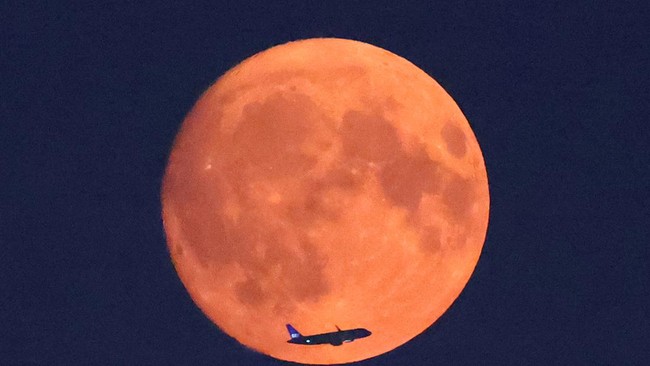
The United States, Russia and China are racing to build nuclear reactors on the Moon. The three superpowers are seeking to conquer space despite scientists’ warnings about the high risk of radioactive accidents.
According to Al Jazeera on Sunday (8 November 2026), the US space agency NASA plans to build a nuclear reactor on the Moon by the end of 2030. Russia and China, meanwhile, are targeting 2036 for their nuclear-powered base project.
The reactor is needed to power equipment that will mine frozen water trapped inside lunar craters. Scientists believe the ice could provide drinking water, breathable air and rocket fuel for future bases.
NASA’s Lunar Reactor 1 is designed to weigh less than 6,000kg and generate 20 kilowatts of electricity independently. Russia’s Selena reactor, by contrast, is projected to be much lighter, at between 1,100kg and 1,300kg, to facilitate a smoother landing.
The US has spent a huge US$20 billion (Rp360 trillion) on its space nuclear programme over the past 70 years. However, it has never succeeded in launching a reactor into space, following a brief 43-day experiment in 1965 that ended in failure.
Nuclear power in space was previously used successfully only by the Soviet Union, from the late 1960s to the 1980s. It launched more than 30 lightweight nuclear fission reactors into Earth orbit to power spy satellites during the Cold War.
Nuclear power is once again being seriously considered because solar panels are seen as inefficient and limited on the Moon. Simon Middleburgh, director of Bangor University’s Nuclear Futures Institute, said nuclear power was currently the most logical option.
“The obvious choice, [but] it has to be used responsibly,” he said.
“The biggest challenge is not nuclear technology at all, but launch regulation, the availability of launch platforms themselves, and landing and setting up the system,” Middleburgh added.
The geopolitical rivalry intensified after US President Donald Trump formally ordered NASA in December 2025 to build the reactor as soon as possible. US Transportation Secretary Sean Duffy also openly acknowledged the heightened competition last August.
“It’s a race to the Moon, in a race with China,” he said.
Analysts have warned of potentially deadly risks if an active reactor falls back to Earth, as happened with the Kosmos 954 satellite in 1978. Middleburgh nevertheless believes that any radioactive contamination from an accident on the Moon would be highly localised.
The 1967 Outer Space Treaty prohibits any country from claiming the Moon, although it does not ban the use of nuclear power there. Norbert Schorghofer, a senior scientist at the Planetary Science Institute, affirmed that signatory countries have the right to explore.
“Countries have the right to mine the lunar surface, as long as it is for peaceful purposes,” he said.
The first country to get its reactor to the frozen-ice deposits could unilaterally establish a “safety zone”. This would effectively lock out other countries, as no one would dare enter an area made radioactive by a rival.
Source: jawawa.id (https://jawawa.id/newsitem/us-russia-and-china-race-to-build-nuclear-reactors-on-the-moon-but-why-1794124252)
Originally published by CNBC Indonesia (https://www.cnbcindonesia.com/news/20261108102000-4-783262/as-rusia-china-berlomba-bangun-reaktor-nuklir-di-bulan-untuk-apa), translated from Indonesian