
US Reportedly Preparing ‘Mother of All Bombs’ to Destroy Iran
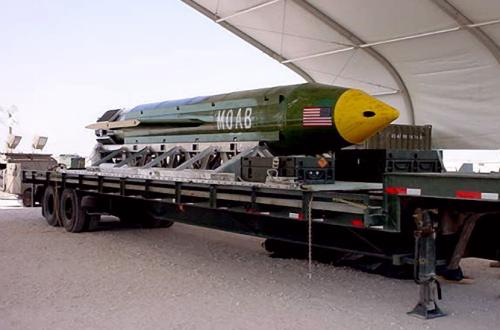
WASHINGTON — The United States is reportedly preparing the option of using the largest non-nuclear bomb in its arsenal to attack Iran’s energy infrastructure and nuclear facilities. But plans to use the weapon nicknamed the Mother of All Bombs have raised a major question: how effectively could it destroy Iranian nuclear installations buried deep underground?
Al Jazeera reported on Thursday (15 October 2026) that the US military had drawn up plans for an attack using the GBU-43/B Massive Ordnance Air Blast (MOAB). The plan is one option should US President Donald Trump order military operations against Iran to resume.
The report cited US officials familiar with internal military discussions, as reported by CNN. Reuters also reported similar information, but said it had not independently verified CNN’s report.
The possible use of a MOAB is seen as carrying a significant risk of escalating the conflict, particularly as fighting between the two countries has been easing.
Questions have also emerged within the Trump administration about the strategic value of using the bomb. Some officials familiar with military planning discussions believe deploying a MOAB may not help Washington achieve its main objectives, including destroying Iran’s nuclear capability. (Al Jazeera, Reuters)
The MOAB is a high-explosive conventional bomb developed by the US in the early 2000s. It contains about 8.5 tonnes of explosives, weighs 9.8 tonnes in total and is more than nine metres long.
Its size means it cannot be carried by stealth bombers. It is usually deployed from a Lockheed C-130 Hercules military transport aircraft.
The name MOAB stands for Mother of All Bombs. The weapon was first produced in 2002–03 and underwent 12 detonation tests.
The US has used a MOAB in combat only once: in April 2017, when it attacked a network of caves and tunnels used by the Islamic State Khorasan Province (ISKP) in Afghanistan.
Afghan authorities at the time said 94 ISKP members were killed in the strike and that there were no civilian casualties. However, there were unconfirmed reports of civilian deaths, while several homes were reported destroyed.
The MOAB is designed to detonate several metres above the ground. Its blast generates a powerful pressure wave intended to destroy personnel, military equipment, cave entrances, and other surface buildings and structures.
Military expert Colonel Nidal Abu Zeid told Al Jazeera that the bomb’s explosive power could destroy various surface targets within a radius of about one kilometre. The scale of the damage would nevertheless depend on the terrain and the density of nearby settlements.
The main difficulty in using a MOAB in Iran is the nature of the nuclear facilities Washington would be targeting.
Several Iranian nuclear installations, including the Fordow complex and an underground facility under construction at Pickaxe Mountain, are reported to have multiple layers of protection and to lie deep underground.
Brussels-based military expert Elijah Magnier told Al Jazeera that using a MOAB would not guarantee the destruction of Iran’s deeply buried nuclear facilities.
He said the bomb has considerable power to destroy exposed targets and vulnerable structures, but is not specifically designed to penetrate thick concrete or mountain rock.
Its use in Afghanistan also does not prove that it can destroy every type of underground installation.
For deeply buried targets, the US has another weapon specifically designed to penetrate hardened underground facilities: the GBU-57 Massive Ordnance Penetrator.
The bunker-buster weighs about 13.6 tonnes, including a 2.7-tonne warhead. It is designed to penetrate layers of earth and concrete before detonating, with reported penetration capacity of about 61 metres in certain conditions.
Even so, using a bunker-buster would not automatically guarantee the destruction of every protected nuclear facility.
Magnier said a MOAB strike could instead amount to a show of military force without delivering a commensurate strategic benefit.
He questioned what concrete objective Washington would seek to achieve by using the weapon, particularly if its ultimate aim were to force Iran to accept a particular political settlement.
If the main reason for using the bomb were simply to create a spectacular explosion, Magnier said, the plan would resemble political theatre more than an effective military strategy.
The use of a MOAB could also prompt a forceful response from Tehran and widen the conflict to other countries in the Gulf region.
Experts quoted by Al Jazeera warned that Iran could increase pressure on neighbouring countries hosting US military personnel or facilities.
In May, when hostilities between the two countries had briefly eased, Kuwait accused members of Iran’s Islamic Revolutionary Guard Corps (IRGC) of infiltrating Bubiyan Island. The incident was reported to have triggered an exchange of fire between Kuwaiti and Iranian forces. One Kuwaiti civilian was injured, while four Iranian soldiers were arrested.
Iran denied invading the island and said its personnel’s navigation system had malfunctioned.
A threat was also issued by IRGC security adviser Mohammad Reza Naghdi. On Tuesday (13 October 2026), he warned that Iran could capture US military personnel if Washington launched a ground attack.
“If the United States launches a ground attack, so many of its soldiers will be captured that it will be forced to raise the white flag,” Naghdi said, as quoted by Al Jazeera.
Meanwhile, Iran’s head of the National Security Council, Mohsen Rezaei, threatened that Tehran could attack regional digital infrastructure, including communications cables, data centres and artificial intelligence facilities in the United Arab Emirates and elsewhere, if the US launches another attack.
The threat suggests the conflict could expand beyond military installations to target strategic infrastructure underpinning economic and technological activity across the region.
Iran is itself reportedly preparing for the possibility of another round of war by stockpiling weapons, strengthening its nuclear and defence facilities, and consolidating domestic support.
In this context, the proposed use of a MOAB presents Washington with a dilemma. The bomb could cause extensive destruction above ground, but may not achieve the most difficult strategic objective: crippling Iran’s nuclear capability.
If the attack fails to achieve its military aims while Iran retaliates by widening the battlefield, using America’s most destructive non-nuclear weapon could instead prolong the war and increase the risk of instability in the Middle East.
Source: jawawa.id (https://jawawa.id/newsitem/us-reportedly-preparing-mother-of-all-bombs-to-destroy-iran-1792111939)
Originally published by Republika (https://news.republika.co.id/berita/tmz37o393/as-dilaporkan-siapkan-induk-segala-bom-untuk-hancurkan-iran), translated from Indonesian