
US Removes Syria from State Sponsors of Terrorism List, Three Countries Remain
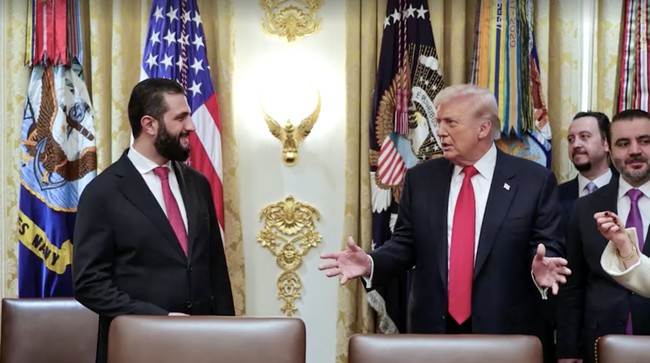
The United States has officially removed Syria from its State Sponsors of Terrorism (SSOT) list, opening a new chapter in Washington–Damascus relations following the fall of Bashar al-Assad’s regime in December 2024.
Syrian President Ahmed al-Sharaa welcomed the decision. “Today, Syria removes a dark stain and tears out a painful chapter from its past to begin the path of development, reconstruction, and rebuilding,” al-Sharaa said in a speech on Tuesday, as quoted by Al Jazeera on Thursday (27/8/2026).
US President Donald Trump had previously announced the plan to revoke the designation in July. The decision, which had applied to Syria since 1979, took effect after passing a 45-day congressional review.
SSOT status carries economic and financial consequences, including restrictions on foreign aid, defence exports, certain financial transactions, and the transfer of goods with both civilian and military uses. The designation also makes banks and companies more cautious about doing business with listed countries due to legal and compliance risks.
US Secretary of State Marco Rubio said Syria’s removal from the list came after Damascus provided “formal assurances” that its government would not support acts of international terrorism in the future. Washington also highlighted the al-Sharaa government’s cooperation with the US in combating the Islamic State group, or ISIS.
The decision is seen as potentially helping Syria’s economic recovery. Sina Azodi, assistant professor of Middle East Politics at George Washington University, said removal from the SSOT list brings “many benefits”, particularly because it can ease Syria’s access to the international financial and banking system.
“All of this will help make trade relations, investment, and diplomatic relations more attractive,” Azodi said.
With Syria’s exit, only Iran, Cuba, and North Korea remain on the US SSOT list. All three have long and conflict-ridden histories with Washington.
Iran has been designated a state sponsor of terrorism since 1984. The US accuses Tehran of supporting various armed groups in the region, including Hezbollah in Lebanon, the Houthis in Yemen, and groups in Iraq and Syria. The designation serves as the basis for various sanctions against Iran’s government, financial sector, military, and oil industry.
Cuba first entered the list in 1982 after Washington accused Havana of supporting armed revolutionary groups. President Barack Obama removed Cuba from the list in 2015 during a period of diplomatic thaw, but Trump reinstated it in January 2021.
The Biden administration’s effort to revoke the designation in January 2025 was subsequently reversed after Trump returned to office.
Meanwhile, North Korea was added to the list in 1988, primarily in connection with its role in the 1987 bombing of Korean Air Flight 858, which killed 115 people.
Washington removed the designation in 2008 as part of negotiations over Pyongyang’s nuclear programme, but Trump reinstated it in 2017. North Korea now also faces extensive sanctions related to its nuclear programme, missiles, weapons proliferation, and other security issues.
Being absent from the terrorism list does not mean being free from sanctions. Beyond the SSOT list, the US maintains various sanctions regimes targeting countries, companies, and individuals. Russia, for example, faces extensive sanctions related to the war in Ukraine but has not been added to the state sponsors of terrorism list despite calls from some US lawmakers to do so.
Venezuela also faces various US sanctions, particularly against officials and its oil sector. However, Washington has recently granted a number of waivers and relief measures allowing limited business activity in Venezuela’s oil, mining, and financial sectors.
The impact of SSOT status on ordinary people has also drawn attention. Ed Augustin, an independent journalist and filmmaker based in Cuba, said the designation “certainly makes life worse for ordinary people” because it causes Cuba to be viewed as a country to be avoided in the global financial system.
Syrian political analyst Ruslan Trad of the Atlantic Council said the list does not function solely as a counterterrorism instrument. According to him, SSOT status can also serve as “a lever for bilateral relations and a strategic signal” in US foreign policy.
“The SSOT list functions less as an objective terrorism registry and more as a foreign policy pressure valve,” Trad said.
With Syria now removed from the list, Washington’s decision shows that SSOT status can change as political relations shift. For Iran, Cuba, and North Korea, their presence on the list means pressure on access to the global financial system will remain one of the US’s primary instruments.
Source: jawawa.id (https://jawawa.id/newsitem/us-removes-syria-from-state-sponsors-of-terrorism-list-three-countries-remain-1787820671)
Originally published by CNBC Indonesia (https://www.cnbcindonesia.com/news/20260827144123-4-762778/as-hapus-suriah-dari-daftar-sponsor-teror-ini-3-negara-yang-tersisa), translated from Indonesian