
US Prepares Fifth-Generation-Plus F-22 Raptor as Combat Technology Set to Change
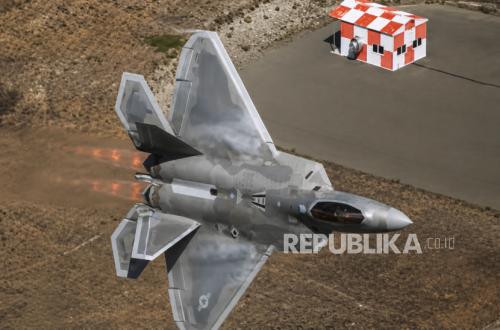
JAKARTA — The United States is preparing a major upgrade to the F-22 Raptor stealth fighter through the development of next-generation sensors, long-range communications systems and aircraft-to-aircraft data-sharing capabilities. The modernisation, being undertaken by Lockheed Martin with the US military, is intended to take the F-22 beyond the standard capabilities of a fifth-generation fighter while maintaining its relevance as air warfare increasingly depends on information networks and unmanned aircraft.
Lockheed Martin chief executive Jim Taiclet disclosed the plan during the company’s third-quarter financial results briefing on 22 October 2026. He said upgrading the F-22 was one of Lockheed Martin’s three main priorities for strengthening US air-combat capabilities, at a cost considered more efficient than building an entire weapons system from scratch.
Defence Industry Europe reported on Wednesday (28 October 2026) that Taiclet was aiming to give the F-22 what is described as “fifth generation plus” capability. The term refers to enhancements to a fifth-generation fighter through new sensor, communications-network and systems-integration technologies, rather than an official reclassification as a sixth-generation fighter.
Taiclet said the programme, being pursued by the advanced development division Skunk Works, includes sensor upgrades, a distributed aperture system for all-round observation, data links and beyond-line-of-sight communications. These capabilities will complement the technologies the F-22 has had since its initial development.
The modernisation is primarily intended to strengthen the F-22’s ability to detect threats, understand the combat situation and share information with other aircraft and military systems. Under this approach, a fighter’s capabilities are determined not only by its speed, agility or weapons, but also by how quickly it can obtain and use information in a joint operation.
Taiclet said the upgrades were part of the company’s strategy to integrate technologies previously developed separately. Lockheed Martin is seeking to draw on sensors, communications equipment and control systems from across its divisions to enhance existing military platforms.
However, Lockheed Martin’s chief executive has not announced a timetable for introducing all the new technologies across the F-22 fleet. Nor has he disclosed the total contract value, detailed performance specifications or a complete list of equipment to be installed under the ongoing modernisation programme.
Why Does the F-22 Raptor Need Modernising?
The F-22 Raptor is a fifth-generation stealth fighter developed by Lockheed Martin in partnership with Boeing for the US Air Force. It was designed primarily to achieve air superiority — the ability to control airspace and engage enemy aircraft in a high-threat combat environment.
The F-22’s main advantages lie in its combination of stealth technology, the ability to fly supersonically without continuously using afterburners (supercruise), manoeuvrability, and integrated sensors and weapons. Together, these features allow it to detect, identify and attack aerial threats while seeking to reduce the likelihood of being detected by adversaries.
But advances in air-weapons technology mean these advantages must be continually updated. Modern radars, long-range air-to-air missiles, electronic warfare systems and integrated air-defence networks require fighter aircraft to have increasingly sophisticated surveillance and communications capabilities.
The F-22 is not a new aircraft. The US Air Force officially began operating it in 2005, and production ended after the final aircraft left the assembly line in December 2011. A total of 187 F-22s were built for the US operational fleet, and there is no active production line for building large numbers of new aircraft.
This makes modernisation one way to preserve the capabilities of the limited F-22 fleet. While the next generation of fighter aircraft remains under development, the F-22’s capabilities must be maintained so it can meet evolving threats and support air operations alongside other aircraft.
The US government has in fact been upgrading the F-22’s capabilities for years. Previous improvements have covered its radar, weapons, software and communications, as well as its ability to withstand increasingly advanced aerial threats.
Taiclet’s remarks, however, point to a broader direction for modernisation. Lockheed Martin is not merely upgrading individual components; it is also seeking to make the F-22 part of an air-combat network able to operate alongside other fighter aircraft and autonomous systems.
New Sensor Worth US$270 Million
One important development in the F-22’s modernisation is the development of a new-generation infrared sensor system. On 22 January 2025, Lockheed Martin announced that it had received a US$270 million contract from the US Air Force to integrate an Infrared Defensive System (IRDS) into the F-22 Raptor.
The system uses TacIRST sensors developed by Lockheed Martin and distributed across the aircraft’s airframe. The technology is designed to improve threat detection through infrared observation, including helping pilots identify the possible approach of enemy missiles.
Infrared sensors have different characteristics from radar. While active radar emits electromagnetic waves and processes their reflections, infrared sensors detect heat radiation from objects, including aircraft engines and other heat sources.
In certain situations, infrared surveillance can provide additional information about threats without relying entirely on active radar. Integrating multiple sensors allows the aircraft’s systems to provide pilots with a more complete picture of the combat situation.
The distributed aperture system Taiclet referred to is related to the approach of placing sensors in several parts of the aircraft to broaden its field of observation. Such technology is expected to reduce the limitations of viewing from a single direction and help pilots detect threats around the aircraft.
Nevertheless, Lockheed Martin has not confirmed that all the technologies Taiclet mentioned on 22 October are identical to the systems covered by the US$270 million IRDS contract. The contract is concrete evidence of ongoing F-22 sensor modernisation, but it should not be treated as the total value of the fifth-generation-plus programme.
The company has also not published operational test results showing how much the new technology improves detection or the F-22’s success in engaging enemy aircraft and missiles. The promised capability improvements therefore need to be distinguished from performance already proven in operations.