
US Political Opposites Unite Over AI Concerns
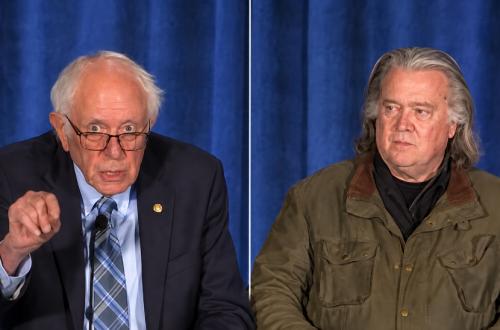
Independent Senator Bernie Sanders and former White House strategist Steve Bannon almost never find themselves on the same political side. Sanders is a leading figure in the United States progressive movement, while Bannon is an influential figure in the Make America Great America (MAGA) movement established by President Donald Trump. However, anxieties regarding the development of artificial intelligence (AI) have brought both to the same stage in Washington.
Sanders and Bannon spoke at the Pro-Human Assembly on Tuesday (15/09/2026), a gathering that brought together members of Congress from both parties, religious leaders, activists, artists, and community groups to discuss the risks of AI development. Both called for stronger oversight of the technology, despite sharply differing views on how such restrictions should be implemented.
Reuters reported on Tuesday, 15 September 2026, that Sanders and Bannon both warned of the risks AI poses to jobs, human safety, and the concentration of power within a handful of technology companies. Reuters described their appearance in the same forum as a rare meeting of two political adversaries united by concerns over AI.
NPR reported on Tuesday, 15 September 2026, that nearly 300 people filled the venue where the event took place. Sanders and Bannon appeared consecutively. However, their commonality ended at the diagnosis of AI risks. When the discussion turned to solutions, their political differences became clearly visible.
One Stage, Two Political Poles
Sanders is an independent senator from Vermont who has for years championed a progressive agenda and criticised economic inequality and the immense power of corporations. Bannon stands at the opposite pole. He previously served as White House strategist during Trump’s first term and remains a significant voice within the MAGA political environment.
The New York Times reported on Tuesday, 15 September 2026, that the consecutive appearances of Sanders and Bannon highlight the growing unease regarding rapidly evolving AI capabilities. The publication noted that concerns about AI are now transcending traditional political divides, even though Washington has yet to reach a consensus on the form national policy should take.
Bannon even acknowledged the political chasm separating him from Sanders. He stated that while they stand on opposite sides on many issues, the matter of AI, in his view, demands a debate that transcends partisanship.
Reuters, on Tuesday, 15 September 2026, quoted Bannon saying that the US must first slow the pace of AI development to understand what is actually happening. He also praised Sanders’ presentation regarding the various risks of the technology.
This meeting, therefore, does not represent the formation of a new political coalition between Sanders and Bannon. There was no announcement regarding legislative cooperation between the two. They met on shared concerns but brought different political prescriptions.
Sanders Seeks to Ban Superintelligent AI
Sanders is taking a far-reaching regulatory stance. Alongside Democratic Representative Greg Casar from Texas, he announced plans for the Ban Artificial Superintelligence Act on Thursday, 3 September 2026.
According to an official announcement from Sanders’ office, the proposal would permanently prohibit the development and deployment of superintelligent AI and temporarily halt the development of advanced AI until federal regulators establish safety rules and model review processes. The proposal also calls for the creation of a new federal agency to oversee AI technology.
In the draft, the category of superintelligent AI is defined as systems that surpass human intelligence or possess capabilities deemed capable of threatening human control and governance. The Sanders-Casar proposal also directs the US to pursue international agreements to prevent the development of such systems in other nations.
NPR reported on Tuesday, 15 September 2026, that Sanders told attendees of the Pro-Human Assembly that the bill would be formally introduced the following week. Thus, while the plan was announced on 3 September, the legislative filing process is expected to follow.
Sanders also highlighted the lack of public involvement in determining the direction of AI development. “Despite living in what is called a democracy, the public has almost no input into the AI revolution that is changing the world,” Sanders said, as reported by NPR on Tuesday, 15 September 2026. He also criticised Congress from both parties, which he believes is responding too slowly to these developments.
Sanders stated that one of his greatest concerns is the potential for large-scale job losses. Reuters, on Tuesday, 15 September 2026, quoted Sanders warning that AI has the potential to eliminate tens of millions of jobs and even erase certain professions.
These statements regarding the consequences serve as Sanders’ warning about the potential trajectory of AI development, rather than an official estimate of the exact number of jobs that will be lost.