
US Military's Request for Access to Indonesian Airspace Causes Uproar: UI Professor's Response
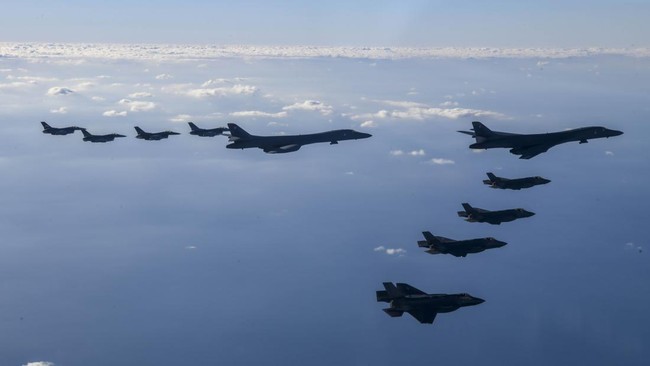
Jakarta, CNBC Indonesia - The United States’ request for military overflight permission in Indonesia must be handled with caution, as it raises concerns about Indonesia’s foreign policy position, which has long upheld the principle of being free and active.
Professor of International Law at the University of Indonesia (UI), Hikmahanto Juwana, revealed that information is currently circulating regarding a request from the US Department of War to the Indonesian Ministry of Defence for blanket overflight clearance, although it has not yet been approved by the Indonesian side.
According to Hikmahanto, blanket overflight clearance is the right of overflight for state aircraft, including military aircraft, to cross the airspace of a country without landing. He explained that under international law, a country’s airspace sovereignty is absolute.
“According to Article 1 of the Chicago Convention, the airspace of a country is complete and exclusive. Thus, every foreign aircraft must obtain permission if it wishes to cross a country’s airspace,” he stated in his comments on Selsaa (14/4/2026).
However, there is an exception for scheduled commercial aircraft regulated under the International Air Service Transit Agreement (IASTA). This agreement allows civil aircraft to cross the airspace of other countries without needing special permission each time they fly, as it has been agreed multilaterally by around 135 countries.
“For scheduled aircraft, there is an international agreement called the International Air Service Transit Agreement (IASTA) which includes agreement to cross the airspace of other countries not for commercial purposes,” he clarified.
Nevertheless, this provision does not apply to state aircraft, including military aircraft or private aircraft. Hikmahanto emphasised that for military aircraft, permission must be granted specifically each time they cross, unless the country being crossed provides prior agreement for a certain period.
“For military aircraft, each time they are to cross, each aircraft must receive approval, unless the country being crossed gives prior approval for a certain period. This is what is called blanket overflight clearance,” he said.
If such permission is granted, the receiving country will provide broad overflight access without distinguishing between aircraft types or flight purposes, as long as it is within the agreed period.
Hikmahanto warned that granting such permission in the current global situation could lead to serious political implications. He assessed that such a step could be seen as Indonesia favouring the US.
Furthermore, he believes Iran could view this policy as indirect support from Indonesia for US military operations. This is considering the possibility that US military aircraft from various bases in the Asia-Pacific region and Australia would need to cross Indonesian airspace to join US forces in the Middle East.
“In the current geopolitical situation, Iran will consider Indonesia as giving space to the US to carry out attacks on Iran,” he said.
He added that Indonesia’s air route could potentially become a strategic path for US military movements towards conflict areas, so decisions regarding overflight permission must be considered carefully.
“Indonesia should not grant blanket overflight clearance to the US,” he concluded.
Previously, the Indonesian Ministry of Defence stated that the currently circulating document is an initial draft still in the internal and inter-agency discussion stage. The document is not a final agreement and does not yet have binding legal force.
The Ministry of Defence emphasised that every discussion of defence cooperation with other countries is always carried out within the framework of prioritising national interests, fully safeguarding the sovereignty of the Unitary Republic of Indonesia, and guided by applicable national and international law provisions.
In connection with this, the Ministry of Defence added, every discourse, proposal, or draft mechanism for cooperation must go through a careful, strict, and multi-layered discussion process before it can be considered further in accordance with applicable mechanisms and authorities, as well as considerations from all related stakeholders.
“The Ministry of Defence of the Republic of Indonesia affirms that authority, control, and supervision over Indonesian airspace are fully under the Indonesian state. Any possible arrangements still guarantee Indonesia’s full authority to approve or reject any activities in national airspace,” the Ministry of Defence said in a written statement on Monday (13/4/2026).
The Ministry of Defence also emphasised that every planned activity must comply with each country’s national law. In the Indonesian context, this means the entire process must follow statutory regulations, institutional mechanisms, and national political decisions. There is no room for unilateral implementation outside Indonesian law.