
US-Iran War Update: Missile Barrage Like 'The Sky Is Falling'
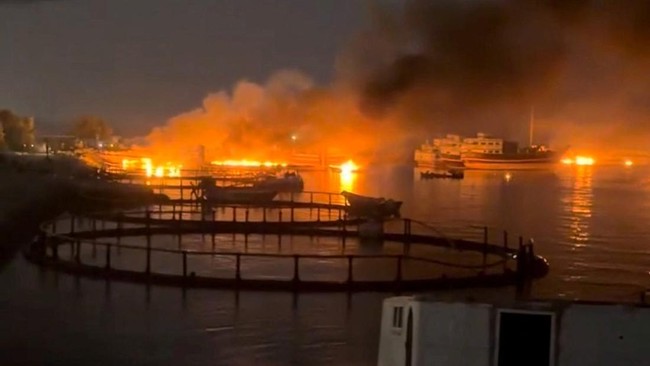
Jakarta, CNBC Indonesia – The conflict between Iran and the United States heated up again after both countries launched attacks throughout Thursday (16/7/2026), marking the biggest escalation since the ceasefire agreed last month began to falter.
According to a Reuters report, the US military announced it had carried out its sixth consecutive attack against Iran with the aim of “further weakening Iran’s military capability”. In the preceding day, Washington launched two major waves of air strikes — for the first time since the ceasefire — mostly targeting Iran’s southern coastal region.
Iran responded by firing missiles and drones at several US military bases in the Middle East, including an airbase in Jordan which, according to Tehran, was used in an attack on a children’s cancer hospital in Iran.
Meanwhile, Trump said on Wednesday that a US citizen detained in Iran had been released as a “gesture of goodwill” from Tehran.
However, the claim was immediately denied by the Iranian authorities. Iran’s judiciary affirmed that no American citizen had been released or exchanged from an Iranian prison, as reported by state media.
On Thursday evening, US strikes again hit Qeshm Island and the area around Bandar Abbas, the location of Iran’s largest port as well as an important base for the Navy and the Revolutionary Guards situated on the Strait of Hormuz. The Mehr news agency reported that several sites in Bandar Abbas were also targeted.
Iranian media also reported attacks on three bridges, a railway station in Bandar Khamir, and Iranshahr Airport in south-eastern Iran. However, Reuters said it could not independently verify those reports.
The latest escalation has also disrupted shipping traffic through the Strait of Hormuz, a strategic waterway and one of the world’s main routes for oil and gas trade. Iran has again tightened its blockade of the area, whilst the US renewed its blockade of Iranian ports.
Tehran is also said to have signalled that it could ask the Houthi group in Yemen to close the Bab al-Mandeb Strait should Washington continue attacking Iranian infrastructure.
In response to the situation, White House Press Secretary Karoline Leavitt stressed that President Trump would not sit idly by in the face of threats to international shipping lanes.
“The President is not going to sit back and allow this active terrorism to take place in the strait without making sure Iran faces consequences,” she said. Nevertheless, Leavitt added that Trump “is always open to diplomacy at the same time”.
Meanwhile, Iranian military spokesperson Brigadier General Mohammad Akraminia affirmed that US air strikes would not be able to cripple Iran’s control over the Strait of Hormuz. According to him, Iran retains the capability to attack the strategic shipping route from various points within its territory.
Alex Vatanka, an analyst at the Middle East Institute, assessed that the two countries are now “back to square one” and will be confronted with a choice between de-escalating the conflict or taking it to a higher level.