
US-Iran War in the Middle East Gives China a "Sigh of Relief", How So?
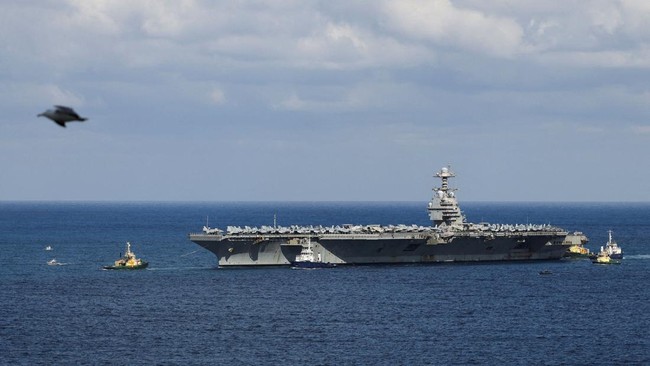
Jakarta, CNBC Indonesia - The United States’ defence strategy is now at a critical juncture following renewed military involvement in the Middle East, which is draining resources that should be allocated to countering China’s power in the Asia-Pacific. Although it once promised a shift in focus to Asia, the outbreak of conflict with Iran has instead forced Washington to withdraw vital assets from the Far East.
The demands of the Iranian war have also caused President Donald Trump to postpone his highly anticipated official visit to China by several weeks. This has deepened concerns that the US is once again diverting its focus at the expense of strategic interests in Asia, where Beijing continues to seek to displace the US as the regional leader.
Sceptics of US involvement in the Middle East argue that the war is hindering Trump from adequately preparing for next month’s summit with Chinese leader Xi Jinping, at a time when economic interests are at stake.
They warn that failing to focus on Asia and maintain strong deterrence could lead to greater instability if China believes the time has come to seize Taiwan island.
“This is a very inopportune time for the United States to turn away and get sucked into another difficult-to-resolve Middle East conflict,” Danny Russel, a researcher at the Asia Society Policy Institute, told The Associated Press on Monday (13/4/2026).
“Rebalancing focus to Asia is highly relevant to US national interests, but it has been undermined by many poor decisions.”
On the other hand, some defend the president’s approach, arguing that his firm actions elsewhere, including in Venezuela and Iran, serve to counter China’s global influence.
“Beijing is the main sponsor of the enemies that President Trump is facing in sequence, and it is wise to address them one by one,” said Matt Pottinger, who served as deputy national security adviser in Trump’s first administration, in a recent podcast.
NATO Secretary General Mark Rutte also stated that the conflict may not be limited to one region alone. He suggested that China could call on its “junior partners” elsewhere to divert US attention if they move against Taiwan.
“It is likely that the conflict will not be contained; something happening in the Indo-Pacific does not stay in the Indo-Pacific,” Rutte said while speaking at the Ronald Reagan Institute in Washington. “This will be a multi-theatre issue.”
Impact of the Iranian War on Asia
Senator Jeanne Shaheen, a senior Democrat on the Senate Foreign Relations Committee, recently led a bipartisan delegation to Taiwan, Japan, and South Korea. There, they heard concerns about the war’s impact on energy costs and the withdrawal of US military assets, including missile defence systems from South Korea and rapid-reaction Marine units from Japan.
Shaheen sought to reassure them of the US commitment to deterring conflict in Asia and strengthening regional stability.
“Failure is not an option,” Shaheen told The Associated Press after returning from Asia. “We know China has said they intend to take Taiwan by force if necessary, and they are on an accelerated schedule. We also know that what is happening in Europe with the war in Ukraine, and in the Middle East, affects those calculations.”
Kurt Campbell, who serves as deputy secretary of state in the Biden administration, admitted concerns that the military capabilities painstakingly built up by the US in the Indo-Pacific may not fully return even after the Iranian war ends.
Zack Cooper, a senior researcher at the American Enterprise Institute, assessed that the longer the conflict drags on, the more resources and focus are drained from Asia. He added that future arms sales to the region will also be negatively impacted.
“The United States has expended a large amount of ammunition in the Middle East and must sustain an increased troop presence there, some of which has been diverted from Asia,” Cooper said. “Meanwhile, Xi Jinping’s wisdom in preparing a ‘war economy’ by stockpiling and adding alternative energy sources is proving fruitful.”
Shaheen added that the US defence industry will struggle to meet demands to replenish weapons stockpiles.
“We are pursuing a number of strategies to fix this, but at this point, weapons delivery timelines continue to slip,” she said. Nevertheless, the senator from New Hampshire felt encouraged that Taiwan, Japan, and South Korea are beginning to bolster their own defences.
The “Pivot to Asia” That Never Materialises
The rebalancing strategy to Asia initially reflected an understanding that the US must be a player in the Pacific to capitalise on the region’s growth and ensure sustained US leadership in the face of China’s rising influence.
“After a decade in which we waged two costly wars with blood and treasure, the United States is turning our attention to the vast potential of the Asia-Pacific region,” a previous president said in a speech to the Australian Parliament some years ago. “So make no mistake, the tide of war is receding, and America is looking forward to the future that we must shape.”
However, the strategy was setback when the Trans-Pacific Partnership (TPP) trade agreement failed to gain US Senate approval. After Trump took office in 2017, he withdrew the US from the partnership and launched a tariff war with China. His successor, Joe Biden, maintained those tariffs and tightened controls on exports of advanced technology while attempting to
Source: jawawa.id (https://jawawa.id/newsitem/us-iran-war-in-the-middle-east-gives-china-a-sigh-of-relief-how-so-1776095490)
Originally published by CNBC Indonesia (https://www.cnbcindonesia.com/news/20260413123522-4-726265/perang-as-iran-di-timur-tengah-bikin-china-bernapas-lega-kok-bisa), translated from Indonesian