
US-Iran War Heats Up: Gulf Becomes 'Hell', Hormuz Closed Again
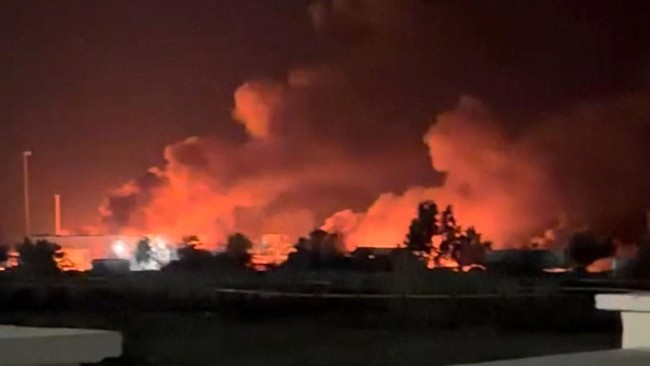
The war between the United States (US) and Iran has heated up again after both countries launched large-scale missile and drone attacks on Sunday (12/7/2026). Tehran expanded its strikes to several US military facilities in the Gulf region, while also declaring the closure of the Strait of Hormuz, the strategic shipping lane that is the lifeblood of global energy trade.
The latest wave of attacks marks the most serious escalation in the series of tit-for-tat actions between Washington and Tehran. Iran continues to assert its control over shipping in the Strait of Hormuz, while the US military ramps up operations to maintain freedom of navigation in the region.
This time, Iran’s attacks also reached Qatar, a country that has been acting as a mediator for ceasefire talks and had not been targeted since April. Meanwhile, the United Arab Emirates (UAE), which was last attacked in early May, said its air defence systems successfully intercepted missiles and drones launched by Iran.
US Central Command (CENTCOM) stated its forces launched further strikes against Iran starting at 5:00 p.m. US East Coast time on Sunday. The operation was conducted “to continue to degrade Iran’s ability to attack civilian mariners and merchant vessels transiting freely through the Strait of Hormuz,” according to a CENTCOM statement on the social media platform X. US President Donald Trump also confirmed that military operations against Iran are ongoing. “We’re hitting them hard,” Trump said in a brief telephone interview with Reuters on Sunday afternoon.
Bandar Abbas Rocked by Explosions
Iranian media reported missile strikes and several explosions around the port of Bandar Abbas, the location of Iran’s main military facilities on the Strait of Hormuz, including the nearby Qeshm Island. The increasing violence further diminishes the chances of success for a temporary agreement between the US and Iran signed last month. That deal was originally designed to reopen the Strait of Hormuz and end the war through further negotiations over 60 days. In the past week, Trump has even stated that he considers the ceasefire to be over, although he remains open to further talks.
The war, which began with joint US and Israeli airstrikes against Iran on 28 February, has shaken the stability of the Gulf region. Iran has repeatedly attacked countries hosting US military bases, while Tehran’s effective blockade of the Strait of Hormuz has driven a surge in global energy prices and exacerbated global inflationary pressures. Rising energy prices, especially for petrol, are also seen as a politically sensitive issue for Trump ahead of the US Congressional elections in November.
Iran Tightens Control of the Strait of Hormuz
Iran had previously sought to establish a permanent system to levy fees on ships transiting the Strait of Hormuz. Before the war broke out, the waterway handled about one-fifth of the world’s oil and liquefied natural gas (LNG) shipments. Tehran also warned all ships not to transit the strait without obtaining permission from the Iranian government. On Saturday night, Iran announced the closure of the shipping lane after firing warning shots that struck a vessel it claimed was transiting the route without permission. A day later, Iran claimed to have disabled a second ship.
Meanwhile, India reported that one of its citizens was missing after the container ship GFS Galaxy was attacked off the coast of Oman. The Omani government said 23 crew members were successfully rescued. Qatar subsequently urged all vessels, including recreational boats, fishing boats, and jet skis, to cease all maritime activities.
The newly formed Persian Gulf Strait Authority declared on Sunday that traffic through the Strait of Hormuz is currently not possible. According to the agency, the condition is due to “the latest illegal movements of United States military forces in the region.” The authority stated that transit permits would be reissued “as soon as stability and calm are restored.”
US: Iran Does Not Control the Strait of Hormuz
On the other hand, the US government asserted that its forces remain in the region to guarantee international freedom of navigation. Washington, which on Tuesday revoked permits for Iranian crude oil sales in response to previous attacks on commercial ships, described Iran’s actions as “aggression, intimidation, threats, and unilateral declarations.” The US government also denied Iran’s claim of full control over the Strait of Hormuz. “Iran does not control the strait. Shipping traffic continues,” the US government stressed.
The US Navy-led Joint Maritime Information Center reiterated that although the security threat remains very high, an alternative shipping lane in the southern part near Oman can still be used for two-way traffic. On Saturday, CENTCOM said the US military struck 140 Iranian military targets. In total, more than 300 targets have been attacked over the last three nights. According to CENTCOM, the operations were carried out “to degrade Iran’s ability to attack civilian mariners and commercial vessels transiting the strait freely.” Meanwhile, Iranian state media reported explosions in several port cities and said an Iranian military officer was killed.
Iran Retaliates by Attacking US Bases
In retaliation, Iran’s Islamic Revolutionary Guard Corps (IRGC) claimed to have destroyed a command and control centre and drone hangar in Jordan, a US ally. Iran also claimed to have struck a US-owned radar site and rocket launch systems in Kuwait, as well as aircraft carrier support facilities and a US military refuelling centre in Oman. Additionally, Tehran claimed to have…