
US-Iran War Becomes China's "Laboratory", Beijing Prepares to Reap Benefits
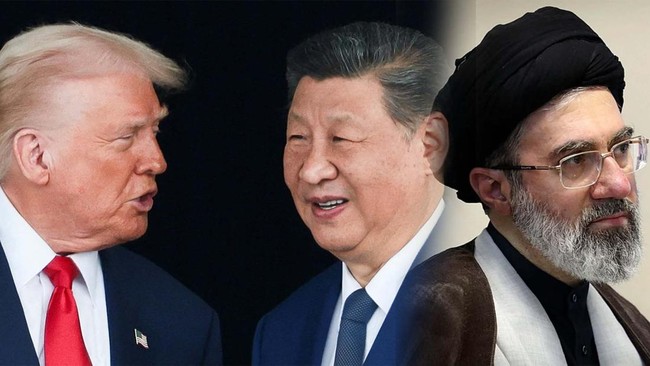
The Iran war, now entering its third month, is increasingly viewed not merely as a Middle Eastern conflict but as a major military “laboratory” under serious scrutiny by China. From Iran’s cheap drone attacks penetrating US air defences to Washington’s use of advanced precision weapons, the conflict provides Beijing with a tangible view of how US military capabilities perform under the pressures of modern warfare.
Analysts in China, Taiwan, and other countries assess that the battles around the Persian Gulf over the past two months could offer crucial clues about potential future conflicts between Beijing and Washington, especially concerning Taiwan. However, they also warn that China risks misjudging its own strengths if it focuses solely on technological successes without understanding the true dynamics of war.
Citing analysis from CNN Indonesia, the Iran conflict also highlights that in modern warfare, opponents always possess adaptive capabilities that can alter the course of the battle. Combat experience, logistical resilience, and the ability to sustain prolonged warfare are said to be just as important as weapon sophistication.
Fu Qianshao, a former colonel in the Chinese Air Force, stated that one of the biggest lessons from the Iran war is the importance of strengthening domestic defences. He assessed that Iran succeeded in finding gaps in US air defence systems such as Patriot and Terminal High-Altitude Area Defense (THAAD).
“We need to devote significant efforts to identifying weaknesses on our defensive side to ensure we remain invincible in future wars,” Fu said, as reported on Monday (11/5/2026).
In recent years, the People’s Liberation Army (PLA) has indeed rapidly developed its offensive capabilities. China has added hypersonic missiles capable of evading interceptors and strengthened its launch platforms.
The PLA Air Force is also accelerating production of the fifth-generation stealth fighter jet J-20, said to be comparable to the US F-35. The British think tank RUSI estimates that China will eventually have around 1,000 J-20 units for long-range precision strike missions.
Additionally, Beijing is developing long-range stealth bombers similar to the US B-2 or B-21.
However, according to analysts, China’s defensive capabilities remain a major question mark.
Iran, with relatively simple technology like cheap Shahed drones and low-cost ballistic missiles, is said to have penetrated US air defences in the Persian Gulf.
On the other hand, the US has launched an air campaign using a combination of advanced weaponry such as the F-35 and B-2 alongside cheaper guided munitions from the B-1, B-52, and F-15. Those strikes have destroyed various targets, from missile launchers and warships to bridges.
Fu assessed that such combinations of attacks should be a serious concern for Beijing.
“We must dig deeper to effectively protect our key locations, airfields, and ports from strikes and raids,” he said.
The Taiwan issue has also become a primary focus in lessons from the Iran war. Taiwan has long been seen as the most potential flashpoint between the US and China.
The Chinese Communist Party has repeatedly affirmed its determination to achieve “reunification” with Taiwan, even though Beijing has never controlled the island. President Xi Jinping has also not ruled out the use of military force.
In Taiwan, analysts assess that China now possesses a combination of high-tech precision warfare capabilities like those of the US and large-scale cheap drone warfare like Iran’s.
“Long-range rockets and swarms of drones will certainly play a key role in China’s joint military operations against Taiwan,” said Chieh Chung from Taiwan’s Institute for National Defense and Security Research.
Nevertheless, questions arise as to whether such forces are sufficient to win a cross-strait war over Taiwan.
China is currently the world’s largest producer of drones. Analysts note that China’s unmanned weapon system production capacity is enormous.
A 2025 report from the War on the Rocks analysis platform even states that Chinese civilian manufacturers could switch to producing up to one billion armed drones per year in less than a year.
“Chinese civilian manufacturers have the capacity to retool in less than a year to produce one billion armed drones annually,” the report states.
Some parties warn that Taiwan is not yet prepared to face attacks from drones on such a scale.
A recent report from a Taiwanese government oversight body states that Taiwan’s current military anti-drone systems are “ineffective” and pose a “major security risk” to critical infrastructure and military bases.
Nevertheless, Taiwan is beginning to enhance its readiness. Gene Su, executive director of Taiwan’s major drone manufacturer Thunder Tiger, has called for increased investment in mass drone production.
“We need to produce continuously, day and night, to counter our enemies,” he said.
The United States is also said to be learning from the Iran war. In a potential Pacific conflict, Washington is likely to focus more on defence than offence.
US Indo-Pacific Command Commander Admiral Samuel Paparo previously stated that drones make war far more expensive for the attacking side.
If a Taiwan conflict occurs, the US or Taiwan could use drones to attack Chinese ships and aircraft carrying hundreds of thousands of PLA troops across the Taiwan Strait.
The cost of those ships and aircraft is far higher than the drones that could destroy them. That factor is said to create a deterrent effect also seen in the Iran war.
The US, for example, has been very cautious about sending warships into the Strait of Hormuz.