
US Invasion Scenario Debated: Could Trump Seize This Iranian Island?
Jakarta, CNBC Indonesia – United States (US) strikes on several of Iran’s strategic islands have sparked fresh speculation that Washington does not merely seek to cripple Tehran’s military capabilities, but may also potentially seize Iranian territory. Although the US is judged to have the military capability to do so, analysts warn such a move could instead drag America into a far larger and more costly ground war.
In recent days, US forces have bombarded the islands of Qeshm, Kish and Abu Musa, as well as several port cities on Iran’s southern coast, including Bandar Abbas. These attacks have revived a question circulating since the start of the US-Israel war against Iran: is Washington preparing an operation to seize Iranian territory?
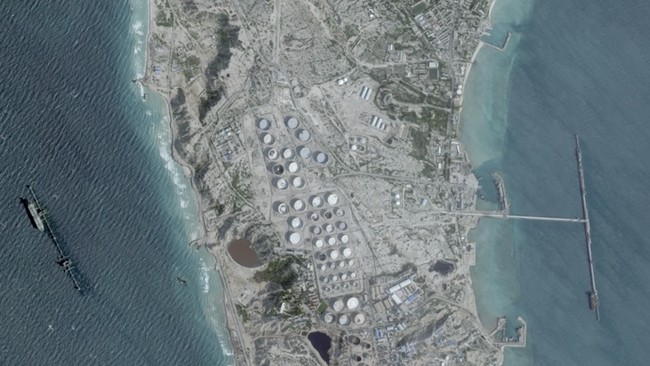
In March, roughly a month after the war broke out, two unnamed US officials told The Washington Post that the US Department of Defense was preparing an operation against Kharg Island, which handles around 90% of Iran’s crude oil exports. The statement briefly fuelled speculation about a possible ground operation.
That speculation subsided after both sides signed a memorandum of understanding (MoU) on 17 June. However, the issue resurfaced after US President Donald Trump refused to rule out such an operation in an interview with Fox News on Monday.
“I can’t tell you that, because if I did, it would be a foolish thing to do,” Trump said when asked about the possibility of such an operation, quoted from an Al Jazeera analysis released on Thursday (16/7/2026).
Trump’s remarks have raised the question of whether the threat is mere political rhetoric or genuinely a military option for Washington.
US Judged Capable of Seizing Iranian Islands
Andreas Krieg, an associate professor of security studies at King’s College London, said the US does, tactically speaking, have the capability to seize Iran’s islands.
In an interview with Al Jazeera, Krieg said that with adequate air, naval and amphibious support, together with a readiness to face subsequent escalation, the US could take control of a small Iranian island.
The US is currently estimated to have around 50,000 military personnel stationed in the Middle East, both at permanent bases and smaller military outposts across the region.
Similarly, Nader Hashemi, a professor of Middle East politics at Georgetown University, said the US is not only capable of seizing Iran’s islands but could also logistically occupy them, as it remains the world’s largest military power.
According to Hashemi, however, the main issue is not capability but the cost that would have to be borne.
Krieg also stressed that seizing an island is very different from holding it.
“Seizing an island temporarily is very different from holding it, supplying it logistically, and deriving strategic benefit from it,” he said.
He judged Qeshm Island to be the most difficult target because of its very large size and its location directly attached to the Iranian mainland, rather than being a remote island.
Smaller islands such as Hengam would be easier to seize, but would remain within range of Iranian artillery, drones, missiles and fast-boat attacks.
According to Krieg, if the US attempted to seize several islands at once, the operation would no longer be a limited strike but would have become a large-scale amphibious campaign.
Thousands of Troops Needed
Krieg estimated that even a limited operation would require at least 5,000 to 10,000 military personnel.
“A limited operation would likely require an initial force of at least 5,000 to 10,000 personnel, once you count combat troops, air defence, engineers, logistics, medical staff and command elements,” he said.
That figure could rise sharply if several islands were targeted, or if the operation’s aims went beyond simply seizing territory in the initial phase.
According to him, all of those forces would be within direct firing range from the Iranian mainland.
“Logistics ships, landing craft and helicopters would have to cross waters exposed to missiles, drones, mines and artillery,” Krieg said.
He added that Iran would not need to rush to retake islands occupied by the US.
“Iran doesn’t need to immediately take those islands back. They simply need to turn them into a costly and politically embarrassing American position through continuous attacks,” he said.
According to Krieg, the US is indeed capable of supplying such forces, but it would have to maintain maritime protection, air superiority and continuous suppression of Iran’s weapons systems.
“The supply-protection mission would become the main mission. What began as an operation to protect shipping could quickly turn into an open-ended territorial occupation commitment,” he said.
Difficult to End the Hormuz Threat
Krieg also assessed that seizing Iran’s islands would not automatically end the threat to the Strait of Hormuz.
He explained that Iran could still launch missiles and drones from the mainland, so the threat to international shipping would remain.
To truly eliminate Iran’s ability to disrupt traffic through the Strait of Hormuz, the US would have to destroy Iran’s defensive systems along the southern coast, and potentially occupy parts of the country’s coastal territory.
“At that point, it would no longer be just about seizing islands. It would be the beginning of a much larger ground war,” Krieg said.
Hashemi considered such a scenario highly unlikely.
According to him, an operation of that kind would require a far more intense bombing campaign than the strikes seen so far.
“All of this remains at the level of theory, not a realistic possibility,” Hashemi said.
Major Risks for the World
Analysts warn that if the US genuinely seized Iran’s islands, Tehran would likely regard it as a major escalation.
Krieg said Iran would almost certainly increase mine-laying in the Strait of Hormuz and step up attacks on merchant vessels, US military bases in the region, and the energy infrastructure of Gulf states.
According to him, shipping companies would likely continue to avoid the Strait of Hormuz regardless of who controlled the islands. Ship insurance premiums are expected to soar, whilst mine clearance would take considerable time.
Such a move would also risk damaging US relations with Gulf states, which want the Strait of Hormuz reopened but do not want their territory turned into a base for military operations or a target of Iranian attacks.
Krieg concluded that although seizing Iran’s islands could deliver a symbolic military victory, the move would risk transforming a conflict about freedom of navigation into a war of territorial conquest, dragging Washington into the very ground-war commitment it has so far sought to avoid.