
US Imposes High Tariffs on Indonesian Solar Panels; MEMR Responds
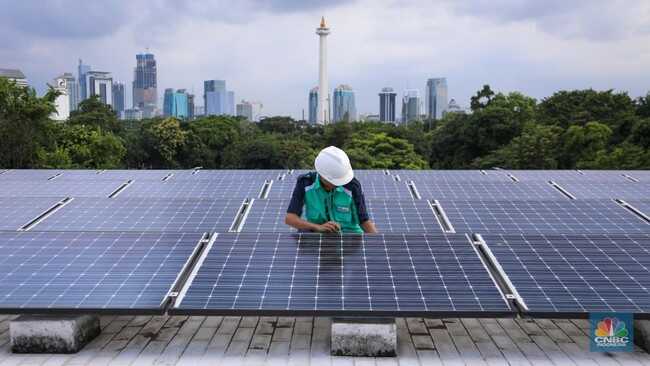
Jakarta - The Ministry of Energy and Mineral Resources (MEMR) has responded to the imposition of high import tariffs by the United States on solar panel products manufactured in Indonesia.
Deputy Minister of MEMR Yuliot Tanjung disclosed that the ministry has conducted preliminary inspections of the products subject to the elevated tariffs.
According to him, products subject to tariffs outside the provisions of the Agreement on Reciprocal Trade (ART) are suspected to be trans-shipped products or merely relabelled in Indonesia, rather than the result of full-scale manufacturing domestically.
“I have also conducted inspections on products subject to tariffs that do not comply with the ART. It turns out that these are merely trans-shipments, relabelling in Indonesia,” stated Yuliot at the MEMR office in Jakarta on Friday (27 February 2026).
For this reason, Yuliot stated that the MEMR, through the Directorate General of New and Renewable Energy and Energy Conservation (EBTKE), would conduct a further investigation of the entire national solar panel industry.
At minimum, the ministry would clearly differentiate between products that undergo only relabelling or trans-shipment processes and products manufactured through domestic manufacturing processes.
“This is precisely what we are fighting for in accordance with the tariffs stipulated in the ART. If it is indeed 15%, then the maximum is 15%. Not more than 15%,” he said.
As is known, following the signing of the Agreement on Reciprocal Trade (ART) between Indonesia and the United States on Thursday, 19 February 2026, US President Donald Trump suddenly struck a blow to the solar panel industry in the country.
Trump imposed countervailing duties of 104.38% on solar cells and panels imported from Indonesia. Trump’s policy was also applied to similar products from India and Laos.
Beyond this, the US Department of Commerce (DOC) imposed individual tariffs on several Indonesian companies, with PT Blue Sky Solar facing 143.3% and PT REC Solar Energy facing 85.99%.
The reason cited for imposing these tariffs is to support similar factories in the US, and to assert that solar panel companies in Indonesia, India, and Laos have received government subsidies, resulting in products from similar industries in the US becoming uncompetitive.
The reasoning used by the US appears to be a decisive blow to Indonesia. How could it not be? With the ART agreement already signed, Indonesia must provide maximum special treatment of US goods entering the domestic market.
In addition to 99% of US products enjoying tariff elimination and accessing a market of 280 million Indonesians, they would also pass freely without having to comply with Indonesian technical regulations. And even if there are technical regulations, they must adhere to US standards.