
US Grapples with Debt, Trump's 'Right-Hand Man' Must Battle the World
The United States government is attempting to curb rising bond yields that are increasingly burdening state finances. However, the move raises questions over whether Washington is resolving its debt problem or merely delaying market pressure.
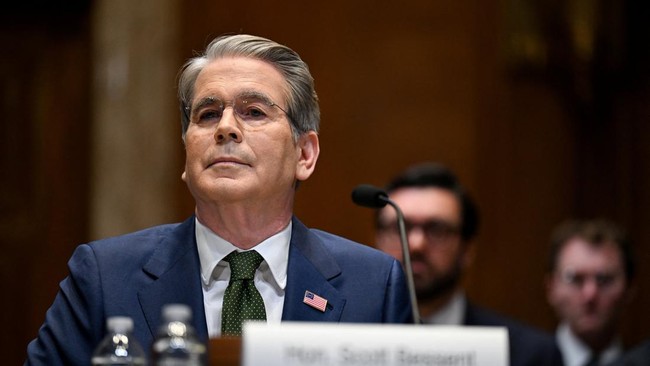
US Treasury Secretary Scott Bessent announced on Wednesday (19/8/2026) that the government will expand buybacks of long-term bonds. The purchase limit has been raised from a previous maximum of US$2 billion to at least US$4 billion for each operation.
Bessent has become one of the busiest and most scrutinised figures following the surge in US Treasury yields. The trusted confidant of Trump is the cornerstone of Donald Trump’s administration in addressing the yield spike.
The programme will only take effect on 9 September and run until 4 November 2026.
At a press conference on Monday (24/8/2026), Bessent stressed that the government will continue to hold bond auctions on schedule.
“We have not bought a single bond,” Bessent said. He noted that the next operation would only be carried out on 9 September.
Although the programme has not yet been implemented, its announcement briefly pushed US bond yields lower. The decline did not last long as yields rose again after the market judged that the bond purchase plan does not address fundamental problems such as the large budget deficit, high debt issuance needs, and inflation risk.
Upward pressure on yields is not confined to the US. Several developed countries are facing similar conditions due to inflation, high financing needs, and ever-expanding government debt.
US Debt Surpasses US$40 Trillion
According to The Economist, the yield on 10-year US government bonds has risen by about 0.6 percentage points this year. Increases have also occurred in German government bonds, up 0.4 percentage points, and Japanese bonds, up around 0.8 percentage points.
The rise comes as the world still faces inflation that has not been fully brought under control.
Wars involving the US, Israel, and Iran have helped push up oil prices, adding renewed pressure on the prices of goods and services.
At the same time, the construction of data centres to support the development of artificial intelligence requires enormous financing. Rising demand for funds has intensified competition for capital, including for governments issuing bonds.
However, the most worrying issue for the market is the state of US government finances.
The budget deficit of Uncle Sam stands at around 6% of gross domestic product. Meanwhile, the US Treasury has stated that federal government debt has exceeded US$40 trillion, or about 120% of GDP.
The Congressional Budget Office estimates that the US deficit and debt will continue to grow in the coming years.
The problem is that rising debt also increases the interest payment burden. More than half of the US budget deficit is now linked to interest payments on previous borrowing.
This situation could create a cycle that is difficult to stop. When yields rise, government borrowing costs increase. The larger interest burden then widens the deficit and forces the government to issue more debt.
Bessent Buys Back Bonds, But Debt Does Not Fall
To ease the pressure, US Treasury Secretary Scott Bessent plans to buy back long-term government bonds. The purchases are expected to boost demand for bonds so that prices rise and yields fall.
Bond prices and yields move in opposite directions. When bond prices rise, yields tend to fall.
However, the US government is not using genuinely new funds to reduce its debt. The buyback of long-term bonds will be financed through the issuance of shorter-tenor bonds.
As a result, the total amount of government debt does not decrease. Washington is merely changing the composition of its debt from long-term to shorter maturities.
The strategy may help ease pressure on long-term bonds for a limited time. But greater reliance on short-term debt also means the government must seek new financing more frequently when those bonds mature.
Bessent said the current rise in yields does not fully reflect the underlying fundamentals of the US economy.
“We believe those yields do not reflect the underlying fundamentals,” Bessent said in a television interview after announcing the buyback programme, as quoted by The Economist.
However, the market does not appear to fully agree. After briefly falling, bond yields moved back towards their pre-announcement levels.
Political Pressure Ahead of Elections
The rise in bond yields is also a political problem for President Donald Trump’s administration.
Midterm elections are drawing closer, while the cost of living remains a major concern for the American public. Two of the most visible expenses are fuel prices and mortgage interest rates.
Rising oil prices have made petrol more expensive. Meanwhile, high long-term bond yields have helped push up 30-year mortgage rates.
When mortgage rates rise, monthly payments become more expensive and people’s ability to buy homes is squeezed.
Under these conditions, efforts to lower bond yields could help ease pressure on mortgage rates. However, the impact depends heavily on whether the market believes the government can control inflation and improve its budget position.
The bond buyback programme is also not the only measure linked to the issue.