
US Expert Says Small Modular Reactors Suitable for Indonesia
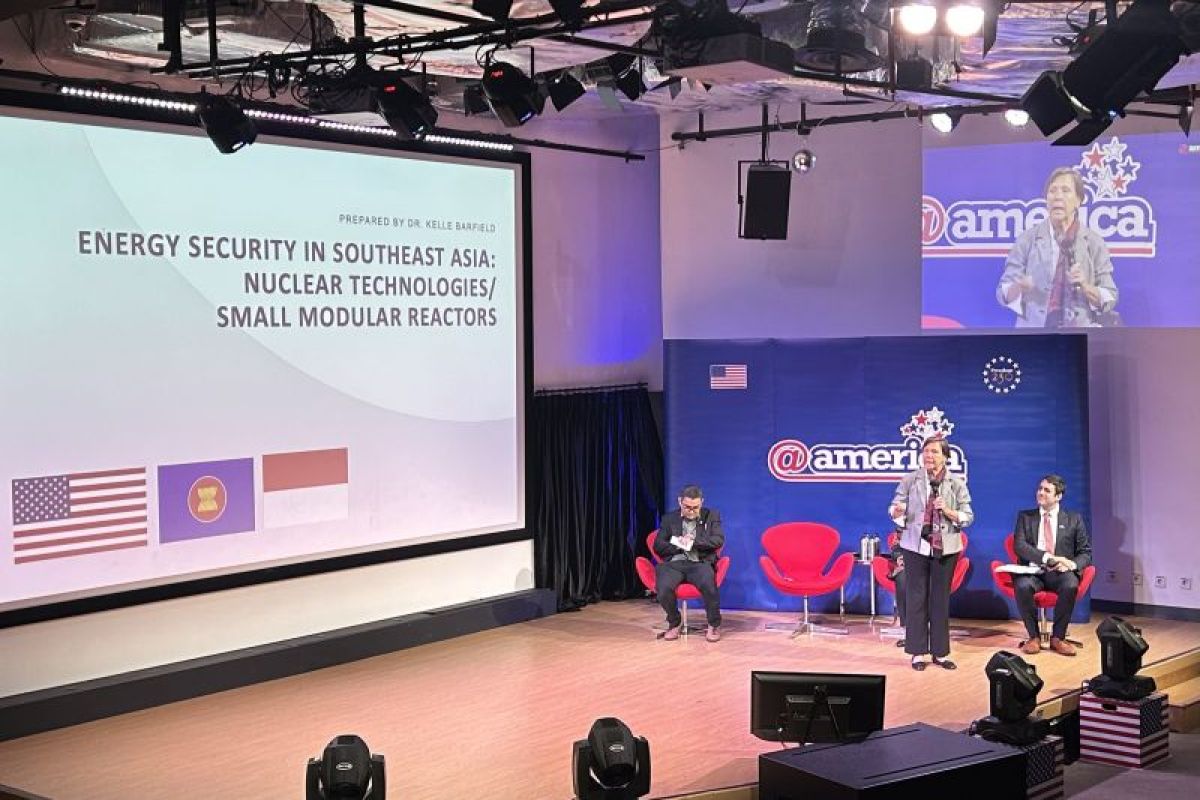
Jakarta (ANTARA) - US Nuclear Stakeholder Engagement Consultant, Kelle Barfield, believes that Small Modular Reactor (SMR) technology has the potential to be a solution for supporting nuclear energy security in Indonesia, which possesses a vast territory consisting of thousands of islands.
Speaking during the “American Leadership in Clean Nuclear Strategy” panel discussion at @america Jakarta on Tuesday, Barfield noted that Indonesia’s challenge is not merely producing electricity, but also ensuring that energy supplies can reach communities across various archipelagic regions.
“Because of their smaller size, SMRs can be placed in more remote areas or in locations with high energy demands, such as mining regions. Thus, SMRs can support electricity needs across various Indonesian regions more easily and flexibly,” he said.
In addition to placement flexibility, SMRs are also considered to have shorter construction times compared to large-capacity nuclear power plants. This condition is believed to accelerate the provision of electricity for regions requiring additional energy supplies.
Barfield referenced the BWRX-300 nuclear reactor project in Darlington, Canada, which is currently under construction. According to him, the project aims to begin operations approximately three years after construction commences.
Furthermore, the expert, who is involved in capacity building through the International Atomic Energy Agency (IAEA), stated that the United States continues to support the development of Indonesia’s nuclear capacity through various cooperation programmes, including technical assistance in technology selection, human resource development, and infrastructure readiness studies.
According to Barfield, this support is provided through the Foundational Infrastructure for Responsible Use of Small Modular Reactor Technology (FIRST) programme, which helps partner nations determine the type of SMR technology most suitable for their national needs.
“The United States has several programmes that can support Indonesia. One of them is the FIRST programme, which focuses on building foundational infrastructure for the safe and responsible use of SMR technology,” he said.
Furthermore, he assessed that cooperation between Indonesia and the United States in the nuclear sector has the potential to grow alongside the increasing interest in SMR technology as a low-emission electricity source to support economic growth and energy security.
Barfield added that workforce development and education are crucial aspects in preparing for nuclear programmes. According to him, student exchanges, training programmes, and university cooperation can help prepare the human resources required should Indonesia develop SMR-based nuclear power plants in the future.
Also present at the event, a member of the National Energy Council (DEN), Sripeni Inten Cahyani, stated that the DEN is considering the use of SMR technology because it is more suitable for Indonesia’s geographical conditions, particularly for remote areas.
Although the investment cost for SMRs is relatively higher, Inten assessed that the technology remains more efficient than using oil-based power plants, such as High Speed Diesel (HSD). However, she acknowledged that SMR technology is still in the development stage in various countries.
Meanwhile, Indonesia tends to only adopt technologies that are proven and commercially available to minimise governance and operational risks.