
US Economy vs Europe: Who Has Prevailed Over the Decade?
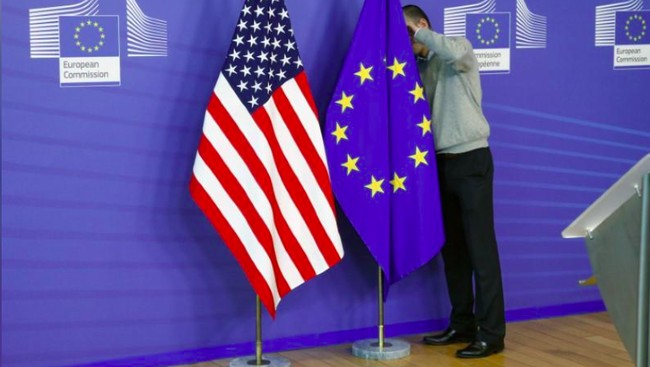
The United States and the European Union are the two largest Western economies of the 21st century. However, over the last two decades, their economic trajectories have diverged significantly.
The 15-member European Union was established in 1993 from predecessor organisations such as the European Community. In 2004, 10 new member states joined, followed by Bulgaria and Romania in 2007.
With the help of these new member additions, along with the strong economies of the United Kingdom and Germany, the EU’s total gross domestic product (GDP) reached US$19.3 trillion in 2008. This figure represented 131% of the US economy that year, which stood at US$14.8 trillion.
The global financial crisis and the ensuing Great Recession changed the EU’s fortunes. The newly expanded bloc faced severe challenges as several member state governments struggled to pay their debts or control large structural deficits. These countries included eurozone members Cyprus, Greece, Italy, Ireland, Portugal, and Spain.
Through a combination of multilateral financial assistance and austerity measures, the EU weathered the crisis. However, in the following years, the aggregate GDP of the 28-member bloc contracted, and the US economy, valued at US$18.3 trillion, surpassed it in 2015. Part of the decline in dollar-denominated GDP also reflected exchange rate shifts as the euro weakened against the US dollar.
The next challenge soon emerged. In a June 2016 referendum, UK voters narrowly chose for the United Kingdom to become the first country to withdraw from the European Union. The process, termed British Exit or Brexit, culminated in the UK’s formal withdrawal in January 2020.
Losing the United Kingdom dealt another blow to the EU’s aggregate economy. Although the country never joined the eurozone, the UK was the bloc’s second-largest member state economy. Combined with the Covid-19 pandemic, Brexit helped push the bloc’s GDP down to US$15.5 trillion in 2020, roughly the same position as a decade earlier.
As the UK economy has struggled throughout much of the 2020s, some in London have begun to raise the possibility of rejoining the EU. Other European countries, including Albania and Montenegro, remain candidates for future membership in the bloc.
Since the pandemic, the US and the EU have followed very different paths. Despite inflation and high interest rates, the US economy recovered robustly from the impact of Covid-19 and is projected to reach US$32.4 trillion by 2026.
Meanwhile, the EU has faced a combination of rising Chinese industrial competition and an energy crisis stemming from Russia’s 2022 war on Ukraine. With economic powerhouse Germany facing prolonged stagnation, the EU’s GDP is projected to reach only US$23 trillion by 2026. This would make the EU economy just 71% the size of the US economy, a sharp reversal from its position in 2008. Currency exchange rates are one cause of this shift, but weaker growth and a series of economic shocks have also contributed to the widening gap.
Source: jawawa.id (https://jawawa.id/newsitem/us-economy-vs-europe-who-has-prevailed-over-the-decade-1786254669)
Originally published by CNBC Indonesia (https://www.cnbcindonesia.com/research/20260809102612-128-757703/ekonomi-amerika-serikat-vs-eropa-siapa-yang-paling-unggul-1-dekade), translated from Indonesian