
US Dominant in Hormuz, but Western Pacific Now Without an Aircraft Carrier
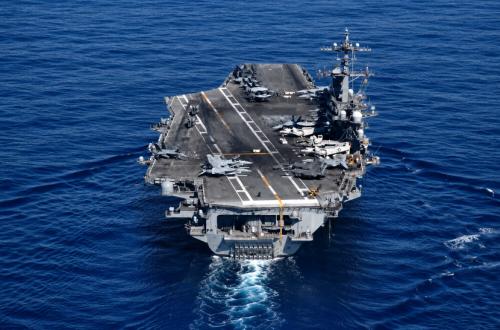
The United States’ war against Iran is beginning to produce strategic consequences far from the Strait of Hormuz. Thousands of kilometres from the battlefield, Washington has had to move one of its most important military assets from Asia at a time when China is increasing its activity in the Indo-Pacific.
The USS George Washington, the US aircraft carrier stationed in Yokosuka, Japan, has left the region and is heading towards the Middle East. The nuclear-powered carrier is projected to replace the USS Abraham Lincoln, whose deployment has exceeded 260 days due to the war against Iran.
The departure of the George Washington could leave the Western Pacific temporarily without a deployed US aircraft carrier. The Associated Press reported that the gap may be short-lived if the US Navy sends another carrier in the coming months. However, the shift illustrates how the Iran war is beginning to burden Washington’s ability to maintain naval power in several regions at once.
The irony is difficult to ignore. The Pentagon has repeatedly positioned the Indo-Pacific as the primary strategic region for confronting China. On 10 August, US Deputy Secretary of Defence for Policy Elbridge Colby affirmed that Washington was not abandoning Asia and wanted to maintain a favourable balance of power along the First Island Chain.
But the demands of war present a different calculation. The ship that had been a symbol of US military presence around Japan, Taiwan, the Philippines and the South China Sea must now move towards the Iranian battlefield.
Greg Poling, Director of the Southeast Asia Programme at the Center for Strategic and International Studies, assessed that Beijing is likely to welcome the situation. According to him, China benefits from the division of Washington’s attention as well as the growing frustration of some US allies and partners with American policy.
The situation does not mean China automatically gains a strategic victory. One aircraft carrier leaving Asia does not mean the entire US military force has disappeared from the Indo-Pacific.
However, the Iran war presents something of value to Beijing: Washington must divide its ships, ammunition, personnel and political attention to other regions at a time when US-China competition is sharpening.
On paper, American strength looks formidable. The US Navy has 11 nuclear-powered aircraft carriers. But that figure does not mean the Pentagon has 11 carriers that can be sent to war simultaneously.
Hudson Institute defence analyst Bryan Clark said the US Navy typically deploys only two or three of its 11 carriers at any one time. The others are in various stages of training, deployment preparation, recovery, repair or maintenance.
Aircraft carriers are military systems that require a long readiness cycle. After months of operation, the ship, its aircraft and its crew require a period of recovery and maintenance before returning to full readiness.
Source: jawawa.id (https://jawawa.id/newsitem/us-dominant-in-hormuz-but-western-pacific-now-without-an-aircraft-carrier-1786938752)
Originally published by Republika (https://news.republika.co.id/berita/tjw81q451/as-perkasa-di-hormuz-tapi-pasifik-barat-kini-tanpa-kapal-induk), translated from Indonesian