
US Dollar Surges, Asian Currencies Take a Hit This Week!
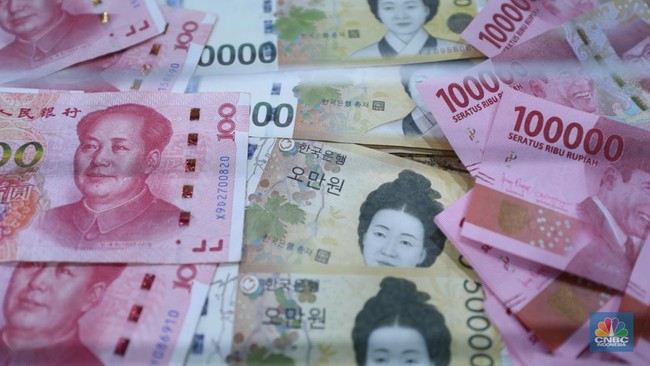
Jakarta, CNBC Indonesia - Asian currencies have weakened against the US dollar throughout this week. The Rupiah also weakened, although the pressure is not as severe as for some other major Asian currencies.
The Rupiah’s exchange rate closed the short trading week in positive territory, coinciding with the long holiday on Thursday and Friday. According to Refinitiv data, the Rupiah ended Wednesday’s (May 13, 2026) trading at IDR 17,460/USD. This represents a 0.17% increase compared to the previous trading close.
This strengthening is a positive development after the Rupiah briefly breached the new psychological level of IDR 17,500/USD intraday on Tuesday and Wednesday. However, on a weekly basis, the Rupiah is still down 0.58% against the US dollar.
Throughout this week, all Asian currencies monitored have weakened against the US dollar.
The sharpest decline was seen in the South Korean Won, which fell 2.48% to KRW 1,497.73/USD.
The Philippine Peso followed with a 1.74% decline to PHP 61.553/USD, followed by the Indian Rupee, which fell 1.67% to INR 95.96/USD.
Significant pressure was also seen on the Thai Baht, which weakened 1.55% to THB 32.66/USD, and the Japanese Yen, which fell 1.35% to JPY 158.76/USD. Meanwhile, the Singapore Dollar corrected by 1.07% to SGD 1.28/USD.
A more limited decline was seen in the Taiwan Dollar, which fell 0.83% to TWD 31.561/USD, and the Malaysian Ringgit, which weakened 0.74% to MYR 3.947/USD.
The Vietnamese Dong weakened 0.17% to VND 26,350/USD, while the Chinese Yuan was the least weakened currency in Asia, falling 0.13% to CNY 6.809/USD.
The widespread weakness of Asian currencies is inseparable from the strengthening of the US dollar throughout this week.
The US Dollar Index (DXY) rose 1.41% to 99.284. This increase indicates that the US dollar is once again in demand by market players, as expectations grow that the US central bank (The Federal Reserve/The Fed) may maintain high interest rates for longer, with the possibility of further interest rate increases.
The US dollar strengthened for five consecutive days on Friday and is heading for its largest weekly gain in two months.
This increase occurred after the market increasingly factored in the possibility that the Fed may still need to take a more aggressive stance to contain inflationary pressures.
This expectation was also driven by an increase in US government bond yields. The yield on the 10-year US Treasury rose to around 4.599%, the highest level in a year.
This increase in yield is a signal that the bond market is becoming increasingly concerned about inflation risk.
Price pressures are once again a concern as energy supplies through the Strait of Hormuz are still disrupted due to the Iran war.
The rising oil prices are exacerbating inflation concerns. West Texas Intermediate (WTI) crude oil surged above US$105 per barrel, while Brent rose to the US$109 per barrel range.
The increase in oil prices risks increasing energy and transportation costs. If this pressure persists, inflation could be difficult to bring down again, limiting the Fed’s room to cut interest rates.
Several Fed officials this week also signaled that controlling inflation remains the top priority. Some officials have even left open the possibility that interest rates may need to be raised if price pressures continue to rise.
The market is also starting to adjust its expectations. According to CME FedWatch, market participants now estimate a probability of around 49.5% that the Fed may raise interest rates by at least 25 basis points at the December meeting. This figure has jumped from 14.3% in the previous week.
This condition is making the US dollar even stronger against many currencies in the world. As US bond yields rise and expectations of high interest rates strengthen, dollar-based assets become more attractive to global investors.
CNBC INDONESIA RESEARCH
(evw/evw)