
US Dollar Reaches Rp 17,630, Could It Hit Rp 18,000?
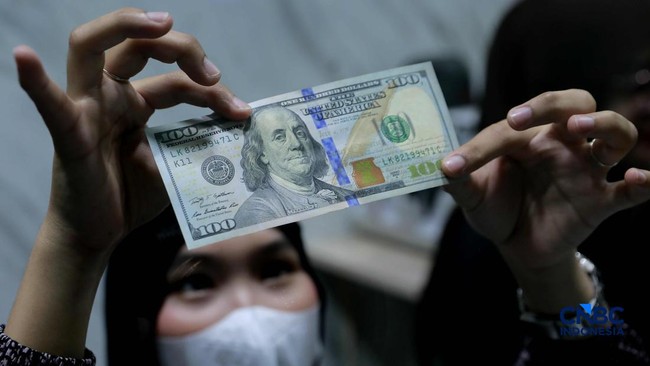
The exchange rate of the Indonesian Rupiah against the US Dollar touched the level of Rp 17,630/US$ at the start of trading on Monday (18/5/2026). This follows a period where the Rupiah had closed stronger at Rp 17,460/US$ prior to the long holiday. Refinitiv data indicates that Rupiah movement in the NDF market has reached Rp 17,680/US$ for one-day positions, while the one-year position has breached Rp 18,040/US$.
This depreciation is influenced by lingering global market sentiments and the demand for US Dollar supplies during the 2026 Hajj season. The weakening of the currency could impact the Indonesian economy as a whole, raising concerns about whether the Rupiah will hit the Rp 18,000 level in the near future.
Yusuf Rendy Manilet, an economist at the Centre of Reform on Economics (CORE) Indonesia, suggests that the current Rupiah weakness stems from a combination of simultaneous global and domestic pressures. He noted that the market is facing a ‘higher for longer’ scenario regarding the US Federal Reserve due to high US core inflation, which has strengthened the US Dollar against most emerging market currencies.
However, Manilet pointed out that the deeper depreciation of the Rupiah compared to regional currencies indicates domestic risk factors. “If it were purely a global factor, the Rupiah’s movement should be relatively in line with the Ringgit, Baht, or Peso. In reality, the Rupiah’s depreciation has been deeper in recent periods, indicating an additional country risk premium being demanded by investors to hold Indonesian assets,” Manilet told CNBC Indonesia.
Regarding the possibility of hitting Rp 18,000, Manilet advised against focusing solely on psychological figures. Instead, he suggested monitoring key indicators such as the DXY movement, 10-year US Treasury yields, capital flows in the SBN (government bond) market, foreign exchange reserves, and Indonesia’s CDS as an indicator of country risk perception. He added that as long as Bank Indonesia maintains consistent triple intervention, reserves remain adequate, and there are no additional fiscal or political shocks, there is still a buffer to keep the market orderly, though policy manoeuvrability is narrower than in previous years.
Manilet warned that if pressure continues, the impact will be felt through various channels, most notably via imported inflation. Prices for goods dependent on imports, such as non-subsidised fuel, medicines, wheat, animal feed, and electronics, could begin to rise gradually.
M. Rizal Taufikurahman, Head of the Centre for Macroeconomics and Finance at INDEF, also noted that the possibility of the Rupiah hitting Rp 18,000 remains open if global pressures persist and policy responses are deemed insufficient by the market. He highlighted that indicators such as foreign capital flows, foreign exchange reserves, SBN yields, the US Dollar Index, global oil prices, and the interest rate directions of the Fed and Bank Indonesia must be closely monitored. He warned that if the Rp 18,000 level is breached, businesses reliant on imports will face higher production costs, while the public will face pressure on purchasing power due to rising inflation.