
US Dollar Lags Behind Ringgit and Yuan-Won, While Rupiah Remains Under Pressure
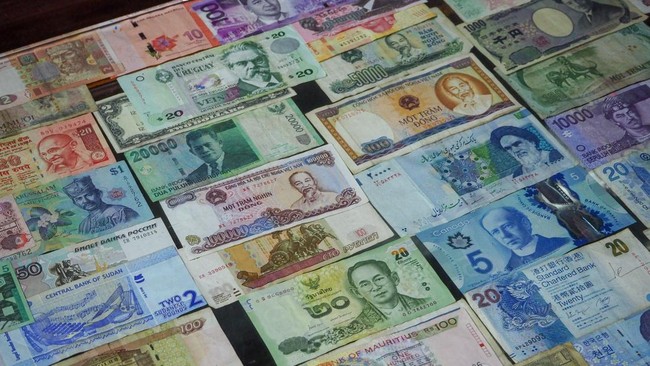
Asian currencies mostly moved higher in trading on Tuesday (27 October 2026).
Refinitiv data at 9.19am WIB showed six of 10 Asian currencies strengthening against the US dollar, while the other four remained in negative territory.
The Taiwan dollar posted the biggest gain in morning trading, rising 0.25% to TWD32.495 per US dollar. The South Korean won followed with a 0.18% increase, while the Thai baht gained 0.15%.
The Chinese yuan and Malaysian ringgit each rose 0.02%, while the Vietnamese dong gained just 0.01%.
By contrast, the rupiah was Asia’s worst-performing currency that morning. The Indonesian currency fell 0.10% to Rp18,130 per US dollar.
The Philippine peso weakened 0.09%, the Japanese yen fell 0.08%, and the Singapore dollar edged down 0.02%.
Despite gains in most Asian currencies, the US dollar itself was stronger. At the same time, the US dollar index (DXY) rose 0.06% to 102.018.
That left the DXY near its highest level in a week. The dollar drew support from improving investor appetite for risk assets, following a renewed rise in technology shares on Wall Street.
Demand for the US technology sector picked up again after the latest developments from artificial intelligence (AI) companies boosted market optimism.
The US dollar also benefited from the euro’s weakness. The single European currency fell towards a two-week low as markets again grew concerned about France’s fiscal position.
Selling of French government bonds pushed the country’s sovereign risk premium to its highest level since the 2011 European debt crisis. This also weighed on the euro and indirectly supported the DXY.
However, currency markets’ main focus this week will be a series of interest-rate decisions by major central banks.
Fed and BOJ in focus
The US central bank, the Federal Reserve (Fed), will conclude its two-day meeting on Wednesday US time, or Thursday in Indonesia.
Markets expect the US central bank to hold interest rates at this meeting, after raising them in September.
The European Central Bank (ECB) is also expected to keep rates at 2.5% on Thursday.
The Bank of Japan (BOJ) will announce its policy decision on Friday. It is expected to hold its rate at 1.25%, but markets will be looking for indications about the prospects for a further increase.
The yen is among the currencies receiving the closest attention ahead of the decision. It fell 0.08% that morning to around JPY157.63 per US dollar.
The yen came under pressure after giving back some of the gains it had made the previous week.
The BOJ continues to face relatively high price pressures. The latest data showed that Japanese services-sector inflation rose 3.7% year on year in September, reinforcing the view that a further rate increase remains possible.
“We expect the BOJ to conclude that underlying consumer inflation is now generally consistent with its 2% price stability target,” MUFG analysts wrote, according to Reuters.
However, MUFG considers that reaching the inflation target once is not enough. The BOJ is expected to shift its focus from the risk of inflation being too low to monitoring risks in both directions.
Markets currently put the probability of a BOJ rate increase in December at slightly above 50%.