
US Dollar Falls, Asia Splits: Rupiah and Ringgit Strong, Yen Declines
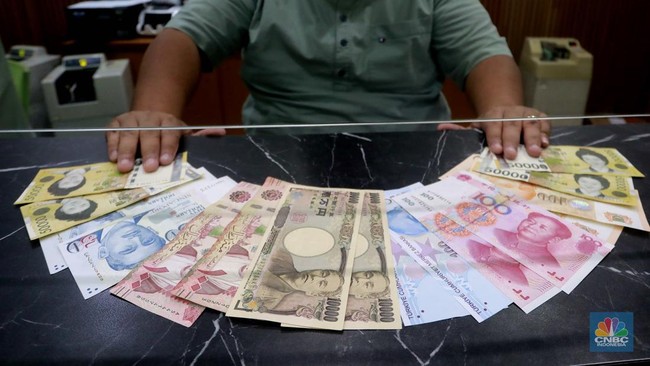
Asian currencies moved in varied directions against the US dollar in trading on Thursday (20/8/2026). Although the US dollar remains in a weak area, some regional currencies appear to be adjusting after initially responding to the greenback’s weakness in the previous session.
According to Refinitiv data as of 09:20 WIB, five of the ten Asian currencies strengthened against the US dollar, while the other five weakened.
The Malaysian ringgit posted the sharpest gain in Asia this morning, rising 0.39% to MYR 4.037 per US dollar. The Philippine peso followed with a 0.28% gain to PHP 61.604 per US dollar. The Thai baht also strengthened 0.18% to THB 32.84 per US dollar.
The rupiah was also in positive territory. The Garuda currency strengthened 0.14% to Rp17,800 per US dollar, continuing its positive trend after closing 0.14% higher at Rp17,825 per US dollar in the previous session.
The Vietnamese dong strengthened 0.10% to VND 26,154 per US dollar, while the Chinese yuan rose 0.08% to CNY 6.724 per US dollar.
On the other side, the South Korean won faced the deepest pressure in Asia, weakening 0.47% to KRW 1,394.61 per US dollar. The Japanese yen also fell 0.21% to JPY 158.49 per US dollar. The Singapore dollar weakened 0.06% to SGD 1.271 per US dollar, while the Taiwan dollar slipped 0.03% to TWD 31.849 per US dollar.
Asian currency movements this morning remain closely tied to US dollar dynamics. The US dollar index (DXY) was stagnant at 98.835 at the same time.
Although flat this morning, the DXY had previously fallen quite sharply. At the previous close, the US dollar index weakened 0.83%, keeping it near its lowest level in three months.
The US dollar came under pressure as market participants scrutinised the US Treasury Department’s move to calm turbulence in the bond market. The move came after long-term US Treasury yields had surged to their highest level since 2007.
The US Treasury Department announced plans to double buyback operations for long-term bonds. The policy was implemented after a sharp sell-off in the bond market pushed the 30-year US Treasury yield to 5.337%, its highest level in 19 years.
Tony Sycamore, market analyst at IG, assessed that the move signals the US government is beginning to respond to the rise in long-term premiums in the bond market.
“This is not formal QE and not yield curve control, but it is a clear signal that Washington is ready to curb the rise in term premium,” Sycamore said, as quoted by Reuters.
Brian Jacobsen, chief economic strategist at Annex Wealth Management, assessed that the move would only be a temporary calming measure for the market.
“The Fed is powerless to influence long-term interest rates. Now the Treasury will issue more short-term debt because of weak demand for long-term debt,” Jacobsen said, as quoted by Reuters.
Despite the weakening US dollar, the market is still not fully calm. Minutes from the US central bank’s (The Federal Reserve/The Fed) meeting last month showed deepening concerns about inflation. Some officials were even prepared to raise interest rates, while many others assessed that higher borrowing costs would be necessary if inflation does not fall towards the 2% target.