
US Dollar Crumbles in Asia: Rupiah, Won, Yen, and Ringgit Strengthen in Unison
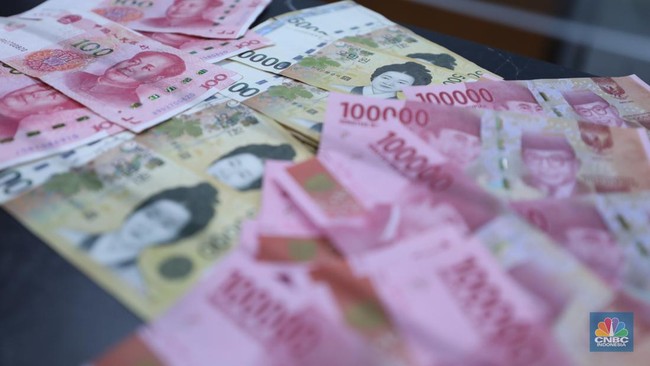
Jakarta, CNBC Indonesia - Asian currencies opened trading on Thursday (6/8/2026) firmly in the green. The weakening of the United States dollar provided room for all currencies in the region to strengthen, including the rupiah.
Citing Refinitiv data as of 09:15 WIB, all ten Asian currencies monitored strengthened against the US dollar.
The sharpest gains this morning were recorded by the South Korean won, which surged 0.34% to KRW 1,416.35 per US dollar. The Taiwan dollar followed with a 0.20% rise to TWD 32.199 per US dollar.
The Thai baht also moved solidly, strengthening 0.15% to THB 33.06 per US dollar, while the Malaysian ringgit rose 0.12% to MYR 4.085 per US dollar.
The rupiah joined the rally against the US dollar. The Garuda currency appreciated 0.11% to Rp17,905 per US dollar. This position pushed the rupiah further away from the psychological level of Rp18,000 per US dollar.
The Japanese yen strengthened 0.08%, followed by the Chinese yuan which edged up 0.04% to CNY 6.472 per US dollar. The Philippine peso and Singapore dollar each appreciated 0.03%. Meanwhile, the Vietnamese dong recorded the smallest gain against the greenback, inching up 0.02%.
The strengthening of Asian currencies this morning was in line with the US dollar remaining stuck in the red. The US dollar index (DXY) was observed to have slipped 0.02% to 99.657 this morning, meaning the DXY remains near its lowest level in six weeks.
The DXY is struggling to find direction as market participants remain cautious, monitoring developments in the US-Iran agreement and awaiting US labour data at the end of the week.
Pressure on the US dollar also came from the decline in world oil prices. Brent crude fell 0.5% to US$79.08 per barrel at the close on Wednesday (5/8/2026), after concerns about energy supply disruptions began to ease.
However, the market is still observing the planned agreement between Iran and Oman, which is said to potentially help end the US-Iran conflict. US President Donald Trump previously stated that a deal to reopen the Strait of Hormuz was close, although US officials stressed they would not agree to Iran controlling access to the world’s most important energy trade route.
Ray Attrill, head of FX strategy at National Australia Bank, assessed that the market is still choosing to wait for clarity.
"The market is really in wait-and-see mode right now," Attrill said in a podcast, as quoted by Reuters.
He also assessed that oil price volatility, which had previously been the main driver of the market, is beginning to subside.
"We are no longer seeing the oil market volatility that over the last several days and weeks has been the main driver of most markets," Attrill said.
In addition to developments in the Middle East, market participants’ focus is also directed at the US nonfarm payrolls data, which will be released on Friday. The labour data will provide new clues regarding the direction of the Federal Reserve’s policy.
According to a Reuters survey, economists estimate that US nonfarm payrolls increased by 80,000 jobs in July, after rising by 57,000 in June. The unemployment rate is expected to remain at 4.2%.
However, the Fed’s stance is not yet fully dovish. Fed Governor Lisa Cook said she is open to the possibility that the central bank may need to raise short-term interest rates to combat inflation that remains too high in the US economy.