
US Dollar Breaches Rp18,000 – Is the Notion of Exporters Reaping Windfalls a Myth?
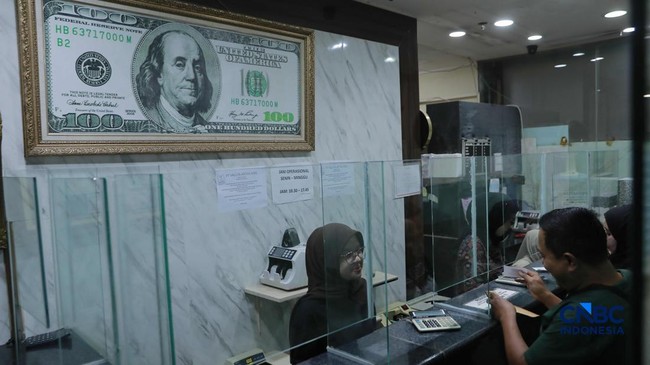
The weakening of the rupiah against the US dollar continues, with the exchange rate now breaching Rp18,000 per US dollar. In trading today, Thursday (4/6/2026), Refinitiv data showed that as of 11:30 WIB, the rupiah had weakened by 0.56% to a level of Rp18,040/US.Thisdepreciationdeepenedfromtheearlierposition, whereat09 : 11WIB, therupiahhadalreadybrokenthroughthepsychologicallevelofRp18, 000/US, reaching Rp18,015/US$ or depreciating by 0.42%.
Amid the surge in the US dollar, a perception has emerged that export-oriented industries will enjoy greater profits, as their revenues are mostly received in dollars. However, industry players assess that many foreign buyers are becoming more cautious in conducting transactions.
‘The current global conditions also make overseas buyers tend to be more careful in making purchases. So even though the dollar exchange rate rises, it does not necessarily automatically increase industry profits significantly. In fact, for many business actors, this condition actually increases cash flow uncertainty and complicates production planning,’ said Abdul Sobur, Chairman of the Indonesian Furniture and Handicraft Industry Association (HIMKI), to CNBC Indonesia on Thursday (4/6/2026).
Industry resilience is not solely determined by the US dollar. The more decisive factors are domestic, particularly concerning overall industry efficiency and competitiveness. He assessed that industries with strong foundations will be better prepared to face external pressures, including when exchange rate turmoil occurs as extremely as it is now. ‘If the industrial ecosystem is healthy and efficient, then the industry will be more resilient in facing any global turmoil, including US dollar fluctuations,’ said Sobur.
Sobur further cited the example of how industrial zones in China are able to maintain competitiveness despite facing various global economic dynamics. Their main strength does not solely derive from technology or large production capacity. ‘When we look directly at industrial zones in China, such as Shandong or Xiamen, what is most palpable is actually not just the technology or the size of the factories, but how the entire industrial ecosystem works in a very disciplined and efficient manner from upstream to downstream. The correlation with resilience to exchange rate turmoil is very strong,’ Sobur stated.
Indonesia itself is considered to have capital that is no less substantial to compete in the global market. The availability of raw materials, the creativity of industry players, and the large domestic market are strengths that can serve as the foundation for long-term growth. However, a number of structural obstacles remain as homework that must be resolved promptly so that the national industry can improve its competitiveness and gain maximum benefit from export opportunities.
‘Meanwhile, Indonesia actually possesses advantages in raw materials, creativity, and a large market. But we still face classic challenges in the form of high logistics costs, policy fragmentation, suboptimal labour productivity, and an industrial ecosystem that is not yet fully consolidated,’ said Sobur.