
US-Canada Trade War Heats Up
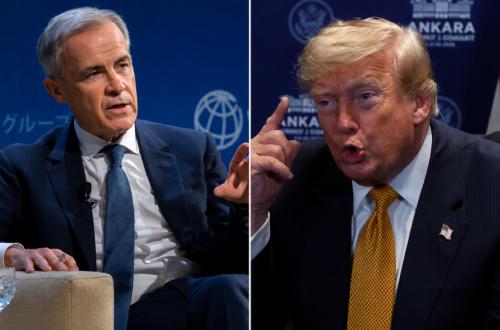
Trade relations between the United States and Canada have deteriorated again after trade negotiations between the two countries failed to reach an agreement. Washington is now imposing a 50 per cent tariff on around US$20 billion of Canadian products, while Ottawa is preparing retaliatory tariffs of equal value.
The new tariffs took effect on Saturday (22/8/2026), deepening the trade war between two countries that for decades have been known as economic partners and close allies.
Canadian Prime Minister Mark Carney said his government would impose retaliatory tariffs on a number of US products starting 8 September. The measures cover products such as steel, dairy products, electronics and agricultural equipment.
Carney described US President Donald Trump’s tariff policy as using economic relations as a tool of political pressure. He stressed that Canada would not allow its economic interests to be determined through unilateral pressure from Washington.
“Canada will respond dollar for dollar,” Carney said, as reported by the Associated Press.
Negotiations failed at the last minute. The latest tariff policy emerged after negotiations that had been taking place for several weeks in Washington collapsed at the final stage.
The two countries had actually signalled that a new agreement was still possible. President Trump even delayed the imposition of tariffs for three days last week because the two sides were considered to be close to a deal.
However, differences over a number of key issues again hampered the negotiations. These included the treatment of the automotive industry, rules on American product content in vehicles receiving tariff relief, and Canada’s trade policies with other countries.
The Canadian government considered Washington’s latest demands to be excessive and potentially limiting Canada’s room to determine its trade policy independently.
Meanwhile, US Trade Representative Jamieson Greer blamed Canada for missing an opportunity to reach an agreement.
The 50 per cent tariff imposed by Washington targets around US$20 billion of Canadian goods. That value is equivalent to around five per cent of Canada’s total annual exports to the US.
The affected products are quite diverse, ranging from food, cosmetics, furniture, sporting equipment such as hockey sticks, to a number of paper, textile and electronic products. Some commodities such as energy, potash and fish are not included in the latest tariff list.
Washington is using a rarely applied provision in the US Tariff Act of 1930, namely Section 338. The Trump administration argues the policy is necessary to respond to what it calls Canadian discrimination against US products and companies.
The new tariffs add to a series of levies previously imposed on Canadian products, including steel, aluminium, automotive goods and lumber.
The latest dispute also increases uncertainty over the future of the North American trade agreement, the United States-Mexico-Canada Agreement (USMCA).
The US, Canada and Mexico were previously bound by the agreement that replaced the North American Free Trade Agreement (NAFTA). However, the increasing use of tariffs by the Trump administration has placed serious pressure on the region’s free trade mechanisms.
US-Canada economic relations are highly integrated. Trade disruptions could hit cross-border supply chains, especially in the automotive, energy, agriculture and manufacturing sectors. Economists also warn that tariffs could raise prices for consumers and add uncertainty for businesses.
For Canada, the issue also touches on a broader dimension. The Carney government has begun pushing for trade diversification so that the Canadian economy is not overly dependent on the US market.
Carney said Canada would strengthen trade relations with other countries. His government is said to have signed more than 20 new agreements in the past year as part of efforts to expand Canada’s export markets.
With the failure of the latest negotiations, there is no schedule for further talks between the two countries. The dispute is no longer merely a matter of tariffs, but is beginning to test the economic and political relationship that has long been one of the main foundations of North America.