
US and MSCI Send Another ‘Storm’, Putting the IHSG and Rupiah at Risk
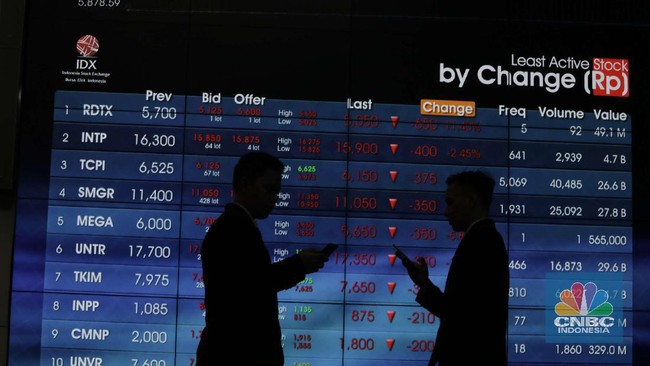
Indonesia’s financial markets are expected to remain under pressure today. The Jakarta Composite Index (IHSG) fell 1.33%, or 79.24 points, to 5,863.78 at Thursday’s close (15 October 2026). The yield on 10-year Indonesian government bonds (SBN) was unchanged at 7.169%.
On Wall Street, US shares rose across the board on Thursday (15 October 2026), or early Friday Indonesian time. Investors began shifting funds out of artificial intelligence (AI)-related stocks and towards sectors seen as offering more attractive valuations, amid concerns about the scale of AI spending and persistent inflation.
The Dow Jones Industrial Average gained 556.21 points, or 1.08%, to 52,177.69, while the S&P 500 rose 0.33% to 7,744.06. The technology-heavy Nasdaq Composite also ended higher, edging up 0.08% to 26,713.03.
The Nasdaq was volatile, however. It fell as much as 1.4% before paring its losses and turning higher towards the close.
Technology shares came under pressure as investors grew more concerned about the scale of companies’ AI investments. Market participants are beginning to question whether AI companies’ potential revenues can justify their heavy capital spending and already elevated share valuations.
Seagate Technology and Western Digital shares extended their declines this week. SK Hynix was also under pressure, contributing to a sharp sell-off in South Korea’s Kospi in the previous session.
Investors are increasingly concerned about a potential oversupply of memory chips, particularly as South Korean producers face intensifying competition from China. Tesla chief executive Elon Musk also commented on the trend in a post on X, predicting that China would produce a huge volume of RAM by 2028.
Concerns about the AI industry’s outlook were also heightened after Anthropic’s revenue was reported to have reached US$16.8 billion in the third quarter of 2026. Some market participants questioned whether the AI company’s revenue growth was fast enough to justify the surge in chipmakers’ valuations.
Rising yields on US Treasuries are also affecting investors’ allocation decisions. With the 10-year Treasury yield above 5%—its highest level since the early 2000s—fixed-income assets are becoming more competitive than highly valued, higher-risk technology shares.
“When Treasury yields reach 5%, their highest level since the early 2000s, investors will start comparing them with making a big bet on AI,” Alex Shahidi, co-chief investment officer at Evoke, part of MAI Capital Management, told CNBC International.
Shahidi said the question was no longer whether investors should buy or sell AI shares, but how much of their portfolios they wanted to concentrate in the sector.
Not all AI-related shares fell. CoreWeave rose nearly 6%, reversing course after plunging more than 15% in the previous session. Investors had been concerned that the company was relying too heavily on debt to finance its AI infrastructure expansion, and its corporate bond yields had also surged.
Micron Technology recovered from earlier losses, closing up nearly 2%. Outside technology, consumer shares supported the market: Walmart rose 1.5%, while Nike gained more than 5%.
Investors were also watching the latest inflation data, which added to concerns that the US Federal Reserve (the Fed) could tighten monetary policy towards the end of the year.
The US Producer Price Index (PPI) rose 1.3% month on month and 6.3% year on year in September. Both increases were the largest since 2022. The figures came a day after September’s Consumer Price Index (CPI) showed an annual rise greater than the market had expected.
The combination of rising consumer and producer prices has intensified concerns that US inflation has not eased, particularly amid high energy prices.
“Today’s PPI report, following Wednesday’s CPI, confirms that inflation is getting worse while energy prices remain high,” said David Russell, head of global market strategy at TradeStation. “Regardless of whether there is an election, prices keep rising and the Fed may be forced to act.”
Investors therefore face a choice: technology shares still offer growth potential from the AI revolution, but high bond yields and the risk of tighter monetary policy are making them more selective about which assets to buy.
Indonesia’s financial markets will continue to face negative international factors, including MSCI’s latest announcement, accelerating US inflation and war. The hotter US producer-price figures could become another storm for global financial markets, including Indonesia. A discussion involving the Fed chair at an IMF-World Bank event will also be watched closely by market participants. Domestically, rumours of a cabinet reshuffle could influence the market.
Here are some of the market factors to watch today:
1. MSCI threatens to downgrade Indonesia’s equity-market status
Morgan Stanley Capital International (MSCI) has opened a consultation on changing Indonesia’s equity-market classification from Emerging Market to Standalone Market. A final decision is expected by 30 June 2027 at the latest.
MSCI cited investor concerns about share-ownership transparency, suspected coordinated trading and the effectiveness of enforcement. Although regulators have announced several reforms, MSCI said it had not seen adequate and consistent progress.
In line with the proposal, MSCI is maintaining a freeze on several changes to Indonesian equity indices. It will not increase the Foreign Inclusion Factor (FIF) or Number of Shares (NOS), add shares to the MSCI Indonesia Investable Market Index (IMI), or move shares into larger-capitalisation index segments.
Market participants can submit feedback until 30 April 2027. MSCI said it could reconsider the reclassification proposal if the consultation produced evidence of material improvements in the governance and functioning of Indonesia’s equity market.
2. Yemen war escalates after Houthis attack presidential palace, killing five
Yemen’s Houthi group launched missile and drone attacks on the Al-Maashiq Presidential Palace complex in Aden on Thursday (15 October 2026). Five people were killed and 16 injured.
Yemen’s government said the prime minister and several cabinet members were safe. The Houthis said the attack targeted a Saudi military operations headquarters in Aden.
Tensions have also risen after the Saudi-led military coalition reported a series of Houthi attacks on Saudi infrastructure. An attack on King Khalid International Airport in Riyadh reportedly killed 17 people and injured 333, while an attack at Abha Airport killed three and injured 28.
The Saudi coalition claimed it had destroyed 127 weapons-storage facilities and launchers in Yemen. The Iran-backed Houthis also warned that Saudi airspace and airports were unsafe.
The conflict has intensified again since fighting between the Houthis and Saudi-backed Yemeni government forces resumed last month. The situation has raised security risks around the Bab el-Mandeb Strait, a strategic shipping route connecting the Red Sea and the Gulf of Aden.
3. US inflation heats up as producer prices post their biggest rise in four and a half years
US inflation is accelerating. Producer prices rose 1.3% month on month in September 2026, their largest increase since March 2022 and well above the market forecast of 0.5%.
Data from the US Labour Department on Thursday (15 October 2026) showed that the Producer Price Index rose 6.3% year on year, its highest rate since December 2022.
The increase was driven by higher energy prices amid the US-Israel war with Iran. Producer energy prices surged 10.8%; petrol rose 20.3%, while diesel increased 21% month on month and 115.2% year on year.
Pressure also spread to services. Producer prices for services rose 0.8%, while road freight costs increased 3.8% and air fares rose 5%.
Higher producer prices could feed through to consumers and complicate the Federal Reserve’s efforts to control inflation. Economists expect core personal consumption expenditures (PCE) inflation, the Fed’s key benchmark, to rise 0.4% month on month in September, or 3.1% year on year.
The figures raise the prospect of further interest-rate increases. According to the CME FedWatch Tool, markets saw about a 30% chance of a rate rise at the Fed’s 27–28 October meeting. The Fed raised rates in September to a range of 3.75%–4.00%.
Meanwhile, US retail sales rose 0.8% in September, exceeding the 0.3% forecast. However, core retail sales, which exclude several major components, grew by just 0.1%, slowing sharply from 1.2% in August.
The combination of high inflation and weakening consumer momentum poses a challenge for the US economy. If prices continue to rise, the Fed will face a dilemma between holding rates to support growth and tightening policy again to curb inflation.
4. US jobless claims rise, but labour market remains resilient
The number of Americans filing initial claims for unemployment benefits edged up in the week ending 10 October 2026, but remained below market expectations, reflecting a still-solid labour market.
The US Labour Department reported that initial claims rose by 1,000 to 199,000, slightly below the market forecast of 200,000.
Continuing claims fell by 4,000 to 1.71 million. The figure remained relatively close to the more-than-three-year low recorded two weeks earlier.
The data indicate that the US labour market remains resilient, in line with the Federal Reserve’s assessment that employment is close to full-employment levels.
Initial unemployment claims by federal employees rose by 68 to 463. The figure is being watched amid the administration’s efforts to reduce the public-sector workforce.
5. Wildfires in Kalimantan put nine listed palm-oil companies in the spotlight
Nine plantation companies have responded to requests from the Indonesia Stock Exchange (IDX) for information about forest and land fires. Most said their operations and 2026 production targets remained on track, with no material impact on financial performance.
The companies are PT Sumber Tani Agung Resources Tbk (STAA), PT Dharma Satya Nusantara Tbk (DSNG), PT Mahkota Group Tbk (MGRO), PT Triputra Agro Persada Tbk (TAPG), PT Jhonlin Agro Raya Tbk (JARR), PT Pradiksi Gunatama Tbk (PGUN), PT Gozco Plantations Tbk (GZCO), PT J.A. Wattie Tbk (JAWA) and PT Andira Agro Tbk (ANDI).
Their responses varied despite most describing the impact as immaterial. PGUN disclosed fires near its concession area, while GZCO said the impact was insignificant. ANDI is still conducting an internal investigation to establish the effect on its business activities.
PGUN said the fires had not halted its main operations. Harvesting and processing at its palm-oil mill continued as normal. The company also said no material damage had been found to biological or fixed assets that would require write-offs.
All PGUN operations are based in Paser Regency, East Kalimantan, which accounts for 100% of the company’s production and revenue. The company’s entire crude palm oil (CPO) output is allocated to supply feedstock for fatty acid methyl ester (FAME) biodiesel production by its affiliate, JARR.
For investors, wildfire risk involves more than damage to plantations and disruption to production. It can also affect supply chains and corporate reputations, and bring legal and environmental consequences. Conditions on the ground and production results through year-end will therefore require close attention.
6. Bahlil opens Rp644bn LPG refinery as Indonesia seeks to cut imports
Energy and Mineral Resources Minister Bahlil Lahadalia inaugurated the Cilamaya liquefied petroleum gas (LPG) refinery in Karawang, West Java, on Thursday (15 October 2026). The facility, owned by PT Energi Nusantara Perkasa (ENP) in partnership with PT Euroasiatic Jaya, cost US$36 million, or about Rp644.5 billion, to build.
The refinery can produce 160 tonnes of LPG a day, or 52,800 tonnes a year. It can also produce 320 barrels of condensate a day, or 105,600 barrels a year.
Bahlil said domestic LPG production capacity was not yet sufficient to meet national demand. Indonesia still imports about 7–8 million tonnes of LPG a year, while domestic production capacity is no more than 8 million tonnes.
He said the Cilamaya refinery could supply about 10% of LPG demand in West Java and Jakarta, which totals 1,000–1,500 tonnes a day.
ENP president director Sarjono said the refinery was designed for a capacity of 40 million standard cubic feet per day (MMSCF), with a maximum design limit of 44 MMSCF. It uses a combination of mechanical refrigeration and turbo-expander technology to optimise LPG recovery during extraction.
With Cilamaya in operation, Indonesia has two LPG-processing facilities, in Gresik and Cilamaya, with a combined installed capacity of 140 MMSCF.
The facility is expected to strengthen domestic LPG supply and help reduce the country’s reliance on imports.
7. Prabowo appoints seven officials as rumours of economic-ministry reshuffle grow
President Prabowo Subianto appointed seven new officials at the State Palace in Jakarta on Thursday (15 October 2026). The appointments include four deputy ministers and three heads or deputy heads of government agencies.
The four deputy ministers will take up key roles in defence, agriculture, and immigration and corrections.
They are Air Marshal Yusuf Jauhari, appointed Deputy Defence Minister for Defence Industry Logistics and Technology; General Richard Taruli Horja Tampubolon, appointed Deputy Defence Minister for Strategy, Doctrine and Force Development; Dr Alim Setiawan Slamet, appointed Deputy Agriculture Minister; and M. Maulana Bungaran, S.H., M.H., appointed Deputy Minister of Immigration and Corrections.
Prabowo also appointed Lieutenant General Kristomei Sianturi as head of the National Disaster Management Agency (BNPB), Professor Satyawan Pudyatmoko as head of the National Peatland and Mangrove Management Agency, and Major General Sriyanto as deputy head of the latter agency.
The appointments came as speculation about a cabinet reshuffle under Prabowo resurfaced. Reports circulating suggest the appointments could continue on Friday (16 October 2026), including for several positions in economic ministries.
One rumour concerns a possible change to the position of…