
US Ally Claims Victory Over China in 'Battleground' Near Indonesia
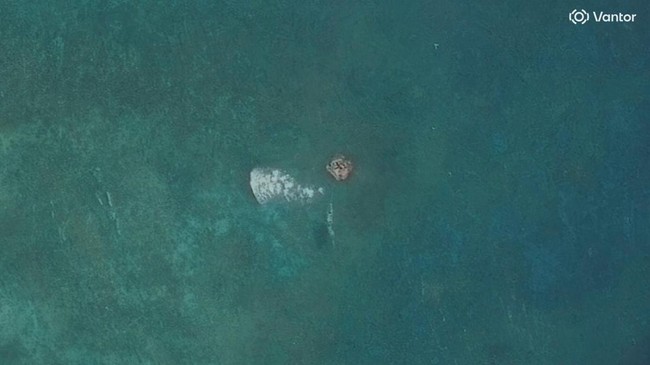
The Philippines has claimed an important diplomatic success after China removed a floating structure previously installed in the disputed Scarborough Shoal in the South China Sea. However, the Philippine military stressed that the move does not end the long-running dispute, as Beijing is still seen as attempting to strengthen its presence in one of the Indo-Pacific region’s main flashpoints.
Philippine Navy spokesman Rear Admiral Roy Vincent Trinidad said the Chinese floating structure at Scarborough Shoal was dismantled and removed last week. According to Manila, the success resulted from diplomatic pressure exerted on Beijing.
“The structure is no longer there. They have removed it. We consider this a major victory for us through diplomatic pressure,” Trinidad told Newsweek.
He cautioned, however, that the Philippines does not consider the matter fully resolved. “But this is not the end of everything, because there are still other features that remain there… China is known for often taking one step back, then moving two steps forward,” he said.
Scarborough Shoal, called Bajo de Masinloc by the Philippines and Huangyan Island by China, lies about 140 miles from the largest Philippine island and deep within the Philippines’ 200-nautical-mile Exclusive Economic Zone. By contrast, the location is about 540 miles from mainland China.
Beijing nonetheless claims historic rights over much of the South China Sea, a strategic shipping lane that has become an arena of geopolitical competition between the United States and China. The Philippines’ position as a mutual defence treaty ally of Washington places the archipelago of about 113 million people on the front line of the rivalry between the two global powers.
According to Trinidad, Manila feared the floating structure was an initial step towards building a permanent installation, as China has previously done on several disputed islands and reefs in the South China Sea. In recent years, Beijing has built various permanent facilities in contested areas, including airstrips, ports, and other military facilities.
China itself stated that the floating structure was used for scientific research and was removed after the research mission concluded. Trinidad questioned that reasoning, saying that if it were truly used for research, China should have made its findings public.
After the structure was removed, the Chinese Embassy in Manila stated that its use was indeed related to scientific research that has now been completed. In a statement delivered on Monday, Chinese Embassy Deputy Spokesperson Guo Wei asserted that Beijing will continue to uphold its claims in the South China Sea.
“China will resolutely safeguard its territorial sovereignty and maritime rights and interests in the South China Sea, while remaining committed to resolving related disputes and managing the maritime situation through negotiation and consultation,” Guo said. He also urged the Philippines not to magnify the issue. “China urges the Philippine side to stop hyping up this issue and to cease provocations, and to continue managing existing differences through diplomatic dialogue,” he added.
Meanwhile, although the floating structure has been removed, confrontations in the area have not subsided. The Philippine Navy stated that its patrols last weekend were blocked by four Chinese warships while conducting a mission in the area. Trinidad said the Philippines will continue routine patrols but is not seeking confrontation with any party.
“We do not want our fishermen, we do not want the government, we do not want the Filipino people to accept a new reality as if it is a reality that must be accepted, that we cannot go there,” he said.
Asked about the possible role of the United States in the Scarborough Shoal incident, given the two countries’ mutual defence treaty, Trinidad affirmed his confidence in Washington’s commitment. “The mutual defence treaty remains in place. The United States provides full support, and its commitment is very strong and unwavering,” he said.
According to Trinidad, although questions have arisen about US alliance commitments following the war in Ukraine and conflicts involving Iran in the Middle East, the security dynamics in the Asia-Pacific differ from other regions. Strategically, the Philippines is part of what is known as the First Island Chain, along with Japan and Taiwan. Washington views this chain of territories as a critical element in efforts to limit the expansion of Chinese influence in the Pacific Ocean.
As tensions with Beijing rise, Manila is also strengthening security ties with Japan and Taiwan. The Philippine government assesses that its country would likely not be spared the impact if China were to launch an attack on Taiwan, which Beijing considers part of its own territory.