
US Alarmed as China's Shipyards Transform into a War Machine
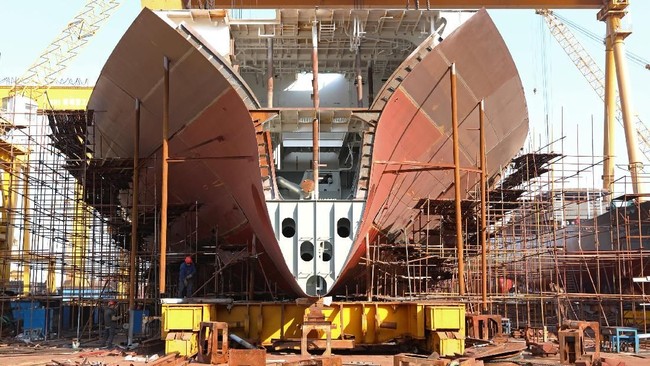
The rivalry for maritime supremacy between the United States (US) and China is sharpening. As China expands its fleet with the support of a robust shipbuilding industry, the US is still grappling with production delays and weak domestic shipyard capacity.
In the 18th century, British politician William Blackstone described the Royal Navy as a “floating fortress protecting the island nation”. Today, it is no longer Britain that rules the waves, but the United States. However, US naval dominance is beginning to be threatened as China builds up its own maritime power.
China is seeking to strengthen control over waters it claims as its territory, despite opposition from neighbouring countries. The ambition to expand its global influence is also driving the expansion of its navy. In a relatively short time, China’s navy has grown from a small force focused on coastal defence to the largest in the world, according to a 2020 US Department of Defense report. At that time, China possessed 350 combat vessels, including warships, aircraft carriers, minesweepers, and support ships. That number surpassed the US fleet of 293 ships, which has barely grown over two decades.
China’s plan to enlarge its fleet to 435 ships by 2030 is considered quite realistic. Conversely, the US target of adding 58 ships to its fleet by 2031, including building a nuclear-powered “Trump”-class warship proposed by the President last year, is deemed difficult to achieve. The reason is that China has an advantage the US lacks: a large-scale commercial shipbuilding industry that serves as the main pillar of its naval resurgence.
After World War II, the dominance of the European shipbuilding industry was displaced by Japan, which relied on cheap steel and labour along with new production methods, before later shifting to South Korea. Now, China is the dominant player. In the last 25 years, its share of the world’s total shipbuilding tonnage has increased from 5% to more than 50%. In contrast, the US commercial shipbuilding industry is virtually negligible, making it difficult for its navy to keep pace with China.
Matthew Funaiole from the Centre for Strategic and International Studies (CSIS) stated that China’s commercial shipbuilding industry is “closely intertwined” with its navy. The overlap between civilian and military activities keeps the shipyards active. When commercial orders slow down, yard facilities can be used to work on military vessels, thereby improving the return on investment.
Warships are indeed far more complex than commercial vessels like container ships. Yet both share many similarities, from steel structures and piping systems to engines and propellers. Marzio Forlini from Bain noted that various types of ships also share many commonalities in their basic foundations. This situation explains why Europe still has a strong naval shipbuilding industry. The region maintains a commercial shipbuilding industry for specialised vessels, such as cruise ships, icebreakers, and offshore energy support ships. Its naval shipbuilding industry not only supplies domestic needs but also the export market.
According to Michael Potter from Accenture, civilian shipyards not only provide production capacity but also serve as a place to hone skills for integrating weapons systems, radar, and other defence equipment. Pierroberto Folgiero, CEO of Fincantieri, Europe’s largest shipbuilder, also believes that the commercial and military shipbuilding industries are complementary. This is evident from the shared manufacturing skills, availability of shipyards, and overlapping supply chains. Folgiero cited cruise ships, Fincantieri’s speciality, as an example. This type of vessel has a high level of complexity because it must be equipped with various facilities, including power plants and water systems, to serve up to 10,000 people and 20 restaurants. According to Folgiero, if a government wants to develop a military shipbuilding industry, “the civilian shipbuilding industry must be nurtured and protected.”
In the United States, efforts to protect the domestic shipbuilding industry have had the opposite effect. The Jones Act, a regulation enacted in 1920 to promote the domestic shipbuilding industry, has instead become a hindrance. The rule requires that cargo transported between domestic ports be carried on ships that are built and crewed by US citizens. This policy has limited competition and driven up costs. The Jones Act is one of the main reasons why, in 2025, the US accounted for only 0.03% of the total tonnage of ships built globally. The rule was temporarily waived to allow foreign tankers to help transport oil as part of an effort to lower fuel prices in the US.
The weakness of the US commercial shipbuilding industry has a major impact on the country’s navy. Its shipyards are struggling to complete construction on time and within budget. Two aircraft carriers being built by a subsidiary of Huntington Ingalls Industries, the largest US military shipbuilder, were originally scheduled for completion in March 2028. Their completion is now expected to be delayed by more than two years. As many as 80% of programmes for building frigates, submarines, and other military vessels are also experiencing delays.
US politicians are aware of this problem. The Ships for America Act, a bipartisan bill proposed in 2025, targets adding 250 ships to the US civilian fleet within ten years through subsidies and other policies. In February, the government also launched a Maritime Action Plan that includes the establishment of a US$20 billion fund.