
US 10% Tariff on Indonesia: Uncertainty More Pressing Than the Rate Itself
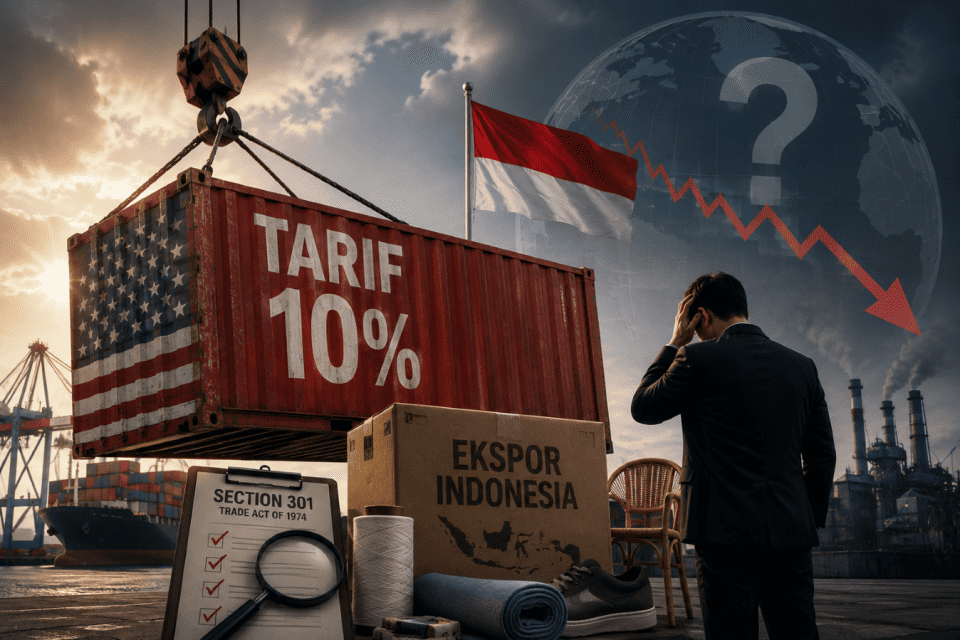
The United States government has officially imposed an additional 10% import tariff on Indonesian products, effective 24 June 2026, based on an investigation under Section 301 of the Trade Act of 1974. This policy targets 17 countries deemed to have insufficiently prevented the trade of goods produced through forced labour practices. Indonesia is included in the group with a 10% tariff, which is lower than the 12.5% levied on Vietnam, Thailand, and the Philippines. This figure provides a relative advantage for Indonesian exporters, but businesses are more concerned about the uncertainty surrounding the direction of US trade policy, which remains in a transitional phase.
Policy uncertainty is far more costly than the tariff itself. Without certainty on the implementation and final rate, companies cannot make medium-term decisions regarding production, export contracts, or investment. This has the potential to alter Indonesia’s competitiveness map in the US market, which has been a strategic export destination. If the final tariff indeed reaches 18%, Indonesia’s relative advantage will be eroded, and export-oriented manufacturing investment flows could shift to other countries.
Labour-intensive industries dependent on the US market—such as textiles and textile products, apparel, footwear, and furniture—will hold back expansion and re-evaluate export contracts. This pressure could spread to small and medium enterprises supplying raw materials and logistics services within their supply chains. The export-oriented manufacturing sector is a primary target for foreign direct investment. Tariff uncertainty causes prospective investors to postpone decisions on relocation or capacity expansion, potentially causing economic growth targets reliant on investment to be missed. In the next three to six months, the combination of high tariffs and a rupiah weakening to around Rp17,925 per US dollar will increase raw material import costs for industries dependent on foreign components, squeezing margins while export demand remains uncertain.
The administrative process of Section 301 in the US, including discussions on product exclusions that will determine whether the final tariff remains at 18% or is reduced for key Indonesian products, needs to be monitored. The risk from the ongoing excess capacity investigation must also be watched; if it results in additional tariffs or new restrictions, already pressured sectors will face a double burden. A key signal will be the realisation of investment and export orders from labour-intensive sectors in the next one to two months, along with the Indonesian government’s policy response to mitigate the impact, whether through incentives or market diversification.