
Urban Mobility Transformation Drives Technology-Based Parking Management
The development of urban areas and increasing public mobility mean parking management is no longer just about providing space for vehicles. Parking systems are now part of the urban mobility ecosystem, required to be orderly, efficient, adaptive, and aligned with technological developments.
This is evident in the Pondok Indah area of South Jakarta. PT Securindo Packatama Indonesia (Secure Parking Indonesia/SPI) manages parking operations at Pondok Indah Mall (PIM) 1, PIM 2, PIM 3, PIM 5, and Pondok Indah Office Tower (PIOT). The five areas have different characteristics and needs, requiring tailored operational approaches.
SPI demonstrated various aspects of parking operations, from capacity management and area layout to Control Room monitoring and the use of digital technology.
“Each area has different characteristics and needs. The challenge is how we adjust operations without reducing service standards,” said Secure Parking Indonesia Managing Director Rustam Rachmat in Jakarta on Wednesday (19/8/2026).
With an aggregate capacity of around 10,000 vehicles across the five areas and 24-hour operations, parking management requires a system capable of keeping pace with the dynamics of the area.
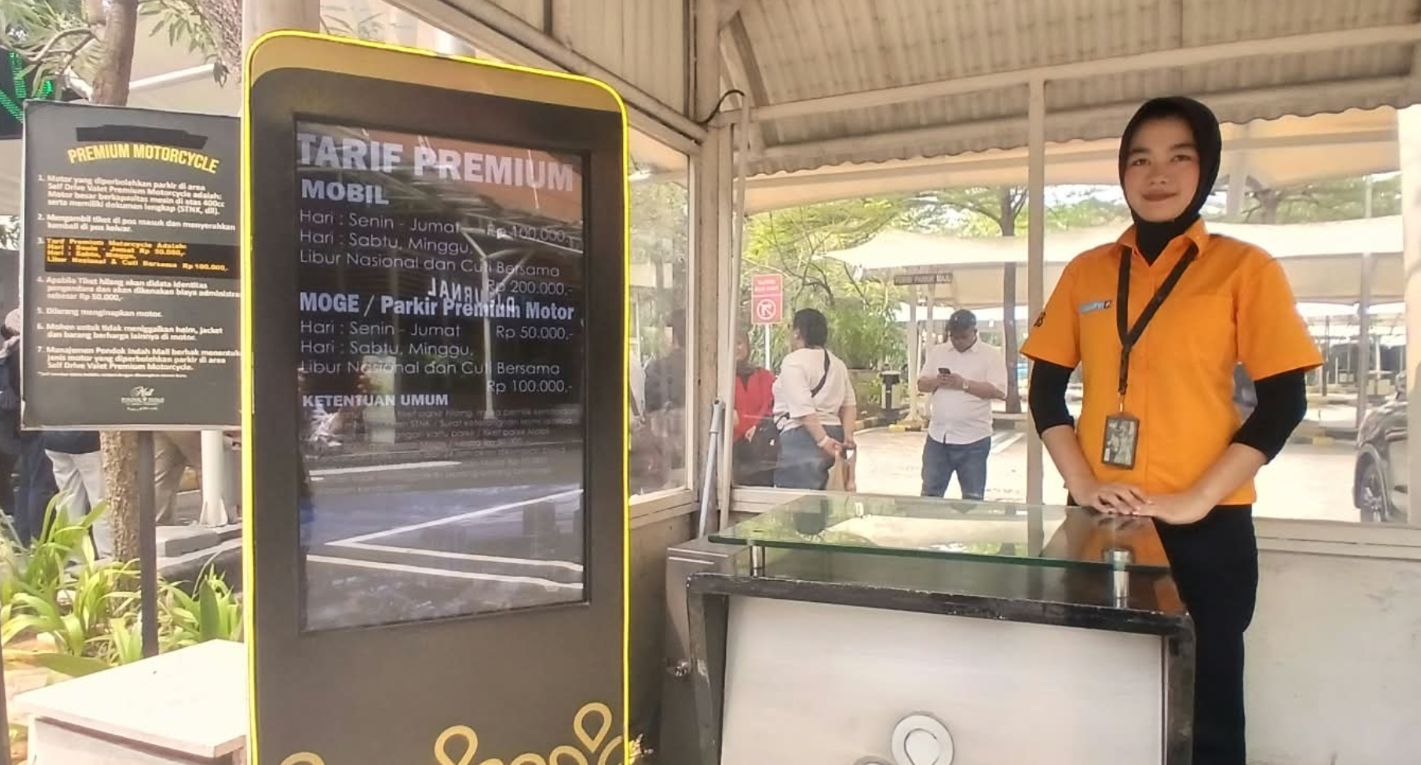
One example is the Premium Area, which has different service patterns and tariffs from regular parking. While tariff policy is the authority of the area manager, SPI ensures that the provisions are applied consistently on the ground.
SPI is also modernising and maintaining areas, including parking markings and floor painting using epoxy. At Pondok Indah, epoxy colours are differentiated on each floor to provide visual identity and help users recognise parking areas.
According to Rustam, markings, colours, and signage are not merely aesthetic elements but help create a more structured and easily understood parking area.
“The standards must be consistent, but the way we implement them cannot always be the same at every location. We need to understand the conditions of each area and adjust operations to the needs on the ground,” he said.
Managing a high-activity area requires continuous monitoring. SPI operates a centralised Control Room at Pondok Indah with a shift system to ensure monitoring and response to field conditions run around the clock.
Automated devices are also used to help monitor parking capacity and support vehicle flow management. Digital transformation is carried out through the Epsilon Parking System (EPS), a cloud-based parking system with centralised control and monitoring to support vehicle recording, reporting, operational monitoring, and digital payment integration.
Meanwhile, eNOS or Epsilon No Scan No Tap allows users to park without tickets, cards, or tapping processes. Vehicle identification uses License Plate Recognition (LPR), while transactions are carried out digitally through an application.
SPI also uses Flaplock to support vehicle access management and security, as well as to accommodate area needs such as EV charging facilities. “Technology helps us work more effectively, but service quality is still determined by how systems and human resources work together,” said Rustam.
Changing urban community needs are also changing the role of parking operators. Operators no longer only ensure vehicles enter and exit, but also need to understand the character of the area, user patterns, manager needs, and operational effectiveness.
Coordination between area managers and operators is an important factor in translating policy into technical implementation on the ground.
“The success of parking services is not just about vehicles being able to enter and exit, but how the service can support the area running well,” said Rustam.
With shopping centres, offices, and economic activity becoming increasingly dense, parking management plays a role in supporting smooth mobility and public comfort.
Amid increasingly complex area management needs, SPI is targeting business growth of 10% in 2026. The company will balance network expansion with strengthening existing locations, technology development, and improving human resource quality.
For SPI, growth is not just about adding locations, but ensuring service standards remain consistent across various areas with different characteristics. “Growth is not only about adding locations. What is no less important is ensuring that every location can be served with consistent operational standards and service quality,” Rustam concluded.