
Upstream Oil and Gas Sector Hopes for Higher Oil Prices – Here’s Why
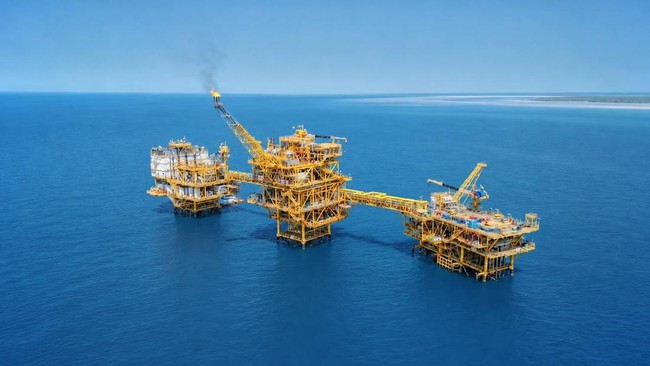
Jakarta, CNBC Indonesia — The Special Task Force for Upstream Oil and Gas Business Activities (SKK Migas) is seeking to use the surge in global crude prices to boost state revenue amid challenges in meeting the national production target. The increase is seen as an opportunity for the upstream oil and gas sector to optimise commercialisation arrangements and maintain its contribution to the state coffers.
SKK Migas Deputy for Finance and Commercialisation Desti Melanti said that a rise in oil prices from the state budget assumption of US$75 a barrel to more than US$95 could offset production volumes that have fallen short of optimal levels. She said the market rally could enable the upstream sector to contribute additional state revenue, potentially exceeding the State Budget (APBN) target.
“State revenue-sharing is initially determined by price and production. When prices rise, even if production does not increase significantly, that can still raise state revenue,” Desti said on the sidelines of a press conference for the 2026 Upstream Oil and Gas Economic Forum (FOREK Hulu Migas) in Jakarta on Tuesday (20 October 2026).
The 2026 APBN assumes an Indonesian crude price (ICP) of US$70 a barrel. The state revenue target from the oil and gas sector is Rp113.06 trillion, while the production targets are 610,000 barrels of oil per day (bpd) and 5,508 million standard cubic feet per day (MMSCFD) of gas.
SKK Migas said global oil prices, which at one point reached US$106 a barrel, could be used to maximise commercialisation strategies. It wants the high-price period to help accelerate the transfer and distribution of upstream production during the remainder of the year.
“Prices are something we cannot control. What we can optimise is the commercialisation scheme to accelerate production,” she said.
Although high oil prices risk increasing the national burden of energy subsidies and compensation payments, the upstream sector can still benefit from the commodity’s price movement. Additional revenue from upstream production-sharing arrangements is crucial to supporting the resilience of state revenue as a whole.
“At the very least, upstream oil and gas can contribute additional state revenue through production sharing as a result of higher commodity prices,” Desti said.
High market prices are projected to help upstream oil and gas state revenue reach 109% of the APBN target by the end of 2026. This could be achieved through adaptive commercialisation arrangements involving SKK Migas and production-sharing contractors (KKKS).
“However, without the commercialisation efforts and strategies of SKK Migas, the production-sharing contractors and policymakers, the state revenue target would be difficult to achieve,” she said.
Source: jawawa.id (https://jawawa.id/newsitem/upstream-oil-and-gas-sector-hopes-for-higher-oil-prices-heres-why-1792497035)
Originally published by CNBC Indonesia (https://www.cnbcindonesia.com/news/20261020165322-4-777925/hulu-migas-berharap-harga-minyak-justru-naik-ini-alasannya), translated from Indonesian