
UPNVJ promotes solar-powered IoT smart irrigation system
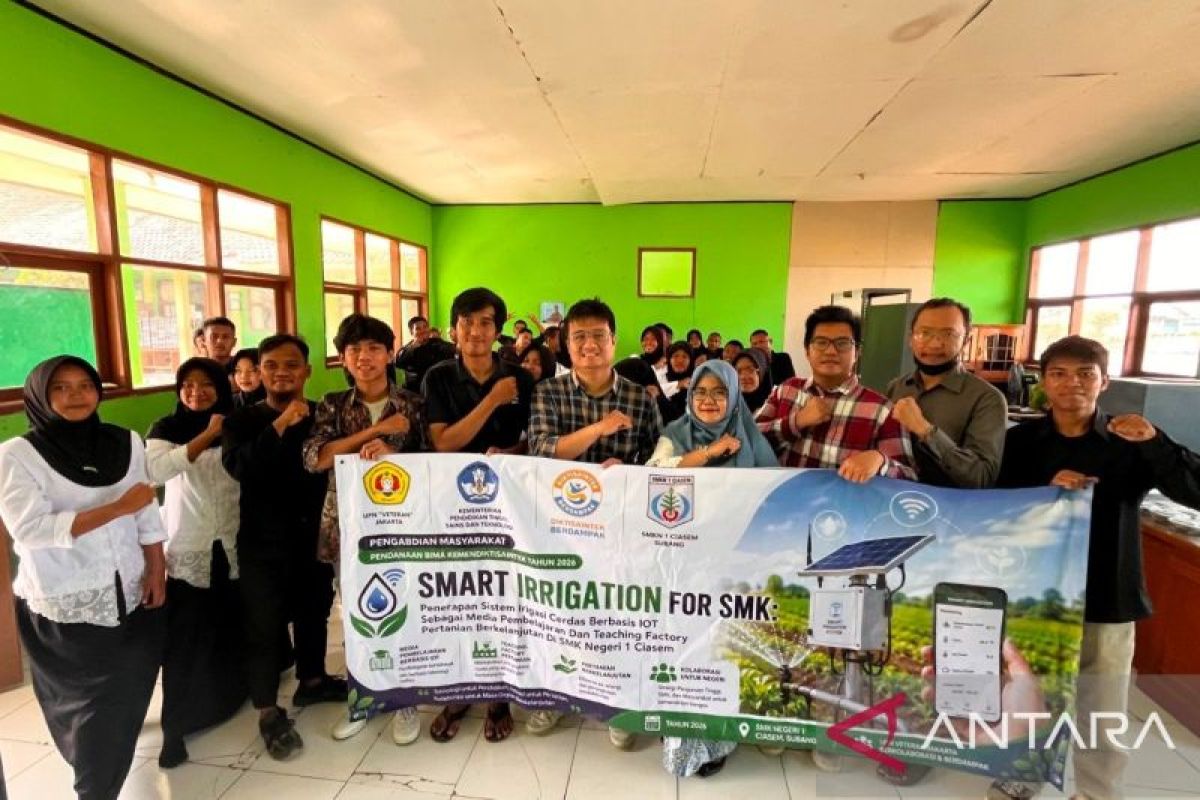
Universitas Pembangunan Nasional “Veteran” Jakarta (UPNVJ) continues to promote technological innovation to support sustainable agriculture through a Smart Irrigation System based on the Internet of Things (IoT) and solar energy.
The implementation of the smart irrigation system at SMK Negeri 1 Ciasem, Subang Regency, West Java, on Thursday (20/8) was carried out through a Community Service (PkM) programme titled “Smart Irrigation for SMK: Implementation of an IoT-Based Smart Irrigation System as a Learning Medium and Sustainable Agriculture Teaching Factory”.
Team leader Mohammad Rachman Waluyo said the technology is not only intended to improve irrigation management efficiency but is also designed as a learning medium that provides students with hands-on experience in understanding agricultural technology developments.
“Through this Smart Irrigation System programme, we want to present a technology that not only helps make irrigation management more measurable but can also serve as a real learning tool for students. They not only learn the concepts of the Internet of Things and renewable energy in theory but can also be directly involved in operating and maintaining the technology,” he said.
The programme, which received BIMA funding from the Ministry of Higher Education, Science and Technology for 2026, is part of efforts to apply science and technology to address modern agricultural challenges while strengthening practice-based vocational learning through the development of a Teaching Factory (TeFa).
The activity was carried out through stages of feasibility survey, preparation, technology installation, socialisation, training, mentoring, and evaluation together with the school.
According to him, collaboration between universities and vocational schools is important in preparing human resources that are adaptive to technological developments.
“We hope this Smart Irrigation System can continue to be utilised as part of the Teaching Factory. In this way, students can gain practical experience relevant to industry needs, particularly in the development of smart farming and technology-based agriculture,” said Rachman.
The activity was chaired by Mohammad Rachman Waluyo together with team members Yulizar Widiatama, Henry Binsar Hamongan Sitorus and Donny Montreano from UPN “Veteran” Jakarta.
The implementation was also supported by a team of students, namely Raulbie Kevinanda Raco, Hilmi Fairuz Faturrohman, and Aydin Rafal Rachmuji, who assisted in the technology implementation, installation, socialisation, and mentoring at the site.
Prior to the implementation of this technology, the Teaching Factory land at SMK Negeri 1 Ciasem still relied on a conventional irrigation system using a diesel pump with flood irrigation methods.
This system meant that watering took quite a long time and still depended on diesel fuel. Based on initial condition identification, watering one hectare of land could take up to 10 hours in a single session.
Pump operation also required around 10 litres of diesel fuel for each watering session. This condition was one of the challenges in managing the practice land as well as Teaching Factory production activities.
Apart from energy efficiency issues, unmeasured water management also had the potential to cause excess or shortage of water for crops. This condition prompted the need for technology capable of assisting watering based on actual soil moisture conditions.
Through this programme, however, the UPNVJ team introduced a Smart Irrigation System that integrates soil and environmental moisture sensors, an ESP32 microcontroller, relays, water pumps, solenoid valves, piping networks, and a solar power generation system.
The system works by reading environmental conditions through sensors, after which the data is processed by the ESP32 to determine watering actions. The pump and solenoid valves can then be activated according to soil moisture conditions. System data can also be monitored through a dashboard that forms part of the technology-based learning process.
According to Rachman, the use of solar energy is an important part of the implemented system. An off-grid solar power system is used as the energy source to support the operation of the irrigation devices.
“The implementation of this technology not only integrates automation and sensor systems but also introduces the use of renewable energy in agricultural activities,” he said.
Thus, students can learn the relationship between internet technology, automation systems, water management, and solar energy directly through practical activities.
The technology product implemented is also equipped with learning modules and Standard Operating Procedures (SOP) as a guide for teachers and students in operating, maintaining, and carrying out initial handling of the system.
In addition to device installation, the activity was also complemented by socialisation and hands-on practice with teachers and students of SMK Negeri 1 Ciasem. Participants were introduced to the concepts of Smart Irrigation, IoT, the function of each component, system operation, dashboard monitoring, and basic device maintenance.
Going forward, the programme will be continued through periodic mentoring and monitoring of the function of sensors, ESP32, pumps, valves, piping networks, solar power system, and dashboard. The use of modules, SOPs, and logbooks will also continue to be encouraged so that the technology can be utilised sustainably in practical activities and the Teaching Factory.
UPN “Veteran” Jakarta hopes that the implementation of the Smart Irrigation System at SMK Negeri 1 Ciasem can be an initial step in developing more modern, data-based, and sustainable agricultural learning.
The collaboration between universities, schools, lecturers, and students is expected to deliver innovation that not only provides technological benefits for partners but also prepares the younger generation to face agricultural transformation and future workforce needs.