
UPI Urges Sisdiknas Bill to Address PTNBH Governance and Teacher Planning Challenges
The drafting of the National Education System Bill (RUU Sisdiknas) is hoped to serve as a moment for addressing fundamental problems in Indonesian education, ranging from the governance of State Legal Entity Universities (PTNBH) and national teacher planning to the continuity of education development.
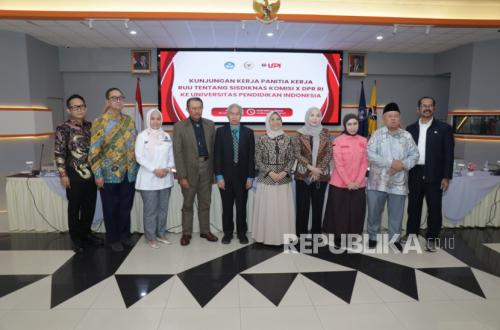
These strategic issues were the focus of a working visit by Commission X of the House of Representatives (DPR) to the Universitas Pendidikan Indonesia (UPI) on Thursday (9 July 2026), a follow-up to a public hearing with the Forum of Rectors of Indonesian State Teacher Education Institutions (LPTKNI) in December 2025.
The working visit, held at the Auditorium of UPI’s Faculty of Economics and Business Education, was led by the Chair of DPR Commission X, Dr Ir Hetifah Sjaifudian, MPP, and attended by Commission X members, representatives of the Ministry of Higher Education, Science and Technology, the Ministry of Primary and Secondary Education, LLDIKTI Region IV, university leaders, and education stakeholders from West Java.
The forum served as a strategic space to gather academic input on the substance of the RUU Sisdiknas so that it can comprehensively address national education needs.
In the forum, UPI Rector Prof Dr H Didi Sukyadi, MA, highlighted the need to refine PTNBH governance so that it returns to its basic philosophy as an instrument for strengthening academic autonomy, rather than being merely a change in financing schemes.
“The core idea of PTNBH is flexibility and autonomy, so that universities can more freely achieve their goal of providing quality education, especially of world-class standard,” said Prof Didi.
Beyond university governance, UPI also stressed the importance of reforming the teacher preparation system through strengthening the Teacher Professional Education (PPG) programme and synchronising regional needs with the capacity of teacher-producing institutions.
According to the UPI Rector, teacher needs planning must be developed in an integrated manner through coordination between central government, regional governments, and universities, to prevent imbalances in distribution and mismatches between graduates’ fields of study and schools’ needs.
UPI also proposed the formulation of a National Education Master Plan as the direction of long-term education development that remains consistent across government periods.
According to Prof Didi, many good education programmes have been discontinued due to policy changes, which is why Indonesia needs a national roadmap that serves as a reference for all stakeholders.
“We need an education master plan. Other countries, such as Vietnam, have been able to maintain the consistency of their literacy development policies despite leadership changes. This is the kind of consistency we need to build so that the quality of Indonesia’s human resources continues to improve,” he explained.
Commission X Chair Hetifah stated that input from academics is an important part of refining the RUU Sisdiknas before it proceeds to further deliberation in the DPR’s Legislative Body.
She said the various issues raised in the forum, such as higher education governance, strengthening the function of teacher education institutions (LPTK), teacher planning, and the optimisation of the 20 per cent education budget, will receive attention in the drafting of the regulation so that it can improve quality while expanding access to education in Indonesia.
She also emphasised the importance of a more integrated teacher needs planning system, so that teacher recruitment, distribution, and welfare improvement can be carried out in a more targeted manner.
Echoing this, Commission X member Ferdiansyah, SE, MM, stressed that the RUU Sisdiknas must include an Education Master Plan (RIP) as the foundation of national education development.
According to him, the existence of the RIP will ensure that every level, path, and type of education has a clear direction of development, so that the national goal of enlightening the life of the nation can be realised sustainably.
He also highlighted the importance of aligning LPTK graduates with real demand for teaching staff in the field, to minimise problems of teacher surpluses and shortages.
Through the forum, UPI reaffirmed its role as an education university that actively contributes academic input to public policy formulation in the education sector.
The various recommendations put forward are expected to strengthen the substance of the RUU Sisdiknas so that it can produce a national education system that is more adaptive, sustainable, and oriented towards improving the quality of Indonesia’s human resources.
These efforts also support the realisation of quality education through stronger education governance, as well as partnership in achieving goals through collaboration between government, universities, and all stakeholders in shaping the future of national education.
Source: jawawa.id (https://jawawa.id/newsitem/upi-urges-sisdiknas-bill-to-address-ptnbh-governance-and-teacher-planning-challenges-1783605230)
Originally published by Republika (https://news.republika.co.id/berita/thwsj0472/upi-dorong-ruu-sisdiknas-jawab-tantangan-tata-kelola-ptnbh-dan-penataan-guru), translated from Indonesian