
Update on Forest and Land Fires: Hotspots Rise in Central, West and South Kalimantan, and South Sumatra
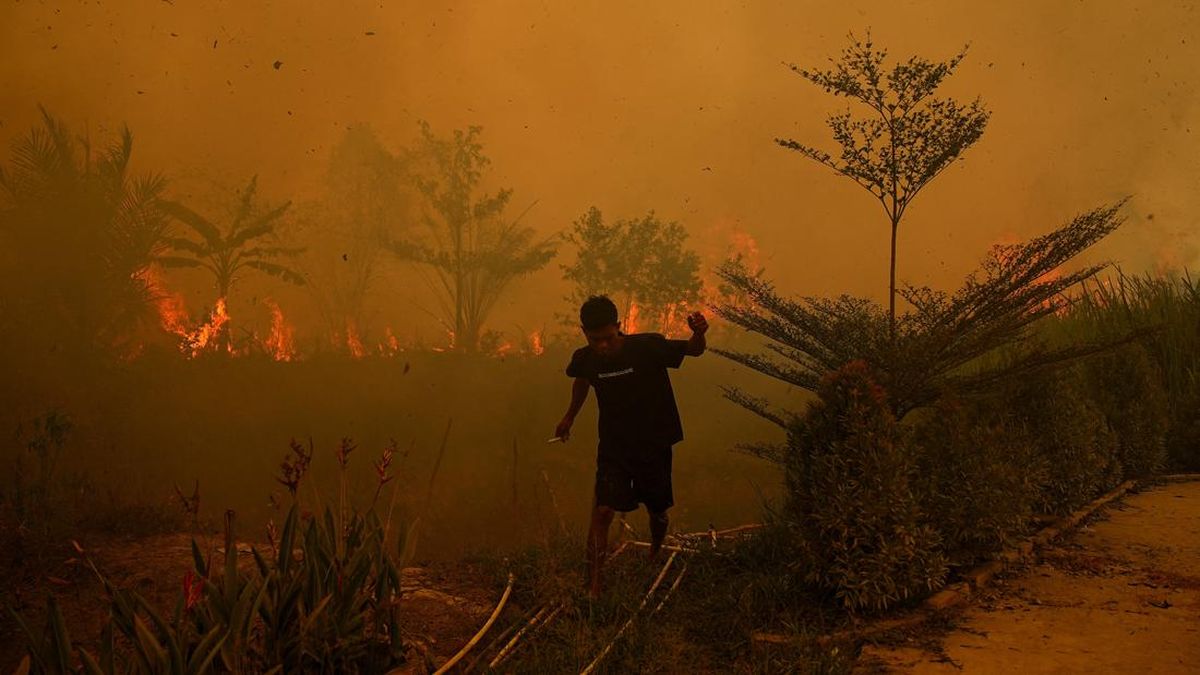
The Forestry Ministry (Kemenhut) has recorded an increase in hotspots, an indicator of forest and land fires, in several regions, particularly in Kalimantan and Sumatra.
In a press release posted on the ministry’s website on Thursday (8 October), it said the national number of high-confidence hotspots had edged down from the previous day.
However, most of the six priority provinces in Sumatra and Kalimantan recorded increases in hotspots.
“Developments in the six priority provinces require continued vigilance. High-confidence hotspots were recorded as follows: Central Kalimantan: 225, up from 182; South Sumatra: 224, up from 71; West Kalimantan: 47, up from 34; South Kalimantan: 31, up from 18; Jambi: 16, down from 21; and Riau: zero, unchanged,” the ministry said, according to its website, accessed on Friday morning (9 October).
The ministry said monitoring through its Forest and Land Fire Control Early Warning Detection Information System (SiPongi) found 1,176 high-confidence hotspots by 9pm Western Indonesian Time (WIB) on Wednesday (7 October). The readings were based on NASA’s Terra/Aqua, SNPP and NOAA-20 satellites.
“That figure is down by 25 hotspots compared with Tuesday (6 October), when 1,201 were recorded,” it said.
The ministry said the figures showed that, although the national total had fallen slightly, concentrations in certain areas still required attention and a robust field response.
“Monitoring, patrols and ground checks are being stepped up, particularly in Central Kalimantan and South Sumatra,” it said.
The ministry reiterated that hotspots indicate surface-temperature anomalies detected by satellites and cannot be treated as equivalent to the number of fires or the area burned.
“A single fire can be detected as several hotspots. Every indication therefore needs to be verified through on-site inspections to establish the actual conditions and determine the appropriate response,” it said.
The ministry said forest and land fire control was being carried out jointly by its Manggala Agni fire-fighting force, the National Disaster Mitigation Agency (BNPB), the Indonesian Military (TNI), the National Police, the Meteorology, Climatology and Geophysics Agency (BMKG), regional disaster management agencies (BPBD), local governments, communities, volunteers, businesses and other stakeholders.
The government has 61 aircraft on standby: 17 for patrols and weather-modification operations, and 44 for water-bombing operations.
Air quality hazardous
In the press release, the ministry said the government was also monitoring air conditions based on PM2.5 concentrations as part of efforts to protect public health. The latest monitoring showed that air quality in some parts of Indonesia was good to moderate, while several areas remained in the unhealthy to very unhealthy categories, particularly in parts of Sumatra, Kalimantan, Java and Papua.
“Pockets of hazardous air quality are still evident in parts of Kalimantan, so air-quality trends and the movement of smoke remain a concern,” the ministry said.
“Air conditions can change as fires develop, depending on particulate concentrations, wind direction and speed, and other atmospheric dynamics,” it added.
The ministry urged residents in affected areas to keep up to date with air-quality information and follow local government guidance. If air quality worsens, people are advised to reduce outdoor activity and wear masks when they need to go outside.
“Particular care should be taken to protect children, pregnant women, older people, and those with respiratory conditions or chronic illnesses,” it said.
The ministry also urged members of the public and businesses not to clear or prepare land by burning.
“If you see smoke, a fire hotspot, burning activity, or wildlife in need of assistance, please report it to officials promptly so that an early response can be made,” the ministry said. Forest and land fire reports can be made to the Forestry Ministry’s fire response post by telephone on 021-5704618, WhatsApp on +62 8131-00-35000, or email at [email protected].