
Update on Anak Krakatau Lava Dome Condition Post-2018 Tsunami: Eruptions Continue
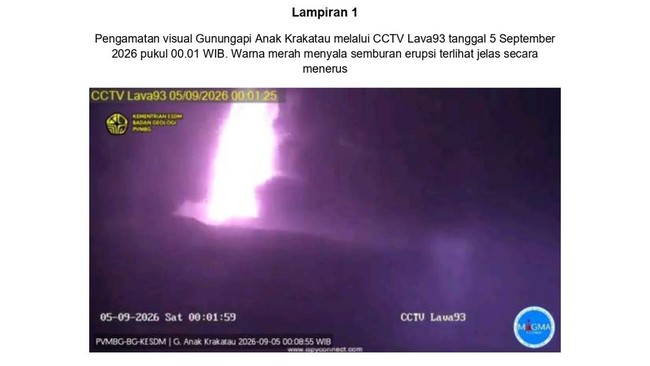
Anak Krakatau volcano continues to undergo continuous eruptions as of Saturday morning (5/9/2/2026), following its resurgence in July 2026. The Geological Agency has confirmed that the growth of the volcano’s body following the 2018 tsunami remains relatively small, meaning there is currently no potential for a collapse that could trigger a tsunami.
Rita Susilowati, Head of the Centre for Volcanology and Geological Disaster Mitigation (PVMBG) under the Ministry of Energy and Mineral Resources, stated that Anak Krakatau’s activity is being closely monitored via two observation stations in Pasauran and Kalianda.
“Our monitoring results show that the growth of the Anak Krakatau volcano body, which reformed after the 22 December 2018 eruption, is still relatively small and does not have the potential to experience a collapse on a scale that could trigger a tsunami,” Rita said during an online press conference on Saturday.
Rita explained that the 22 December 2018 tsunami occurred after Anak Krakatau’s activity caused part of the volcano’s body to collapse into the sea. That event took place when a series of eruptions and changes to the volcano’s structure triggered a massive landslide into the ocean, displacing water and generating tsunami waves that struck the coasts of Banten and Lampung.
“Regarding tsunamis, following the collapse of Anak Krakatau’s body in 2018, the volcano is currently forming a new lava dome. Our monitoring results indicate that this does not pose a tsunami risk,” she added.
Following that incident, Anak Krakatau underwent prolonged low-scale eruptions until 16 December 2023. This phase was a process of construction or the rebuilding of the volcano’s body, before eruptive activity increased again on 2 July 2026, leading to its status being raised from Level II (Alert) to Level III (Standby).
On 5 September 2026, continuous eruptions were recorded from approximately 23:07 WIB to 04:40 WIB and were still being observed in the morning. “As of this morning, our observation stations are still recording that the activity of Mount Anak Krakatau continues to show continuous eruptive bursts,” said Rita.
The eruptions are also believed to be linked to reports of booms and vibrations heard by residents in several areas across West Java, Banten, and Bandung. According to Rita, the acoustic energy from certain eruptions can travel hundreds of kilometres, while differences in air temperature and wind direction and speed can affect the pattern of sound propagation.
However, the Geological Agency emphasised that synchronising eruption timings with community reports is still necessary to confirm the source of the booms.
Currently, the primary danger from Anak Krakatau stems from eruptive activity in the form of lava flows, which may be accompanied by flying incandescent rocks, rather than tsunamis.
“Even though the sound is heard from afar or there are vibrations, the recommendation from the Geological Agency remains unchanged: stay at Level III (Standby) status and the recommended distance remains 3 km,” said Rita.
The Geological Agency has requested that the public avoid all activities within a 3-kilometre radius of Anak Krakatau’s centre of activity and remain vigilant against flying incandescent rocks, lava, pyroclastic flows, and heavy ashfall. Meanwhile, residents in Banten and Lampung outside this radius are advised to remain calm and follow official information, as the latest evaluation shows that the current condition of Anak Krakatau does not show the potential for a collapse that could trigger a tsunami.