
Up to 50,000 East Java Workers at Risk of Lay-offs, with Manufacturing Most Vulnerable
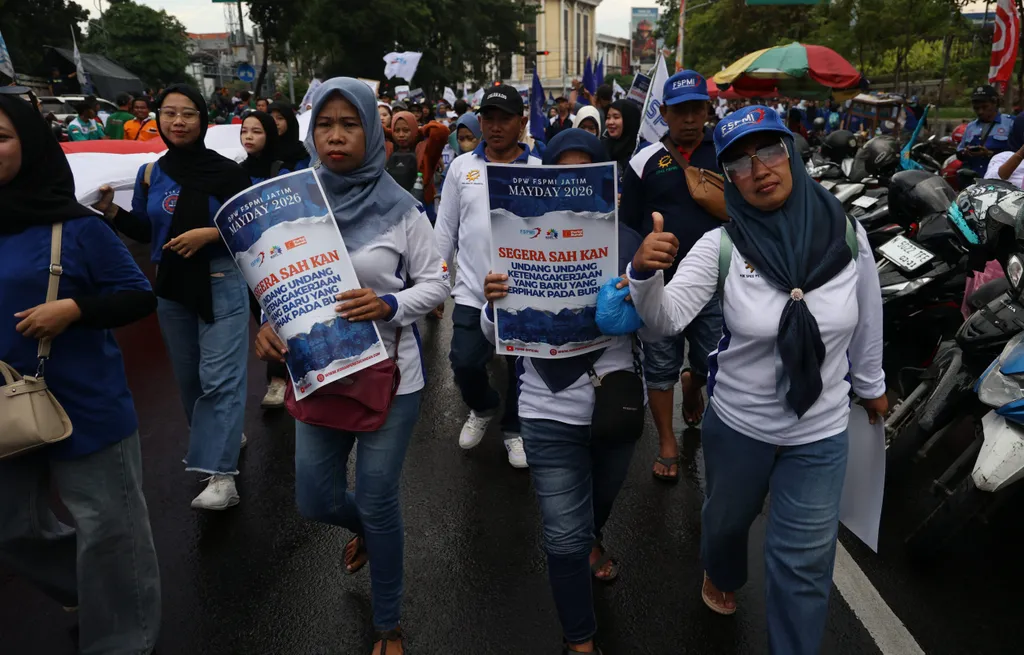
The threat of layoffs looms over workers in East Java, particularly in the manufacturing sector. Labor unions state that up to 50,000 individuals are at risk of losing their jobs by 2026.
11 Okt 2026 12:05 WIB · Ekonomi & Bisnis
Runik Sri Astuti
Some workers in East Java are increasingly feeling the threat of layoffs looming over them. Dismissals can occur at any time, even while they are still busy working. This situation is not unrelated to the impacts of national and global economic turmoil.
Based on data collected by several labor unions in East Java, the potential for layoffs in 2026 is estimated to reach around 50,000 workers in the formal sector. The number of workers at risk of losing their livelihoods is more than ten times greater than the data gathered by the Ministry of Manpower.
The Chairman of the Indonesian Metal Workers Federation (FSPMI) of East Java, Jazuli, stated that East Java has the potential to become one of the provinces with the highest number of layoffs nationally. The workers most vulnerable to job loss are those employed in the manufacturing industry, particularly in labor-intensive sectors.
“The industries include textiles, garments, footwear, paper, electronics, wood, and furniture. These industries are the most vulnerable to the fluctuations of the national and global economy,” said Jazuli, Sunday (11/10/2026).
Jazuli exemplified that local textile, garment, and shoe products, which previously dominated the domestic market, are now facing intense competition from imported products from China. According to him, this situation is closely related to the increasingly lax import policies.
Imported products from China, according to Jazuli, flood the market by offering lower prices and designs that are considered more modern, although their quality is not necessarily better compared to domestic industrial products. This situation is exacerbated by the weakening purchasing power of the community, leading consumers to tend to choose cheaper products.
He cited that in Sidoarjo, many shoe factories have closed and laid off their employees. Small and medium-sized shoe industries, such as those in Wedoro and Mojokerto, have also been reported to have gone out of business. Meanwhile, several shoe factories that are still operating have relocated part of their production processes abroad, resulting in a decrease in the number of workers.
Jazuli added that the downturn in the manufacturing sector is also triggered by the rise in industrial gas prices as well as the prices of main raw materials and auxiliary materials. Some raw materials and auxiliary materials still rely on imports, making them highly susceptible to fluctuations in the exchange rate of the rupiah against the United States dollar and the global geopolitical conditions.
On the other hand, employment conditions are also worsened by the growing number of workers losing their jobs due to contracts expiring and not being renewed. Some companies are also shifting permanent workers to outsourcing.
The termination of the employment relationship for contract or part-time workers, according to Jazuli, is often not recorded as layoffs in government data. As a result, there is a significant discrepancy between the data from labor unions and the government regarding the number of workers who have lost their jobs.
Based on data from the Ministry of Manpower as of August 1, 2026, the number of workers affected by layoffs in East Java was 4,800 people.
According to Jazuli, the data does not fully reflect the conditions on the ground. He believes that the figures primarily refer to the disbursement of the Job Loss Guarantee (JKP), while many workers who have lost their jobs are unable to access this guarantee due to not meeting the requirements or being unaware of the application mechanism.
The uncertain employment situation is an anomaly amidst East Java’s high economic performance, which exceeds national growth.
According to data from the Central Statistics Agency (BPS), East Java is the second largest contributor to the economy on the island of Java, with a contribution of 25.4 percent. East Java is also the second largest contributor to the Indonesian economy, with a contribution of 14.34 percent.
East Java’s gross regional domestic product (GRDP) in the second quarter of 2026 reached around IDR 930 trillion.
There are three main sectors contributing to the economic performance of East Java according to the field of business, namely industry with a contribution of 31.11 percent, trade 18.22 percent, and agriculture 11.20 percent. In addition, there are 14 other business sectors with a total contribution of 39.47 percent.
The industrial sector is the most dominant economic driver in the Land of Majapahit, a nickname for East Java. The industry in this province is dominated by manufacturing and absorbs approximately 3.58 million workers.
Along with the large manufacturing sector, the population of East Java, which reaches approximately 42 million people, also drives the development of the trade sector. This sector has become one of the backbones of employment, absorbing around 4.56 million workers.
At the same time, East Java has become one of the national food granaries. Although the contribution of the agricultural sector to GDP is only 11.2 percent, which is far below that of industry and trade, this sector actually creates the largest number of jobs, amounting to approximately 7.7 million workers.
However, the majority of jobs in the agricultural sector are informal. Meanwhile, formal employment is still largely supported by the manufacturing industry.
In response to the threat of mass layoffs, labor unions are urging the East Java Provincial Government to strengthen mitigation efforts. One of the ways is by facilitating communication between workers, the business sector, and the central government to find solutions so that companies do not need to carry out layoffs.
At the same time, labor unions are urging local governments to maintain a conducive business climate so that the industrial sector can grow. This effort includes simplifying the licensing process, eradicating illegal levies, and ensuring business security so that investors do not relocate their investments outside East Java.
On the 81st anniversary of East Java, which falls on October 12, 2026, workers hope that the policies of the East Java Provincial Government will increasingly favor the welfare of workers. One of these policies includes the determination of the Provincial Minimum Wage (UMP) and the Regency/City Minimum Wage (UMK), which are considered to be closer to the standards of a decent living needs (KHL).
According to Jazuli, the East Java minimum wage (UMP) for 2026, which is around Rp 2.4 million per month, is still far from the minimum KHL standard that, according to labor unions, reaches around Rp 3.5 million per month. In fact, the minimum wage standard essentially serves as a reference for workers with a certain length of service, while in reality, many workers have families and face greater living expenses.
East Java Deputy Governor Emil Elestianto Dardak has stated on various occasions that amidst the turbulent economic situation, several indicators show that the economic performance of East Java remains on a positive trend.
He gave an example, the distribution of People’s Business Credit (KUR) in East Java is of large value with a non-performing loan (NPL) ratio of around 1.9 percent.
“This means that KUR debtors in East Java, especially MSME actors, are resilient customers,” said Emil during the opening of the East Java Festival 2026 and the East Java Investment Forum (EJIF) 2026, Friday (2/10/2026).
Another indicator is regional economic growth and the value of regional gross domestic product. East Java’s GDP is largely supported by the manufacturing industry sector. However, according to Emil, supporting the industrial sector is not a simple matter, especially if the region does not solely rely on natural resources or low-wage labor.
“Therefore, East Java must focus on excellence in its economic ecosystem, especially in the manufacturing industry,” said Emil.
He added that to support trade and manufacturing, a conducive business ecosystem is necessary. In this regard, infrastructure becomes very important, in addition to skilled and educated human resources.
On the other hand, the purchasing power of the community also needs to be maintained in order to create a strong market for manufactured industrial products while simultaneously stimulating the trade sector. According to Emil, the manufacturing industry sector is one of the important pillars of the economy in East Java.
“If we want to create more jobs, we have to develop industry,” said Emil.
What industries have the potential to be developed in East Java? Emil stated that the types of industries that can be developed are very diverse. However, the provincial government hopes that industrial development can be directed towards the downstream processing of agriculture, thereby aligning with efforts to increase added value for farmers.
An example is the bioethanol industry as a downstream product of sugarcane, as well as the gondorukem and turpentine industries as downstream products of pine resin. To establish these new industries, the East Java Provincial Government continues to strive to attract investment.
One of the efforts was made through the 2026 East Java Festival and the 2026 East Java Investment Forum (EJIF) which took place on October 1-2, 2026. The activity, a collaboration between the East Java Provincial Government, district/city governments, and the East Java Bank Indonesia Representative Office, brought together business actors, potential investors, project owners, local governments, and financial institutions.
A number of domestic and international investors were present, including those from the United Kingdom, the Netherlands, Australia, China, Japan, South Korea, Saudi Arabia, Singapore, and Malaysia.
EJIF 2026 offers 28 Investment Project Ready to Offer (IPRO) projects with a total investment value of approximately IDR 73.7 trillion, spanning the manufacturing, tourism, infrastructure, and agro-industry sectors. In addition, seven industrial estates and special economic zones, 80 potential assets owned by local governments, and various potential banking projects are being offered. “The strong capital base, manufacturing and agriculture sectors, are attractive investment opportunities in East Java,” said Emil.
The Head of the Bank Indonesia Representative Office for East Java, Ibrahim, stated that the activity resulted in an investment agreement amounting to IDR 2.4 trillion through 12 investment commitments in East Java.
According to him, investment not only supports economic growth, but also has an impact on employment absorption and poverty alleviation.
“A favorable investment climate, combined with fiscal sustainability, financial system stability, and a payment system, will be key to driving sustainable economic growth,” said Ibrahim.
Writer:
Runik Sri AstutiEditor:
Mukhamad Kurniawan
Source: jawawa.id (https://jawawa.id/newsitem/up-to-50-000-east-java-workers-at-risk-of-lay-offs-with-manufacturing-most-vulnerable-1791723012)
Originally published by kompas.id (https://www.kompas.id/artikel/intense-layoffs-are-lurking-50000-vulnerable-workers-are-affected?open_from=English_Page)