
UOB Economist: Strengthening Manufacturing Key to Building Consumer Confidence
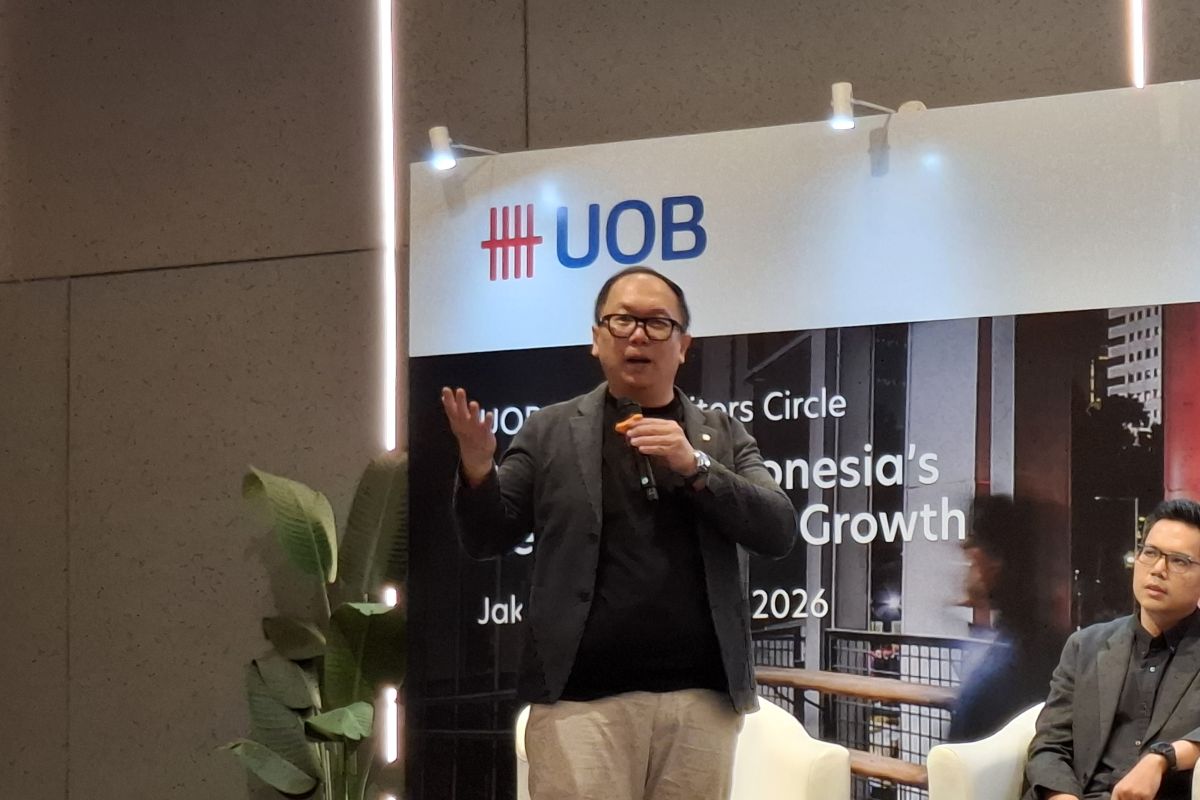
ASEAN Economist at United Overseas Bank (UOB) Enrico Tanuwidjaja believes that strengthening the manufacturing sector is one of the keys to creating sustainable employment while also building consumer confidence to maintain Indonesia’s economic growth momentum.
Enrico assessed that economic performance in the first two quarters of 2026 received a strong boost from government consumption, whereas household consumption has not yet become as strong a driver as needed to support growth sustainably.
“Indonesian consumer confidence must be built. One way is for the manufacturing sector to be pushed,” Enrico said at the UOB Media Editors Circle 2026 in Jakarta on Wednesday.
According to him, strengthening consumer confidence needs to begin with the creation of new, sustainable jobs. In this regard, manufacturing can serve as one of the backbones because it provides a relatively more stable base of economic activity and employment.
Job and income certainty can then strengthen household confidence to spend their income, allowing private consumption to play a stronger role in supporting growth.
Enrico compared this with some activities in the services and digital sectors, which he considers more sensitive to changes in business conditions and funding sources.
“Fiscal policy must be directed to the right areas, those with high multipliers, manufacturing being one of them. And that will build confidence,” he said.
Data from Statistics Indonesia (BPS) shows that Indonesia’s economy grew 5.29 percent year-on-year in the second quarter of 2026. Household consumption grew 5.06 percent, Gross Fixed Capital Formation (PMTB) grew 6.87 percent, while government consumption grew 15.98 percent. This data was also presented in UOB’s presentation.
In the first quarter of 2026, the national economy grew higher at 5.61 percent. Household consumption grew 5.52 percent year-on-year, while government consumption increased 21.81 percent. BPS noted that household consumption remained the highest source of growth during that period.
Enrico assessed that the high pace of government consumption cannot continuously serve as the foundation for growth because there are limits to fiscal space. Therefore, other sources of growth need to be strengthened further.
In his presentation, he saw investment as one of the additional sources of growth that needs to be optimised, among other things by creating a business climate that makes investors willing to reinvest their profits in Indonesia.
Exports are also seen as having room to be strengthened by developing business sectors based on domestic production, while government spending needs to be directed more effectively to produce a greater multiplier impact on the economy.
“Secondly, exports. The weakening rupiah is good and can be utilised. We should try to direct and promote locally based business sectors that sell abroad. For example, wood sold overseas. It is cheap, and we are competitive,” Enrico said.
The Ministry of Investment and Downstreaming/BKPM recorded that investment realisation throughout the first half of 2026 reached Rp1,010.6 trillion, growing 7.2 percent year-on-year and absorbing 1,448,862 Indonesian workers. In the second quarter alone, investment reached Rp511.8 trillion and absorbed 742,293 workers.
In addition to job creation and increased reinvestment, Enrico assessed that rupiah exchange rate stability is an important factor in strengthening the confidence of businesses and consumers.
He said Indonesia essentially already has various reform agendas to increase economic growth capacity. Therefore, the next challenge lies in implementing policies consistently.
“One key is capable policy execution,” Enrico said.
Meanwhile, the Ministry of Industry continues to strengthen the Programme for Increasing the Use of Domestic Products (P3DN) to boost demand for national manufactured products.
As of 21 July 2026, the government has issued 56,555 Domestic Component Level (TKDN) certificates covering more than 7,000 industrial companies. The Ministry of Industry has also simplified the certification process through Minister of Industry Regulation Number 35 of 2025.
In addition to strengthening the domestic market, the Ministry of Industry has allocated Rp58.2 billion in 2026 for a machinery and industrial equipment restructuring programme, Rp65.2 billion for strengthening industrial human resources, and Rp14.4 billion for the application of industrial technology.
These policies are directed at increasing the productivity and competitiveness of the national manufacturing sector.
From the manufacturing side, Bank Indonesia (BI) recorded a Prompt Manufacturing Index (PMI) of 51.43 percent in the second quarter of 2026, still in an expansion phase. The index is forecast to increase to 52.32 percent in the third quarter of 2026.
BI’s Business Activity Survey also shows that utilised production capacity increased from 73.33 percent in the first quarter to 73.80 percent in the second quarter of 2026. BI forecasts that the processing industry’s performance will improve in the third quarter in line with sustained public demand.