
UOB Economist: Six Reform Agendas Pave Way for 8 Percent Growth
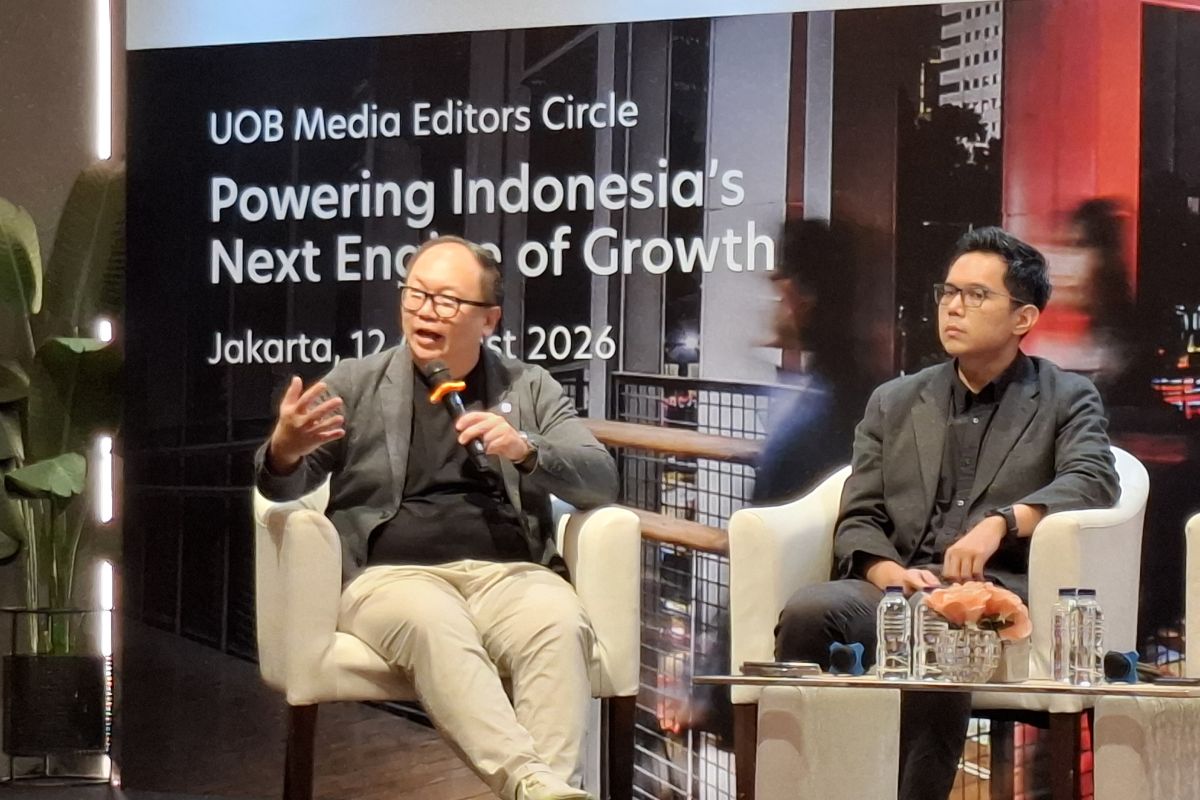
ASEAN Economist at United Overseas Bank (UOB) Enrico Tanuwidjaja believes that six reform agendas pursued in parallel can open room for Indonesia’s economic growth towards the 8 percent range in the long term.
According to him, Indonesia’s economic growth capacity can still be increased if various structural improvement agendas are carried out consistently and in a complementary manner.
“Actually, if we had reformed from the start, we could have grown much higher than now,” Enrico said at the UOB Media Editors Circle 2026 in Jakarta on Wednesday.
In his presentation, Enrico identified six main reform areas: sustainability, connectivity, utilisation of the large domestic market, access for micro, small, and medium enterprises (MSMEs) to digitalisation, access for MSMEs to credit, and integration of MSMEs with larger corporations and international markets.
The UOB economist’s scenario shows that implementing these six reforms could bring the economic growth trajectory to around 7.5 percent by 2030, compared with around 6.0 percent in the baseline scenario.
Over a longer horizon towards 2045, the reform trajectory points to a growth range of 7–8 percent.
Enrico considers growth of around 6 percent to be below the capacity Indonesia should be able to achieve if various economic potentials were utilised more optimally.
“And believe me, 6 percent growth is too small for us,” he said.
According to him, the size of the domestic market is one of the main assets that can still be further leveraged to create growth. Strengthening the domestic market can also provide greater room for national products and businesses to develop.
Enrico gave the example that production from one region could be directed to meet the needs of other regions, so that businesses do not rely solely on export markets.
He also believes that strengthening MSMEs needs to be done comprehensively, from expanding access to financing and digitalisation to connecting businesses with larger corporations and international markets.
In the same presentation, UOB placed energy transition and sustainability, food security, healthcare reform, industrial downstreaming, and digital transformation as part of the long-term economic transformation agenda.
Enrico stressed that increasing growth capacity requires implementing these various agendas quickly and simultaneously, not partially.
“If we do it quickly and in parallel, the 8 percent prediction can really be reached. This is a macro calculation,” he said.
On the government side, economic growth of 8 percent in 2029 has become one of the targets in the 2025–2029 National Medium-Term Development Plan (RPJMN).
As a step towards that target, the government in the 2027 Macroeconomic Framework and Fiscal Policy Principles (KEM-PPKF) has set an economic growth target in the range of 5.8–6.5 percent.
The government is also expanding access to financing for MSMEs. As of 28 June 2026, realisation of People’s Business Credit (KUR) reached Rp147.70 trillion for 2.32 million debtors, or 50.83 percent of the 2026 KUR ceiling target of Rp290 trillion.
Strengthening credit access is in line with one of the reform areas highlighted by UOB, namely enlarging MSMEs’ access to financing so that their business capacity and connectivity with the larger economic chain can improve.
Furthermore, Enrico believes that the various agendas to increase economic capacity are essentially already available, so the next challenge lies in the consistency of their implementation.
“The homework includes some easy parts and some difficult parts. But there is a way out; it is just a matter of whether we want to execute or not,” Enrico concluded.