
Unusual Sight as Barito River in Kalimantan Dries Up
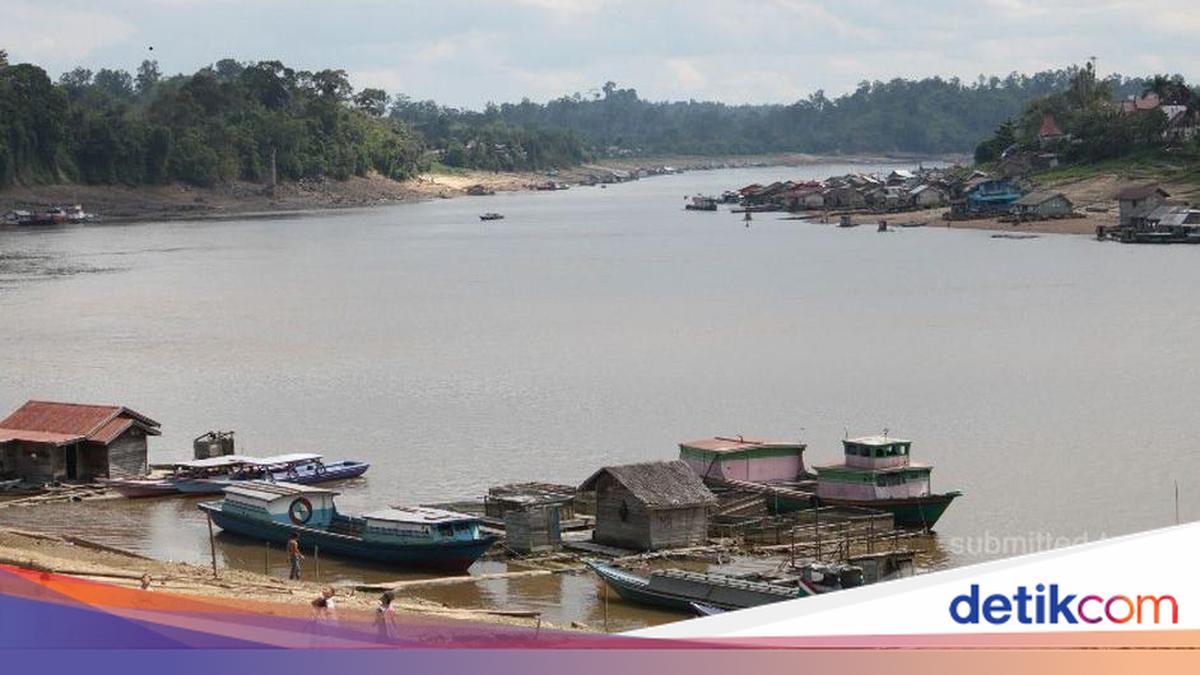
The Barito River in Central Kalimantan is drying up as the dry season takes hold. An unusual sight has emerged as stretches of sand appear in the middle of the river. The receding river was visible around the Kalahien Bridge in Kalahien Village, Dusun Selatan District, South Barito Regency, Central Kalimantan, on Friday (21/8/2026). Sand appears to have formed in the middle of the river, splitting the flow and making some areas resemble a beach.
Local resident Rudi Hermansyah said the Barito River’s recession has been quite severe since early August. According to him, the land emerging in the middle of the river is one sign that water levels have dropped significantly. “This condition not only changes the river landscape but is also beginning to disrupt water transport activities. A number of cargo ships and barges are reported to be having difficulty passing through the shallow parts of the river,” Rudi said, as reported by detikKalimantan on Friday (21/8/2026).
Ships that usually rely on the Barito River as a transport route have had to slow down, search for parts of the channel that are still passable, and even become stranded when the water depth is no longer sufficient. “The impact is also felt in distribution activities. The Barito River has been one of the important routes for the movement of goods and the needs of communities around the river basin,” he said.
If the receding conditions continue, disruptions to water transport are feared to widen. Shallowing also has the potential to further limit the movement of ships, especially for large vessels. “Another phenomenon, the emergence of sandbars around the Kalahien Bridge, is a clear picture of how the long dry season is affecting river conditions in Central Kalimantan,” he concluded.
For communities that depend on river transport, the receding Barito River is not merely a change of scenery. The condition could affect mobility, goods distribution, and economic activity if it persists over a long period.
BMKG Explanation
The Meteorology, Climatology, and Geophysics Agency (BMKG) has revealed the cause of the Barito River drying up. BMKG said the Central Kalimantan region is entering the peak of the dry season. “In terms of rainfall, in the first ten-day period of August 2026 in Central Kalimantan, rainfall was indeed in the low category (0-10 mm per ten-day period),” said BMKG Director of Climate Change Fachri Rajab.
He said the Central Kalimantan region generally experienced days without rain in the medium category (11 to 20 consecutive days without rain) and the very long category (31 to 60 consecutive days without rain). “Currently, most of Indonesia, including Central Kalimantan, is in the peak period of the dry season,” he said.
River Transport Nearly Paralysed
BMKG Principal Secretary Guswanto revealed that the phenomenon of the Barito River receding is not merely a change in landscape, but a real impact of extreme drought and low rainfall. Guswanto said the phenomenon has serious consequences for transport, logistics, and the regional economy.
Guswanto revealed the current condition of the Barito River. He said the Barito River has experienced a drastic drop in water discharge at Muara Teweh, with water levels only around 0.6 metres compared to the normal 5-11.5 metres. “As a result, river transport is almost paralysed,” he said.
Furthermore, Guswanto said stretches of sand have appeared under the Kalahien Bridge in South Barito. As a result, transport has been disrupted, with large ships, coal barges, oil barges, and timber barges unable to sail. “Only small boats such as jukung can still operate on a limited basis,” he said.
Guswanto explained a number of contributing factors. The drying up of the Barito River, he said, is due to the long dry season, low rainfall, and regional phenomena. “The decline in rainfall in Central Kalimantan has drastically reduced the water supply from the upstream Schwaner Mountains. In terms of regional phenomena, similar conditions are also occurring in other rivers in Kalimantan, indicating a more extreme climate pattern,” he explained.
Guswanto warned of the long-term threat from this phenomenon. According to him, if the trend continues, it could reduce the contribution of the mining and plantation sectors to regional GDP. “This is part of a drier climate cycle, with serious consequences for transport, logistics, and the regional economy,” he said.