
Untan students create AI-based building crack detector
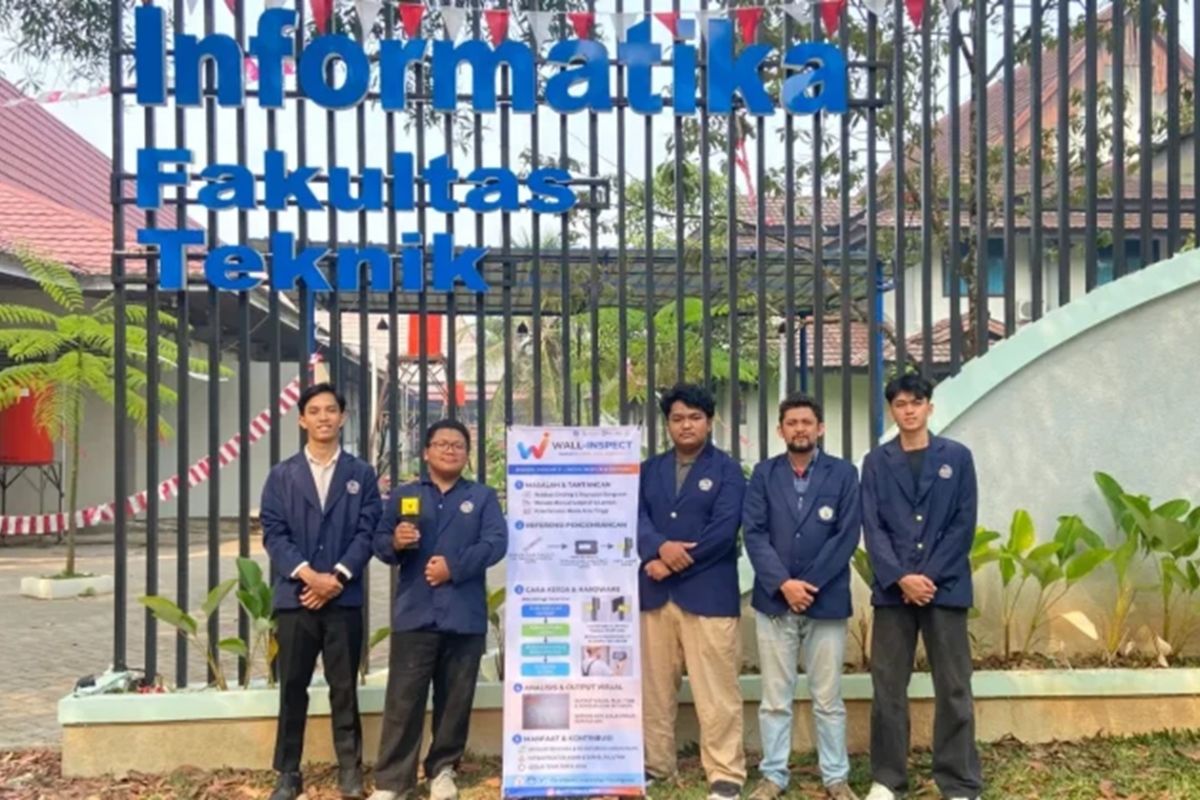
Students at Tanjungpura University (Untan) in Pontianak have developed WALL-INSPECT, an artificial intelligence-based device for detecting cracks in building walls in real time.
The innovation was developed by students from the Informatics and Civil Engineering study programmes of Untan’s Faculty of Engineering through the Student Creativity Programme in the Karsa Cipta (PKM-KC) category for the 2026 fiscal year, funded by the Ministry of Higher Education, Science and Technology (Kemendiktisaintek), said WALL-INSPECT team leader Dzulfikar Nuril Al-Amien in Pontianak on Friday.
“When the user points the camera at a cracked section of wall and presses the trigger on the device handle, the system captures the image, processes it, and then displays the analysis results directly on the LCD screen,” he said.
WALL-INSPECT combines Convolutional Neural Network (CNN) technology to recognise crack patterns with depth sensors to measure the dimensions of damage quantitatively.
The device’s analysis results include the level of damage, the depth and length of cracks, and follow-up recommendations that can serve as considerations for users in determining the condition of a building.
According to Dzulfikar, the innovation was developed to address the limitations of conventional inspections, which still rely on manual observation and are therefore prone to subjectivity and dependent on the experience of the inspector.
Physically, WALL-INSPECT is designed to be compact, resembling a handheld scanner, and can be operated hands-free. The device uses a Raspberry Pi 4 as its processing centre and utilises OpenCV and the Open Neural Network Exchange (ONNX) format in system development.
The device’s development involved collecting wall image datasets, designing the system, implementing the AI model, and testing in real-world environments to measure reliability and accuracy in detecting cracks.
The team led by Dzulfikar consists of Dhimas Dwi Prasetyo, Husaini Ibnu, and Muhammad Irza Al Hafi, with faculty supervisor Khairul Hafidh. The collaboration between Informatics and Civil Engineering students is expected to produce increasingly practical and accurate building inspection technology.
“Going forward, WALL-INSPECT is expected to support early damage detection, reduce the risk of structural damage, lower repair costs, and promote safer and more sustainable building and infrastructure management,” said Dzulfikar.