
Unsoed's 'Haram' Counter: When University Admission Becomes a Marketplace
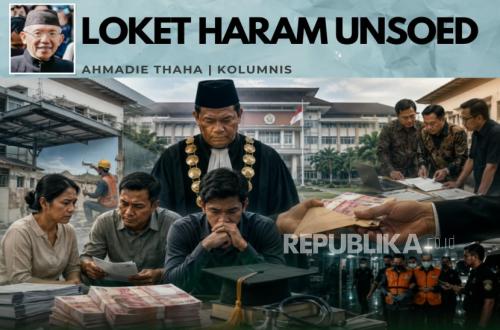
We are angered when state money is stolen. We are upset when positions are abused. But we can become truly furious when money and power are allegedly exchanged at the gates of education. For it is there that we stake a child’s belief that their future can still be fought for through diligent study.
We are not now discussing rumours. The Corruption Eradication Commission (KPK) has released the case construction of alleged extortion and gratification in the independent admission pathway for new students at Jenderal Soedirman University (Unsoed), Purwokerto, Central Java.
On 21 August 2026, the KPK detained six Unsoed leaders and named them as suspects. They are Unsoed Rector Akhmad Sodiq, Vice Rector III Norman Arie Prayoga, Head of Academic Affairs Eko Sumanto, and three private parties: Dian Mulia Wardhana, Adhi Wiharto, and Mulyono alias Nono.
According to the KPK’s construction, the scandal began, among other things, with an alleged demand for Rp650 million from the parents of a prospective medical faculty student. The demand was made by Norman Arie Prayoga with the knowledge of Rector Akhmad Sodiq through intermediaries Dian Mulia Wardhana and Adhi Wiharto.
The money was handed over by the parent, but the prospective student in question apparently still did not pass the selection. It is only logical that the parent asked for the money to be returned in full. However, the money had apparently been used by Dian and Adhi for personal purposes. To cover the repayment, Norman borrowed money from a private party.
The chain of events did not stop there. To repay the loan, a promise of payment emerged through the disbursement of three projects within Unsoed. These included the procurement of a canopy, the renovation of a canteen, and the painting of a building. The three jobs were carried out by a CV owned by Mulyono.
If the KPK’s construction is proven in court, what we are witnessing is not merely a case of envelopes under the table. This is a portrait of how dark transactions at the student selection gate can spread to physical procurement projects for goods and services. From a seat in the Faculty of Medicine, it leaps to the renovation of a canteen and the painting of a building.
This forces us to ask: what kind of system allows money to enter through the student admission gate, then circulate out through physical projects at a state university? If we only punish these six people without fixing the holes in the system, we are actually merely replacing figures without ever changing the way it works.
This practice occurred in the independent pathway. In this pathway, prospective students are indeed required to pay official components in the form of Single Tuition Fees (UKT) and Institutional Development Contributions (IPI). At Unsoed’s Faculty of Medicine, UKT ranges from Rp7.1 million to Rp17 million, while IPI ranges from Rp100 million to Rp260 million.
Medical education indeed requires large operational costs — from laboratories, teaching hospitals, to medical facilities. But high official costs do not automatically mean corruption. The fundamental problem arises precisely when, behind those expensive official tariffs, a dark price is layered on top.
Official money enters the state treasury and institutional accounts, while dark money enters personal pockets. When a tariff of Rp650 million is set so that someone can cross the entrance gate, it is no longer a discussion about the cost of education, but rather the buying and selling of seats.